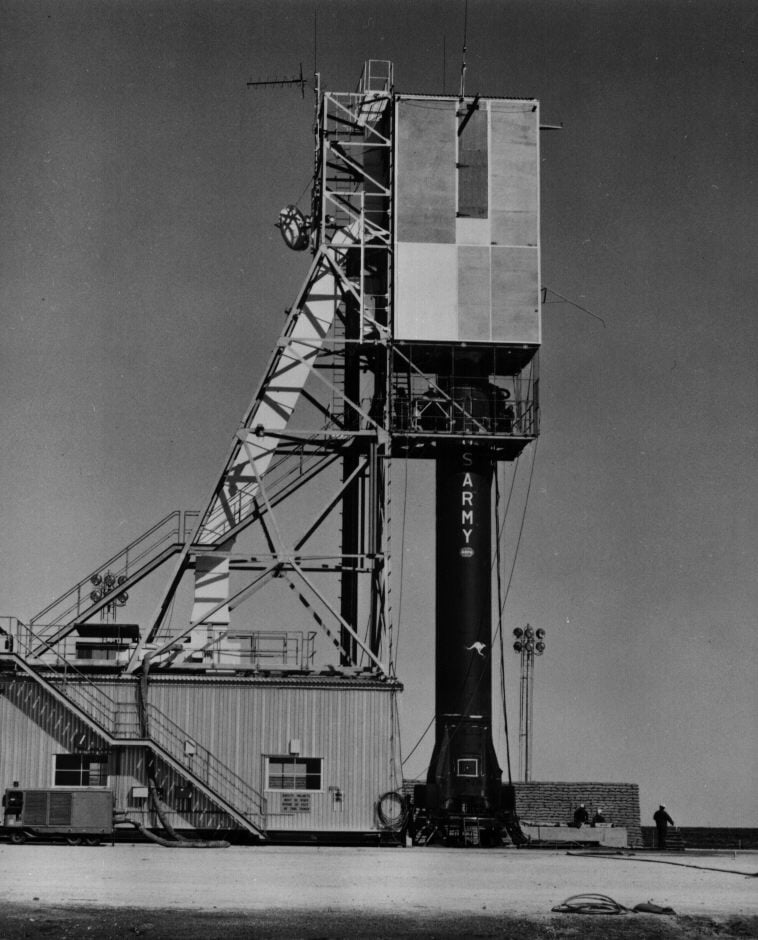
On 28 November 1967, at the Woomera rocket range in outback South Australia, a six-hour countdown started on time and ticked all the way down to 30 seconds before launch. Then it stopped. A heating-cooler unit attached to the rocket had failed to eject, and everyone had to come back the next day.
I’m not a space engineer. I came across this story the way most people probably would, through a passing mention of Australia’s first satellite, and the more I read the more amazing it got. The rocket on that pad was a spare, left over from an American weapons test and given to Australia. The 45-kilogram satellite on top of it had been designed and built in Australia in about eleven months. And when it finally flew, at 2:19 the following afternoon, Australia had launched its first satellite, from its own soil, on an American rocket.
It was called WRESAT, short for Weapons Research Establishment Satellite. Here’s how it happened.
A spare rocket nobody wanted to ship home
The opportunity came out of a weapons program. During 1966 and 1967, Woomera hosted SPARTA, a joint US, UK and Australian project to gather data on the conditions nuclear warheads would face as they plunged back into the atmosphere. Ten American Redstone rockets were brought to Woomera for it, along with re-entry vehicles and an American team to fly them. If the name Redstone sounds familiar, it should. Modified Redstones launched America’s first satellite in 1958 and its first two astronauts, Alan Shepard and Gus Grissom, in 1961.
Only nine of them were needed, as Kerrie Dougherty OAM, space historian at the Australian Space Agency, notes in a paper on Australia’s early satellites. That left one spare. By then the Redstone was an obsolete rocket, and as Dougherty explained to me by email, the Americans “weren’t particularly interested in taking the spare back to the US”. Shipping it home wasn’t cheap either. As the Honeysuckle Creek history site puts it, “To send them back to the US would be a considerable expense.”
Project manager Des Barnsley, whose account is reproduced on that site, wrote that by late 1966 it was clear at least one of the ten vehicles would be surplus, and the idea of using it to launch an Australian satellite “was unofficially raised”. Who suggested it first has never been completely clear, Dougherty says. The Americans may have made the offer on their own, or WRE staff may have hinted that a rocket nobody wanted to take home would make a nice gift. Either way, the US decided it would be “a nice gesture of support to Australia” to donate it.
The catch: it had to fly before the end of 1967
The gift came with a deadline. The experienced American launch team would prepare and fire the rocket for the WRE, but only before they packed up and went home. That meant the launch had to happen as soon as possible after SPARTA wrapped up, and “definitely before the end of 1967”.
Everyone brought something to the table. The US supplied the rocket and a launch team from the aerospace company TRW “at no cost”. NASA agreed to track the satellite and collect its signals through STADAN, its worldwide network of tracking stations, “also at no cost”. The UK supported the launch operations through its long involvement with Woomera. Australia’s job was the satellite itself.
In other words, three countries lined up a rocket, a launch crew and a global tracking network, and Australia had less than a year to build something worth putting on top.
Eleven months, start to finish
Defence Science and Technology, the Weapons Research Establishment’s successor, records that design work began in early 1967 as a joint venture between the WRE and the University of Adelaide, and that the satellite was designed, developed, built and launched in eleven months. Barnsley’s own figure, written later, was “just less than twelve months”.
Whichever figure you use, the whole thing fitted inside a single year, with the team working towards a launch deadline that couldn’t move.
Not everyone thought it could be done. “There was plenty of scepticism from the US,” Dougherty told me. When I asked her what made it possible to build WRESAT so quickly, her answer was one word: “necessity!” If the satellite wasn’t ready before the US team left, the launch wouldn’t have gone ahead, or would have had to wait until a WRE team could be trained to prepare and fire the rocket themselves.
It also helped that the Australians weren’t starting cold. Barnsley put the speed down to work that had started long before the offer arrived. The WRE and the University of Adelaide’s physics department had spent years working together on upper atmosphere research using sounding rockets, small locally built rockets that carry instruments high into the sky and then fall back to Earth rather than going into orbit. WRESAT’s scientific payload, developed by the University of Adelaide, grew directly out of the instruments they had been flying on sounding rockets since 1962. The team already knew how to build the instruments. What they had never done was put them into orbit.
“With a lot of ingenuity, innovation and pragmatic decisions, they were able to have WRESAT ready to fly by November 1967,” Dougherty said.
The key people named on the history site are Barnsley as project manager, Professor J H Carver of the University of Adelaide, Bryan Rofe as officer in scientific charge, and Dr Don Woods. By Barnsley’s account, the outside contracts cost “a few hundred thousand dollars”.
Who deserves the credit?
I also asked Dougherty how she would split the credit between the two countries. She started with the Americans. The project “simply would not have occurred if the rocket had not been offered by the US”, the launch was handled by the experienced US team, and NASA provided the global tracking.
“But the rapid design and construction of the satellite itself, and its scientific payload, was an all-Australian project, albeit with advice and guidance from the US.”
Weighing it all up, this is where she landed.
“So I guess that I would have to put it at 50/50, or maybe even 60/40 in favour of the US, since their offer made the whole project happen. Australia gained entry to the ‘Space Club’ at a greatly discounted price!”
The tight schedule did come at a cost. The biggest drawback of working to the US timetable, Dougherty said, was that there was no time to design and build solar panels, so WRESAT had to run on batteries, “which severely limited its operational lifespan”.
Bumping around in the back of a truck
The satellite stayed attached to the rocket’s spent third stage in orbit, so there are two weights for it. The satellite on its own was a cone about 1.6 metres long, weighing 45 kilograms. Together with the burned-out stage it rode on, the whole package that reached orbit weighed about 72.5 kilograms and was a little over two metres long.
My favourite detail comes from the curator’s notes on Australian Screen Online. The American team was reportedly horrified to see WRESAT bumping around in the back of an open truck. The Australians’ response was that if it couldn’t survive the short ride, it was unlikely to survive lift-off.
The same notes record that very few dignitaries turned up to watch when it finally launched on the 29th.
What it did up there
WRESAT went into a near-polar orbit, so each lap carried it high over the far north and far south of the planet, without passing directly over either pole. Its path was a stretched oval, ranging from a couple of hundred kilometres above the Earth to more than 1,200 kilometres.
Its instruments measured ultraviolet light and X-rays coming from the Sun, along with a faint ultraviolet glow, called Lyman alpha, made when sunlight is scattered by the thin cloud of hydrogen surrounding the Earth. In plain terms, it was measuring kinds of sunlight that the upper atmosphere soaks up before they can reach the ground, which you can only properly study from above. Defence’s history describes the aim as improving understanding of how the upper atmosphere affects climate and weather, and helping US research programs gather physical data. The readings came back by radio on 136.350 MHz.
That was the big step up from the sounding rockets the team had flown before. A sounding rocket only spends a few minutes high enough to take these readings before it falls back to Earth. WRESAT could take them orbit after orbit, for days. Short as its working life was, Dougherty says it “obtained valuable data for comparison with the sounding rocket data already obtained at Woomera”.
With no solar panels, WRESAT simply transmitted until its batteries ran flat. According to DST, it completed 642 orbits and sent back scientific information during 73 of them, roughly its first five days. It then kept circling silently for weeks until it re-entered the atmosphere and burned up on 10 January 1968, over the Atlantic Ocean west of Ireland.
There’s one more neat footnote. As space writer Andrew LePage notes at Drew Ex Machina, the rocket that carried Australia’s first satellite was also the last known Redstone ever flown.
A donated rocket and a lot of goodwill
The successful launch brought congratulations from the US, including a message from the US Vice-President. Among them was a note from Gilbert Ousley at NASA in Maryland: “There were many sceptics here concerning the time scale, but you proved them wrong.”
Barnsley was blunt about where the whole thing came from. He wrote that “without the outstanding relationship between Australia and the US DoD and NASA the project could never have been contemplated, let alone undertaken.”
That seems fair to me. The rocket, the launch crew and the tracking network all belonged to someone else, and the window was a matter of months. What Australia brought was a group of people who already knew how to build the instruments, and who finished them inside a deadline that was set before the work began.
Dougherty summed it up better than I can. “WRESAT was a fine example of Australian technical and scientific skills, innovation and our inventive ‘make do’ tradition, made possible by the generous donation of the launch vehicle by the US.”
That’s what amazes me most. It wasn’t one country going it alone. It was three countries deciding a leftover rocket was too good to waste, and a small team in Adelaide and Woomera making sure it wasn’t.