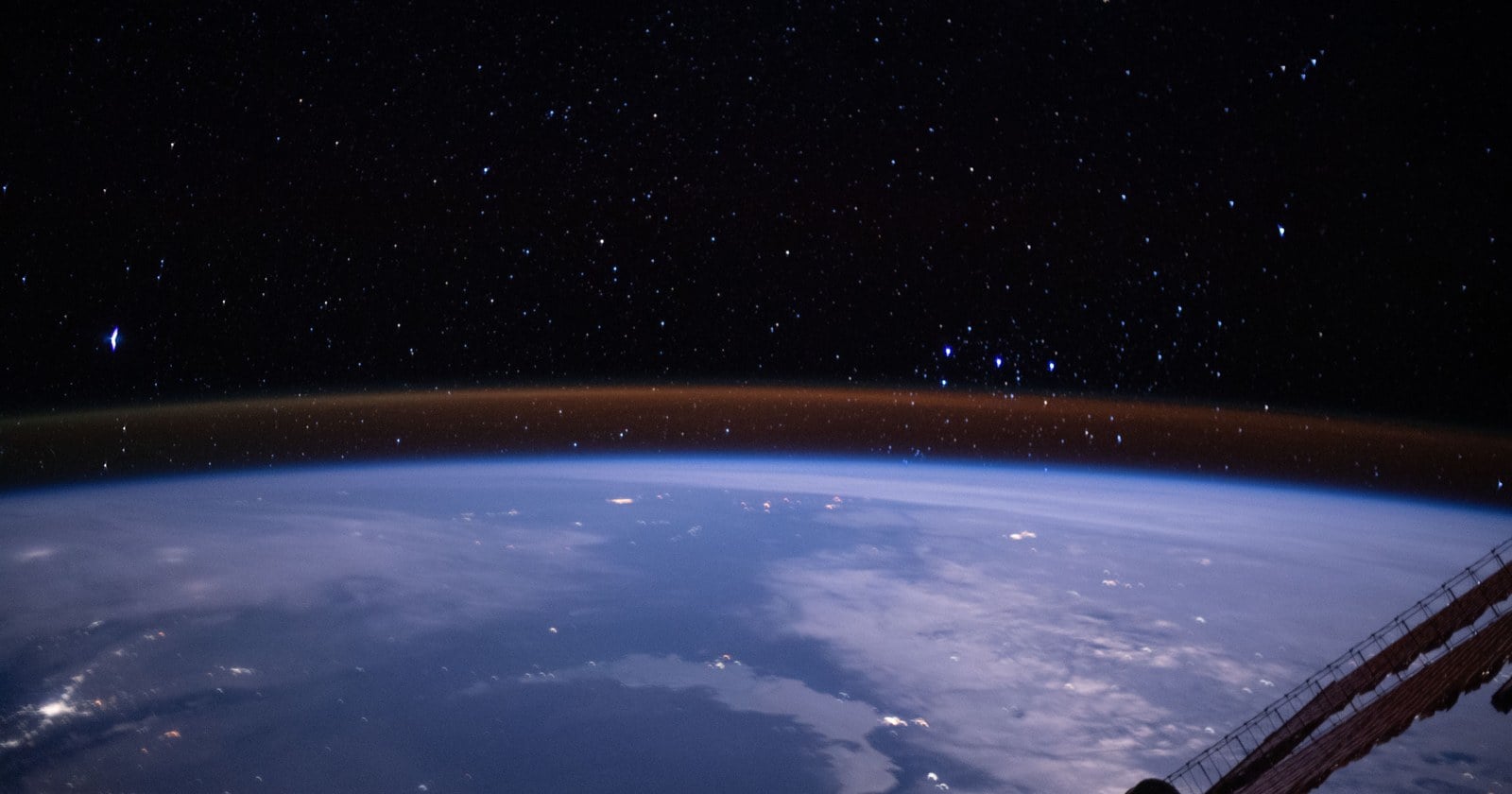
There is no line where the atmosphere stops. It thins the way a beach gets wetter towards the sea, until at some point you are in the water and nobody can say exactly when that happened. So the edge of space is not something anyone discovered. It is something people chose, and they chose differently.
For decades that disagreement cost almost nobody anything. It is starting to. Tourist rockets fly into the disputed band with paying passengers and come back down. Hypersonic military vehicles pass through it. The question of which number is right has turned into a question about astronaut wings, ticket sales and, eventually, sovereign airspace.
Three numbers, one of them legal and it is blank
The familiar figure is 100 kilometres, the Kármán line. The FAI, the world air sports records body, uses it to separate aviation records from astronautics records. A 2023 FAI presentation by Nicolas Bérend says the federation set it in 1960, with a group of scientists that included Theodore von Kármán, “for separating aeronautics and astronautics records”. The name came slightly earlier: Andrew G. Haley coined “Kármán line” in a 1957 paper after discussions with Kármán. That is what the 100 kilometre figure is, a records-keeping convention with a date on it.
The American figure is 50 miles, about 80 kilometres. The US Air Force used it for its astronaut wings, and the Federal Aviation Administration used the same threshold for the commercial astronaut wings it handed out until it ended that programme after 2021. In 2005 NASA gave civilian astronaut wings to three X-15 pilots, retired NASA pilot Bill Dana and the families of the late John B. McKay and Joseph A. Walker, acknowledging “their flights above 264,000 feet altitude”. That is 50 miles. When those flights happened only the military had wings to hand out, so civilian pilots flew just as high and got no badge. Dana’s first flight into space took him 58.13 miles above the Mojave Desert on 1 November 1966.
The legal figure does not exist. The 1944 Chicago Convention gives every state complete and exclusive sovereignty over the airspace above its territory. The 1967 Outer Space Treaty says outer space is not subject to national appropriation. Neither treaty says where one ends and the other begins, a gap a 2017 briefing to the UN space committee’s legal subcommittee lays out plainly. The committee has had the item on its agenda since 1966. Inside it the USSR repeatedly proposed 100 or 110 kilometres and the United States rejected any definition at all. The subcommittee’s 2026 draft report still carries “Matters relating to the definition and delimitation of outer space”, sixty years on.
What the physics says depends on what you ask it
Kármán himself was blunt about this. In 1961 lectures quoted in the FAI presentation he said that where atmosphere ends and space begins “is a judiciary rather than a scientific problem”, and he proposed a range, 300,000 to 400,000 feet, roughly 91 to 122 kilometres, rather than a line. The 100 kilometre figure was a round number inside that range.
Bérend’s lift-based analysis for the FAI in 2023 points to about 110 kilometres. McDowell’s argument, based on satellite drag and orbital survival, points lower.
Jonathan McDowell, an astronomer who has worked at the Harvard-Smithsonian Center for Astrophysics, made the satellite case in a 2018 paper in Acta Astronautica, “The edge of space: Revisiting the Karman Line”, free to read on arXiv. He looked at the orbits of real satellites. An elliptical orbit whose lowest point sits at 100 kilometres can survive for long periods. A satellite whose lowest point drops below 80 kilometres is “highly unlikely to complete its next orbit”. That lowest point is the perigee. McDowell argues that this makes roughly 80 kilometres a useful boundary.
Two other things happen to land in the same place. Meteors, moving much faster than satellites, usually break apart somewhere in the 70 to 100 kilometre range, a sign that the atmosphere starts to bite there. The mesopause, a boundary layer in the upper atmosphere, lies in the same broad region, though its height varies with latitude and season and is not fixed at 80 kilometres. McDowell also notes that 80 kilometres falls within 500 metres of the old 50-mile astronaut wings line. Those are separate ideas that land in roughly the same place. He suggests adopting exactly 80 kilometres as a better convention, one that fits what satellites actually do.
He is also clear about how arbitrary the field has been. Citing an earlier survey by Goedhart, he counts almost 30 different proposals between 1951 and 1962, ranging from 20 kilometres to 400. A spread of twenty to one, inside a single decade, tells you how little the physics forced anyone’s hand before McDowell checked the orbits.
The FAI took the argument seriously. In a statement on 30 November 2018 it said recently published analyses presented “a compelling scientific case” for lowering the line from 100 to 80 kilometres, and it proposed a joint workshop with the International Astronautical Federation for 2019. The workshop did not move the line. The 2023 presentation’s own conclusion is that the boundary of space “is, in any case, a matter of convention”, and the commission’s March 2025 plenary minutes record “the decision to retain the 100 km value”. The FAI has looked at 80, and has chosen 100.
Why the 20 kilometres now matter
On 11 July 2021 Richard Branson flew on Virgin Galactic’s Unity 22 to an apogee of about 86 kilometres. Nine days later Jeff Bezos flew on Blue Origin’s New Shepard past 100. Two days before Branson’s flight, Blue Origin posted that New Shepard was designed to fly above the Kármán line “so none of our astronauts have an asterisk next to their name”. By McDowell’s number, and by the US number, Branson’s passengers went to space. By the FAI’s, they did not. Virgin Galactic has kept selling tickets in that gap ever since, even through its current pause in flights while it builds its next ships. The dispute is no longer about an X-15 pilot’s badge. It is about what a company can truthfully print on a brochure.
The military version is less visible and more serious. Some hypersonic boost-glide weapons pass through the band on the way up and down; a 2023 Congressional Budget Office analysis models one US design reaching about 120 kilometres before spending most of its flight at 30 to 40 kilometres. For a vehicle passing over another country at 90 kilometres, an agreed boundary could help determine whether it had entered sovereign airspace. Neither an astronaut-wings rule nor an air sports convention settles that question. Nor would being in space put a weapon beyond the law: the Outer Space Treaty says activities there are carried out in accordance with international law, including the UN Charter. An agreed boundary could clarify the sovereignty question, although it would not by itself settle the legality of a weapon’s passage or use. It is the piece that is missing.
We put that to McDowell by email. “I think indeed the choice of a boundary does start to matter more as there is more activity in that liminal region,” he wrote, “both tourist suborbital flights and hypersonic military tests.”
So why has the world not switched to 80? “These things take a long time, decades,” he said. “I think my view is slowly gaining ground but I don’t know if it will ever win out!”
What to make of it
The honest reading is this. Physics does not hand you one number. Different physical criteria produce different answers: about 110 kilometres in Bérend’s analysis, about 80 in McDowell’s, and Kármán’s own answer was a range. Every line anyone has drawn is a convention. McDowell’s case is that 80 is a better convention than 100 because it matches what satellites actually do, and that is a fair case. But physics can inform the choice without settling what the boundary should mean in law.
What has changed is not that vehicles reached the band. X-15 pilots were there in the 1960s. What has changed is that the band now has customers, competitors and weapons in it, and each of them is in space according to one authority and not according to another. The edge of space was always going to be a decision. For decades, states managed without agreeing on it. Commercial flights and military vehicles now give that unresolved question practical consequences, without making agreement inevitable. McDowell’s own estimate is decades, if ever.