
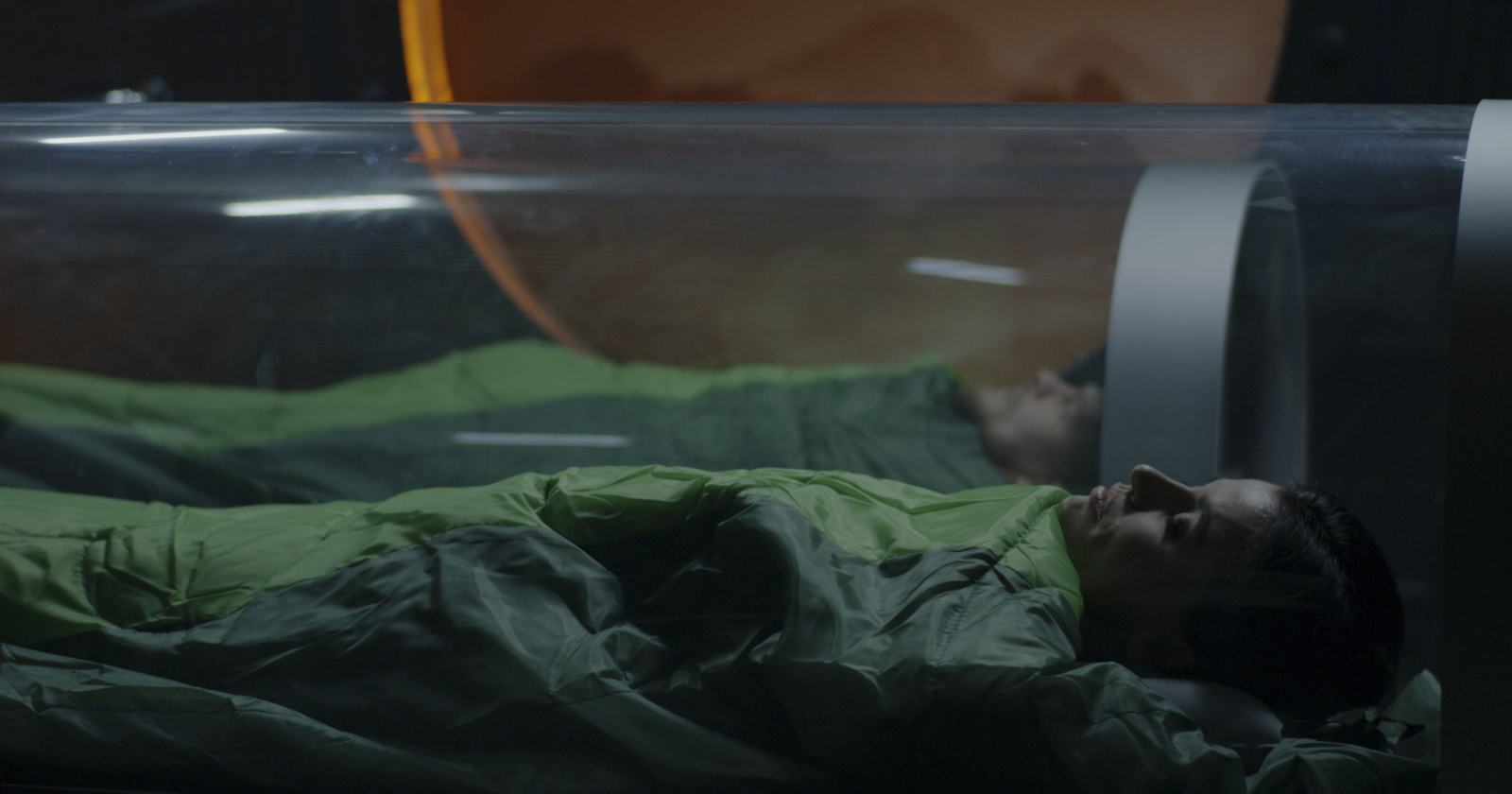
Zip yourself into a padded cubicle barely wider than your shoulders, strap down so you do not drift into the wall overnight, then try to ignore the fourth sunrise since dinner.
NASA writes eight and a half hours of protected sleep into its mission rules. What crews actually get is closer to six. Across 2,951 nights of wrist-monitor data gathered aboard the International Space Station, astronauts slept under six hours on 1,294 of them, and three quarters of the station crewmembers who answered the question said they had used sleep medication in orbit.
What a decade of wrist monitors found
Those figures come from a ten-year study led by Laura Barger of Brigham and Women’s Hospital, published in The Lancet Neurology in 2014. Astronauts wore an actigraph, a watch-sized motion sensor that infers sleep from stillness, across 26 shuttle flights and 13 station expeditions.
Shuttle crews averaged 5.96 hours a night. Station crews managed 6.09. Both slept roughly 50 minutes longer once they were back on the ground.
The sleep debt started well before launch. During the training-heavy stretch about three months out, crews were already averaging under six and a half hours, around half an hour less than the average American adult. They arrived in orbit tired.
The medicine cabinet in orbit
Zolpidem, sold as Ambien and Stilnox, dominated the shuttle records, accounting for about three quarters of the nights when a single dose was logged, with its extended-release version adding another 12 per cent. On those flights, 61 of 78 crewmembers reported taking a sleep-promoting drug, on 52 per cent of in-flight nights, and on about one in six of those medicated nights a second dose followed before morning. Use climbed to 60 per cent on the nights before a spacewalk. Barger’s team calculated that hypnotic use in space ran roughly twenty times higher than the share of Americans using the same class of drug in a given year.
Objectively, the payoff was small.
Crews fell asleep faster on medicated nights and rated the sleep better. The wrist monitors were less impressed, recording about eleven extra minutes of sleep, a difference that did not reach statistical significance, and a 1.3 per cent gain in sleep efficiency that did but amounts to a few minutes of tossing avoided.
That marginal benefit carries a cost. Sedative-hypnotics come with an explicit warning against use in work requiring full alertness, and the researchers noted that every crewmember on a mission can be dosed at the same time. There is no designated driver on a space station.
Why orbit makes a terrible bedroom
Sixteen sunrises a day, for a start.
The station laps the planet every 90 minutes, so the sun comes up on a schedule no body clock can use. Steven Lockley, a sleep specialist at Brigham and Women’s Hospital, has described light as the lever worth pulling: the blue wavelengths in white light push alertness up, and taking them out lets sleep pressure build.
The hardware conspires too. Sleep stations are shielded to sit below 50 decibels, which is quiet for a spacecraft and loud for a bedroom, since the life support fans run around the clock. Crews strap themselves down so they do not drift into equipment. Dockings and handovers force schedule jumps that shove everyone’s body clock sideways by hours at short notice.
What the lost hours cost
One station journal entry, logged in a NASA review of astronaut diaries and quoted in the Lancet Neurology paper, reads simply: “I fell asleep while typing.”
Something measurable sits behind that. A 2022 study in the journal Sleep, led by Christopher Jones at the University of Pennsylvania, tracked 24 astronauts through six-month station missions using a three-minute reaction test taken every four days. Nights under six hours lined up with slower response speed, higher reported stress and heavier perceived workload.
Both studies are observational, and neither can prove the sleep loss caused the slump. Astronauts are also a small, ferociously self-selected group who push through things most people would ring in sick for.
The fixes being tried
The fluorescent panels started coming out in 2016. In their place went programmable LED assemblies that can be run blue-heavy through the working day and warm in the hours before lights out, building an artificial dusk into the ceiling.
Ground testing suggests the idea has legs. In a 45-day simulated mission at NASA’s Human Exploration Research Analog, a dynamic lighting schedule collapsed circadian misalignment from 26 per cent of sleep episodes under fixed lighting to a single episode out of 342.
None of it solves the harder problem waiting further out. A station crew in trouble can be home inside a day, and a flight surgeon in Houston is a radio call away, arguing in something close to real time about that second dose. A crew bound for Mars gets neither. They will run their own pharmacy, keep their own hours, and decide for themselves, at three in the morning or whatever passes for it, whether tomorrow can afford tonight.
