
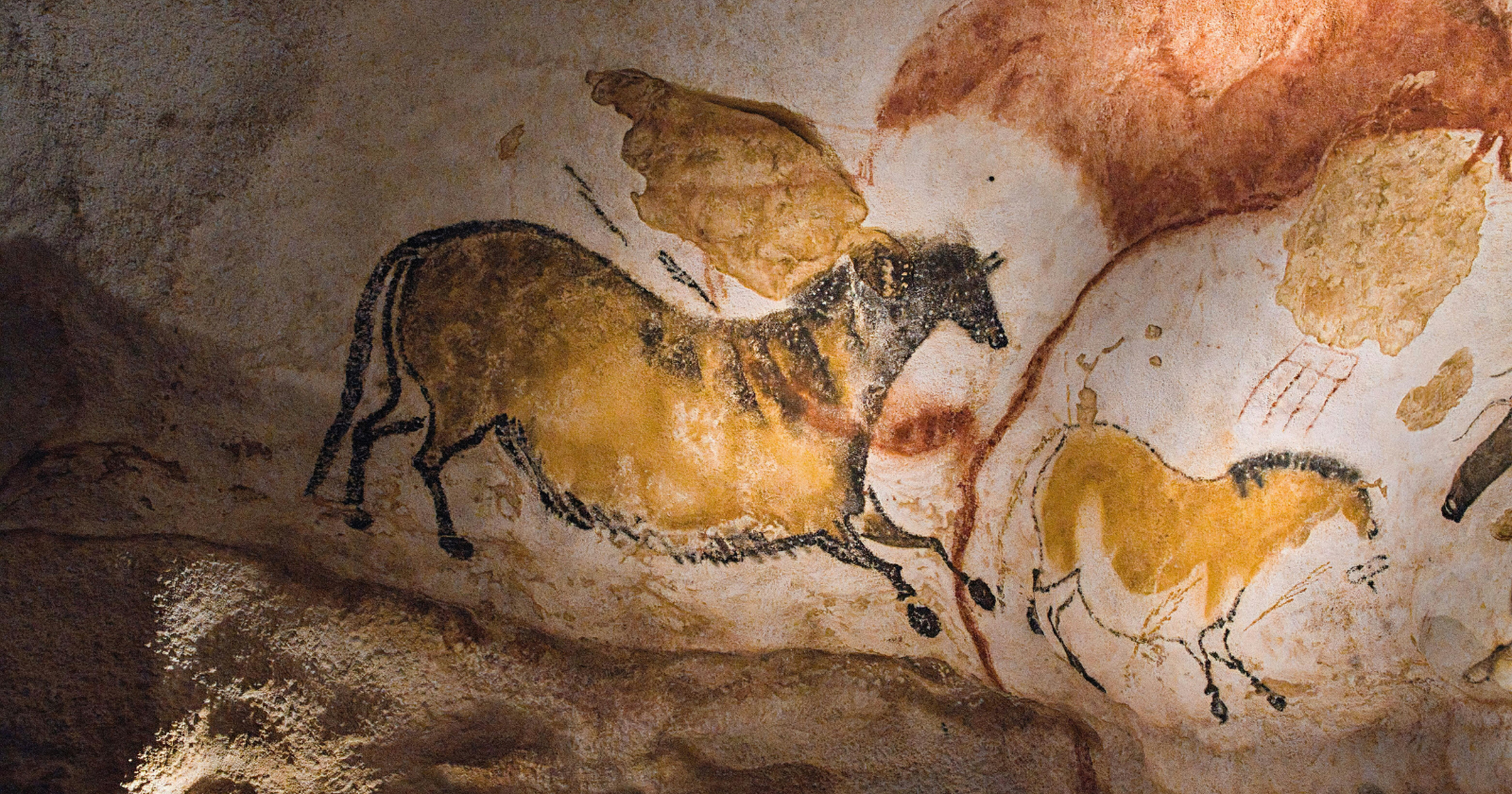
In September 1940, four teenagers and a dog stumbled into a hole in a hillside near Montignac, in southwestern France, and found themselves standing inside a painted Ice Age cathedral.
The walls of the Lascaux cave were covered in bulls, horses, stags and abstract signs — some 600 paintings and nearly 1,500 engravings, laid down roughly 17,000 years ago and sealed in the dark ever since. They had survived, in near-perfect condition, for the entire span of human civilization and then some. They would not survive twenty years of tourism.
The visit that wore out a masterpiece
Lascaux opened to the public in 1948, and it was a sensation. Through the 1950s the crowds swelled — by the middle of the decade well over a thousand people a day, and on peak days as many as 1,500 to 1,800, filing through the narrow galleries to see the most famous prehistoric art on Earth.
Each of those visitors did something invisible and destructive: they breathed. A human being exhales carbon dioxide and water vapour, and thousands of them per day, packed into a small sealed chamber, steadily changed the air. The cave’s microclimate — temperature, humidity, the chemistry of the air itself — had held stable for seventeen millennia. In a decade of tourism, it was overturned.
The walls began to sicken, in two colours.
Green sickness and white sickness
First came the green. A film of algae and lichen, fed by the carbon dioxide and the electric lights installed to illuminate the paintings, started creeping across the walls — conservators called it the maladie verte, the “green sickness.”
Then came the white. Veils of calcite crystals began forming over the images — the maladie blanche — as the disturbed air chemistry deposited minerals across the very surfaces the paintings sat on. Between the algae eating the walls and the crystals growing over them, art that had endured since the last Ice Age was visibly deteriorating within two decades of being found. The breath of the admirers was erasing the thing they had come to admire.
Sealing the cave
By the late 1950s the French government was alarmed enough to investigate, and in 1963 the Minister of Cultural Affairs, André Malraux, made the call: close Lascaux to the public entirely.
It has never reopened. The paintings were painstakingly treated — the crystal growth halted, the algae and lichen reversed — and the cave was placed under permanent, near-dark monitoring, its air and walls watched continuously by a small specialist team who have fought off further outbreaks of mould and microbes in the decades since. Today only a handful of researchers enter, briefly, in tightly controlled conditions. For everyone else, the door is shut.
That solved the conservation problem and created an economic one. Lascaux was the region’s great attraction, and sealing it cut off the town of Montignac from its most famous asset. The answer was audacious: if people could not see the cave, France would build them another one.
The cave that is a copy
In 1983, after some eleven years of work, Lascaux II opened about 200 meters from the original — a concrete-shell replica reproducing the Hall of the Bulls and the Painted Gallery in exacting detail.
A team of some twenty artists and sculptors, led by Monique Peytral, had recreated the paintings using, as closely as possible, the same pigments and techniques as the Paleolithic originals — ochre, charcoal, manganese — copied from photographs and tracings onto walls molded to match the real cave’s contours. The point was not a museum display but the illusion of the cave itself: the same shapes, the same crowding animals, the same dark.
It worked well enough that France kept going. A newer, far larger and more complete facsimile, Lascaux IV, opened in Montignac in 2016 — a full reproduction that lets visitors walk the cave’s whole length, with tablet guides in their own languages. Between the versions, replica Lascaux has now been admired by more people than the real cave ever was, and touring reproductions have carried the paintings around the world.
The paradox in the dark
There is a strange, almost philosophical knot at the center of Lascaux, and it is worth sitting with.
The paintings survived 17,000 years precisely because no one could see them — sealed, stable, forgotten. The moment they became visible, they began to die, killed by nothing more sinister than the attention of the people who loved them. Saving them meant sealing them away again, back into the dark that had preserved them in the first place. Human eyes, it turned out, were the one thing the art could not withstand.
So France resolved the contradiction the only way it could: by splitting the cave in two. The real Lascaux sits sealed on the hillside, seen by almost no one, doing what it did for seventeen millennia — surviving in darkness. And 200 meters away stands its double, built to be looked at, absorbing the breath and the crowds and the wear that the original can no longer take. One cave to be seen; one cave to survive. It is a peculiar kind of preservation, but it is the only kind that ever worked: the most-viewed Ice Age paintings in the world are ones no visitor has actually seen.