

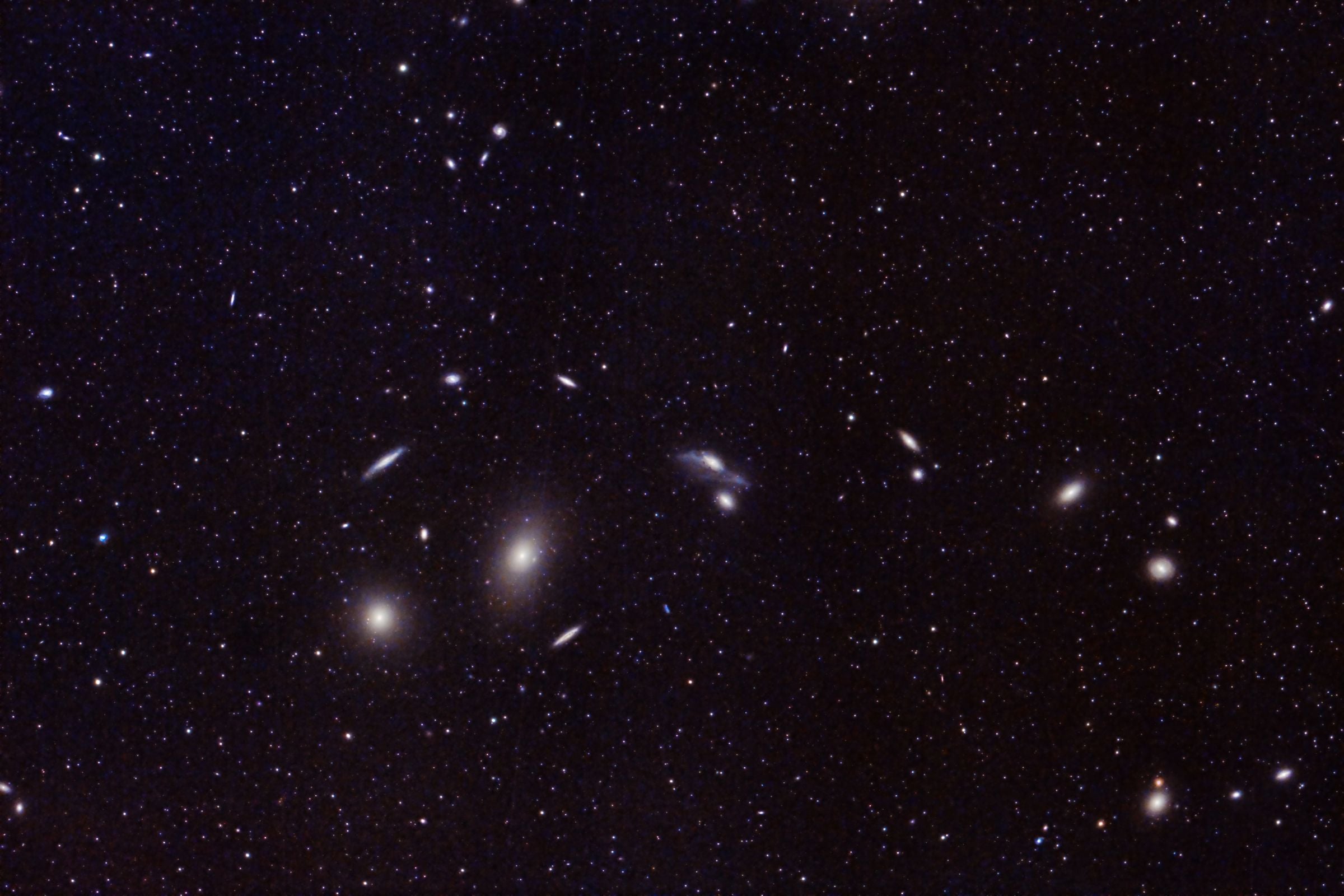
A deep optical search around three galaxies has produced 47 dwarf-galaxy candidates in a patch of sky where only four had been reported before. The difference is striking, but it needs a precise label: 43 are newly reported candidates, not 43 confirmed satellites.
The result, published in Astronomy & Astrophysics, began with astronomers looking through the images themselves. That makes the discovery as much a story about selection as about galaxies. A survey catalogue is not a neutral copy of the sky. It is the sky after depth, software thresholds and human judgement have determined which patches of light become named objects.
Three pairs of eyes searched the mosaic
The VST-SMASH team studied two adjoining pointings covering about 2.6 square degrees. The field contains the face-on spiral NGC 5068 at 5.2 megaparsecs, roughly 17 million light-years away, plus the more distant lenticular NGC 5084 and elliptical NGC 5087 near the Virgo Supercluster’s outskirts.
The observations came from the 2.6-metre VLT Survey Telescope and its wide-field OmegaCAM at Paranal Observatory in Chile. The combined exposure amounted to about 2.7 hours in the g band, 3.4 hours in r and 2.2 hours in i. In the two deepest bands, the mosaic reaches extremely faint surface-brightness levels near 30 magnitudes per square arcsecond under the paper’s stated measurement convention.
For the first pass, three co-authors independently scanned the full g-band image for diffuse, “fluffy” sources with shallow-looking profiles. They did not begin with an automated detection catalogue or a preselected list. Joining their tags produced 71 possibilities.
The team then built colour cutouts, considered aperture colours, removed objects that were extremely red or blue, and had all three inspectors grade each source. The final sample contains 30 grade-A, or high-probability, dwarfs and 17 grade-B, or likely, dwarfs.
The work did not remain an all-human exercise. Software detected many contaminating stars and background galaxies, people refined the masks, and code measured surface brightness and fitted one-dimensional Sérsic profiles. “Found by eye” accurately describes initial detection and vetting, not the whole analysis.
How a visible galaxy can evade a catalogue
The obstacle is surface brightness, not simply total brightness. A galaxy may contain enough light to measure once its position is known, yet spread that light across so much sky that few pixels stand out above the background. Source finders tuned to compact or high-contrast objects can then split it, merge it into background structure or never trigger on it.
The candidates have a median Sérsic index near 0.8, indicating shallow light profiles. In the one direct earlier-data comparison developed by the paper, previous imaging of a known candidate was about one magnitude shallower after telescope size and exposure were taken into account. VST-SMASH traced a smoother, better-constrained outer profile.
The pattern has precedent. SpaceDaily previously reported three ultra-faint dwarfs recovered through manual inspection of DECaLS images around NGC 300. Trained eyes can notice coherent diffuse shapes that fall awkwardly between catalogue rules.
That does not establish a contest in which people beat algorithms. The new study did not run a matched automatic search or inject synthetic galaxies to measure recovery rates.
Deeper imaging is central to the result, and some recent wide-field searches did not cover this region. The defensible conclusion is that earlier catalogues contained only four of these 47 candidates, not that automation was proven to fail on all 43.
The catalogue has a human selection function
Visual searching trades one set of biases for another. The observers deliberately avoided many very small and extremely faint sources because distant background galaxies can imitate dwarfs. That choice reduces contamination but also makes the list incomplete by design.
About three quarters of the candidates look smooth, like dwarf ellipticals or dwarf spheroidals. Roughly ten show arms, clumps or central structure. The authors caution that roughly one-arcsecond ground-based resolution can erase real substructure, while the search criteria themselves favour diffuse objects. Both effects can tilt the apparent morphological mix.
Their colours and sizes agree reasonably well with known dwarf populations, and only four matches appeared in literature searches using major astronomical databases. Yet distance remains unknown for almost the entire sample. Stellar masses quoted in secondary accounts depend on placing the objects at an assumed 26 megaparsecs. Move them nearer or farther and the inferred masses and physical sizes change substantially.
Three possible hosts, but no measured orbits
On the flat sky, candidates cluster around NGC 5068, NGC 5084 and NGC 5087. The team’s empirical association scheme links at least ten to NGC 5084 and gives about five a high-probability connection to NGC 5087. Several others lie at plausible projected separations from NGC 5068.
Those assignments combine projected separation, apparent size, brightness and the few available distances. The authors describe parts of the probability construction as somewhat arbitrary, and the model does not allow for an isolated dwarf. Even a suggestive arrangement roughly perpendicular to NGC 5084’s disc is not a detected satellite plane. Distance and radial-velocity measurements must come first.
The next survey should combine eyes and code
VST-SMASH was designed so its nearby-galaxy fields also fall within Euclid’s survey footprint. That creates an unusually useful cross-check: the ground-based data are deep and cover blue optical bands, while Euclid supplies sharper imaging from space. Spectroscopy can then decide which attractive smudges occupy the same three-dimensional neighbourhood as a proposed host.
A hybrid workflow is already becoming normal. Euclid’s first dwarf census used catalogue measurements and selection cuts before visual classification, finding 2,674 candidates in 14.25 square degrees. The point is not to replace eyes with code, or code with eyes, but to quantify what each stage misses.
Only after confirmation can the VST candidates enter serious counts of satellites or tests of dark-matter models. As SpaceDaily recently reported for an exceptionally faint stellar stream beyond the Milky Way, low-surface-brightness structures can become powerful gravitational tracers. For now, the important finding is simpler: changing how astronomers look changed the apparent population by an order of magnitude.