

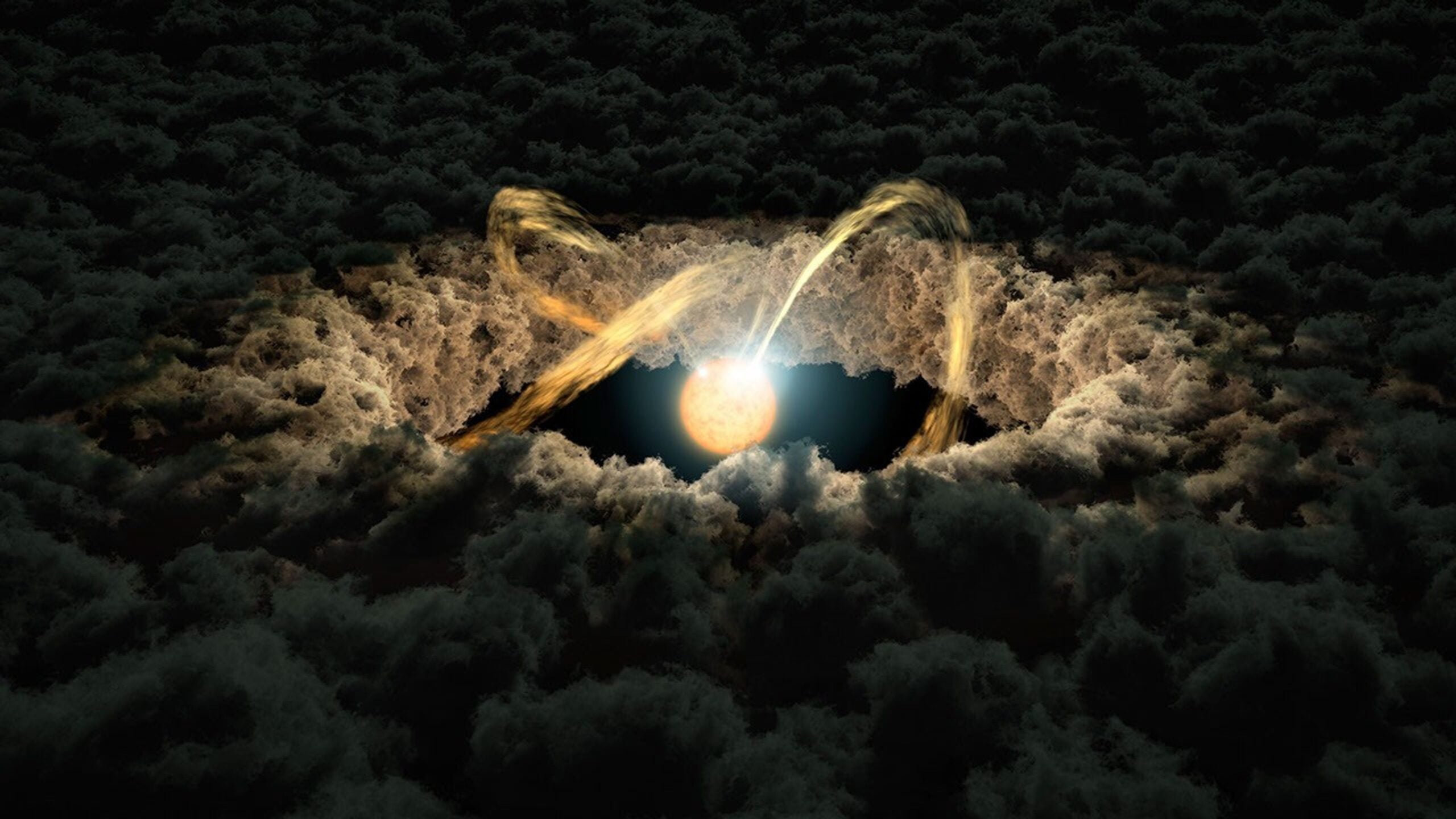
The first solid worlds assembled in the outer Solar System did not simply collect a representative scoop of everything around them. A new analysis of carbonaceous iron meteorites indicates that their parent planetesimals contained only 8 to 17 percent fine, volatile-rich matrix. The rest, as much as 92 percent by mass, was dominated by millimetre-scale rocky particles called chondrules that had been intensely heated before they cooled.
The result, published in Nature Astronomy, pushes evidence for selective planet building into roughly the Solar System’s first million years. Previous meteorite work had documented a related trend in carbonaceous bodies that formed about two to four million years after the first dated solids.
“Worlds” needs a precise meaning here. These were planetesimals, the asteroid-scale predecessors from which planets and moons grew, rather than completed outer planets. No intact example from this earliest generation survives. Their lost composition has instead been reconstructed from the metallic cores that reached Earth as iron meteorites.
The finding also does not mean that the outer disk lacked ice. The surrounding material was rich in cold dust, water ice and organics. The surprise is that so little of that fine-grained component entered the first known bodies.
The 92 percent was chondrule-rich rock
Primitive carbonaceous meteorites preserve two visibly different ingredients. Chondrules are compact, usually rounded silicate particles made when dust or earlier solids experienced short bursts of high temperature. Some were melted into droplets; others were thermally sintered. They later cooled into the small rocky beads found throughout many meteorites.
Matrix is the material between them. It consists of much finer dust that largely avoided comparable heating and retained more volatile elements, carbon-rich compounds and water-bearing material. A chondrite’s matrix fraction is therefore more than a description of its texture. It records how much cold, chemically rich dust accompanied the heat-processed rock into a parent body.
The new study inferred matrix fractions of 0.08 to 0.17 for the earliest carbonaceous iron-meteorite parent bodies. Subtracting those numbers from the whole gives chondrule fractions of about 83 to 92 percent. The title’s “heat-forged rock” refers to that upper-end chondrule share, not to a direct measurement of a surviving miniature planet.
That distinction matters because the meteorites being analysed are metal, not pristine conglomerates in which the original chondrules can still be counted. The conclusion depends on chemical reconstruction.
The earliest original rocks were melted away
Planetesimals assembled during the Solar System’s opening epoch inherited abundant aluminium-26. This radioactive isotope had a half-life of about 717,000 years, so its decay supplied a powerful but rapidly fading source of internal heat.
Bodies that formed early received enough aluminium-26 to melt extensively. Metal separated from silicate and descended into their interiors, forming cores. The process erased the starting mixture’s visible texture: chondrules dissolved into magma, ice reacted or escaped, and fine matrix ceased to exist as a recognisable component.
Later collisions broke some of those differentiated worlds apart. Pieces of their metal cores became the carbonaceous iron meteorites available today. They no longer look like the original planetesimals, but some elements and oxidation relationships survived well enough to carry a record of what went into them.
This creates an unusual investigation. There is no primordial rock to inspect under a microscope and no direct count of beads and dust. The researchers instead asked what starting mixture could produce the chemistry retained by cores after melting and differentiation.
As NASA’s overview of early planetary systems notes, planetesimals began appearing extraordinarily quickly in the outer nebula. The timing explains both why this first generation is scientifically valuable and why its original fabric was so thoroughly destroyed.
Sulfur became a measure of missing matrix
Damanveer Grewal of Yale University, Zhongtian Zhang of Princeton University and Joanna Drążkowska of the Max Planck Institute for Solar System Research used two independent chemical proxies. The first was bulk sulfur.
In carbonaceous material, sulfur is much more concentrated in fine matrix than in chondrules. If an original planetesimal incorporated a large matrix fraction, the body’s total sulfur inventory should have been correspondingly high. Some of that sulfur would subsequently follow metal into the core, where iron meteorites could preserve evidence of it.
The team reconstructed the total sulfur content of each parent body from core chemistry and estimates of the core’s share of the body. The resulting inventories were too low for matrix-rich starting material. Across the sampled carbonaceous iron-meteorite groups, sulfur pointed to an original mixture overwhelmingly dominated by chondrules.
Yale’s account of the research explains why the oldest material had to be approached through these residual signatures: the aluminium-26-rich parent bodies melted completely, destroying the textures that would otherwise reveal their ingredients directly.
There is no direct observation of an ancient gas stream “rejecting” an icy grain. The filtering language describes the process inferred from the composition pattern. Sulfur supplies a quantitative estimate of the result after that process had finished.
Iron supplied a separate test
The second proxy was the valence state of iron outside sulfides. In simple terms, it measures how oxidised the iron was before the parent body differentiated.
Fine matrix carried water ice and oxidised silicate precursors. A planetesimal that accumulated more matrix therefore gained more material capable of oxidising iron. Chondrule-rich starting material should leave a more reduced signature.
The researchers used core-mantle mass balance to work backwards from meteorite measurements to that original state. The iron calculation returned matrix fractions in the same 8 to 17 percent interval as the sulfur calculation.
That agreement is more important than either number alone. Sulfur abundance and iron oxidation respond to different aspects of matrix and require different calculations. Their convergence makes it harder to explain the result as a quirk of one element’s behaviour during melting.
It does not remove every assumption. The reconstruction uses the compositions of chondrules and matrix in younger surviving chondrites as end members for material that no longer exists intact. Estimates of original core size and sulfur distribution also carry uncertainty. The range is a defensible population estimate, not a recipe precise to the last percentage point for every early body.
Gas sorted the solids without knowing their chemistry
Why would a cold outer disk build its first planetesimals mainly from material that had already been heated? The proposed answer begins with drag.
Tiny matrix grains were strongly coupled to the nebular gas. As gas moved through the disk, these particles tended to travel with it. Millimetre-scale chondrules had greater inertia and responded differently. They could drift, settle toward the disk’s midplane or become concentrated in pressure maxima while finer dust remained suspended and was carried onward.
A recent review of planetesimal formation describes how pressure bumps and related structures can trap larger solids while very small grains remain coupled to gas. When particle concentrations become high enough, processes such as streaming instability can help collapse the solids into planetesimals.
The gas was therefore not a literal sieve and did not distinguish hot rock from icy dust by temperature or chemistry. It separated particles because size, density and porosity determined their aerodynamic response. The hot and cold components happened to occupy different parts of that physical spectrum.
“Filtered out” is also relative rather than absolute. Even the earliest reconstructed bodies retained 8 to 17 percent matrix. They were strongly depleted in fine ice-rich dust, not perfectly free of it.
Later bodies incorporated much more cold dust
Carbonaceous chondrite parent bodies that formed two to four million years after the first calcium-aluminium-rich inclusions generally contain more matrix. Across much of the record, the fraction rises with accretion time, from roughly 30 percent in some groups to nearly the whole rock in the most matrix-rich examples.
The new iron-meteorite points extend that relationship into an earlier interval that previously lacked intact evidence. Aerodynamic sorting did not begin only after the disk had been evolving for several million years. It appears to have influenced composition from the onset of outer planetesimal formation.
The pattern also offers an explanation for the scarcity of the oldest chondrules in unmelted meteorites. Many early chondrules may not be missing because few were made. They may have been captured efficiently by the first aluminium-26-rich bodies and then destroyed when those bodies melted.
One group cautions against turning the general trend into a universal clock. CR chondrites formed comparatively late, around 3.7 million years after the first solids, yet contain only about 17 percent matrix. Different rings, dust traps or local histories could produce exceptions inside a changing disk.
The outer disk was divided in more than one way
SpaceDaily previously reported meteorite evidence that the young Solar System contained a gap separating inner and outer reservoirs. Isotopic differences indicate that material on the two sides did not mix freely.
The new work addresses a second kind of selection within the outer reservoir. Chondrules and matrix could originate in the same broad region yet enter planetesimals at different rates because gas drag treated them differently. The disk could be divided geographically by rings and gaps while also sorting particles locally by their motion through gas.
The finding also bears on when chondrules existed. Earlier SpaceDaily coverage examined one model in which Jupiter-driven collisions generated chondrules about 1.8 million years after Solar System formation. That may describe one later production route.
The present inventory does not identify the event or events that heated the earliest grains. It does require chondrule production to have been widespread from the beginning, before the oldest differentiated outer bodies assembled. Several heating mechanisms or several generations of chondrules may therefore be needed.
A chemical record of selective construction
The standard broad picture still holds: the outer Solar System offered colder, more volatile-rich material than the inner region. What changes is the assumption that location alone determined the composition of its first bodies.
Available ingredients and incorporated ingredients were not the same thing. Before gravity locked solids into planetesimals, gas motion had already changed which particles could gather together. The earliest bodies sampled by carbonaceous iron meteorites were consequently much rockier and more matrix-poor than their cold surroundings might suggest.
The inference rests on a small and indirect archive. Accretion ages are relative to the first solids rather than exact calendar dates. The study reconstructs parent populations, not named planets, and it cannot yet show whether the inner Solar System followed the same chondrule-to-matrix sequence.
Even with those boundaries, two independent tracers connect vanished early bodies to a longer trend preserved in younger meteorites. During the first million years, outer Solar System construction was already selective: compact, heat-processed beads gathered efficiently, while much of the finest ice-rich dust stayed with the flowing gas.