
Elias 2-24 b is not merely young by planetary standards. The star, disk and planet are no more than about one million years old, making this the youngest confirmed exoplanet yet reported. The world sits inside a narrow gap in its birth disk about 55 astronomical units from its star, or roughly ten times Jupiter’s present distance from the Sun.
The confirmation appears in The Astrophysical Journal Letters in a paper led by Andrea Bernardi of Universidad Diego Portales. NASA describes the object as about as massive as Jupiter, while the paper’s comparison with one-million-year evolutionary tracks gives a range of 1.9 to 4.0 Jupiter masses. That estimate does not include the extra light that ongoing accretion may produce.
The finding is worth taking seriously, but it should not be read as the final word. It comes from one unusually young system and the inferred mass is model-dependent. Its value is that it puts a directly detected object where a decade of disk observations had suggested a planet should be, at an age and distance that standard growth calculations find difficult to accommodate.
A dark ring was the first clue
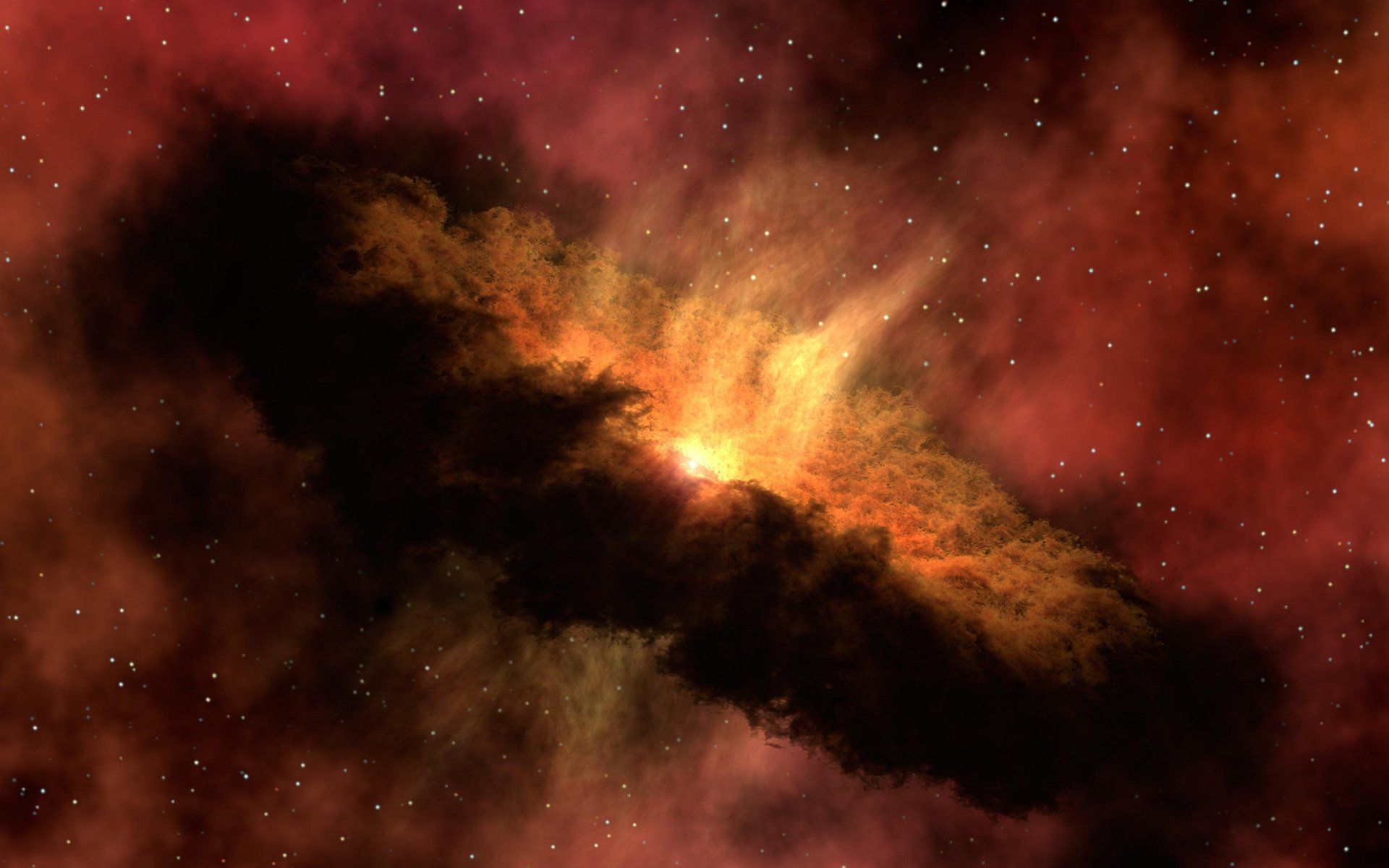
Elias 2-24 is a young star in the Ophiuchus star-forming region about 450 light-years from Earth. It remains surrounded by a broad protoplanetary disk, the reservoir of gas and solids left from star formation and the environment in which planets can assemble.
ALMA observations published in 2017 resolved three partially separated gaps in that disk, centred at roughly 20, 52 and 87 astronomical units. The middle gap was particularly interesting. Its width and the amount of apparently missing material were compatible with a forming giant planet, but compatibility is not confirmation.
Disks can acquire rings and gaps without a planet sweeping out an orbit. Changes in grain growth, pressure, chemistry near molecular snow lines and dust trapping can all make radio images look structured. A gap is therefore a place to search, not a planet detection by itself.
Later observations with the European Southern Observatory’s Very Large Telescope found a faint point of infrared light near the middle gap. Researchers also reported kinematic and thermal disturbances in the gas consistent with a planet interacting with the disk. The evidence converged on the same location, but the point source still had to be distinguished from processed starlight, an imaging artefact or a background object.
Keck’s archive supplied the missing motion test
Bernardi and colleagues returned to observations made with the Keck II telescope’s NIRC2 camera and vortex coronagraph in 2018 and 2020. The coronagraph suppresses the bright central star so that much fainter sources close to it become accessible. Adaptive optics corrects much of the blurring introduced by Earth’s atmosphere.
The team reprocessed the images with angular and reference differential imaging. These methods use changes in viewing geometry and comparison data to separate a persistent astronomical source from the optical pattern left by the star and instrument. Principal-component analysis then models and subtracts the remaining glare.
The recovered point lay 394 plus or minus 31 milliarcseconds from the star. At the distance of Elias 2-24, that corresponds to a projected separation of 54.9 plus or minus 4.3 astronomical units. Its position angle was 298.8 degrees, with an uncertainty of 3.2 degrees.
Most importantly, the source appeared in both epochs and moved with Elias 2-24 rather than tracing the path expected for a remote background star. It also occupied the narrow gap already mapped in the disk. Shared motion, location and independent disk signatures together allowed the team to confirm the candidate as Elias 2-24 b.
“Jupiter-mass” is a useful shorthand, not a precise weighing
NASA’s account calls the planet about as massive as Jupiter. The journal paper is more specific about both the estimate and its uncertainty: comparing the measured near-infrared brightness with one-million-year isochrones gives between 1.9 and 4.0 Jupiter masses.
That calculation explicitly does not include accretion effects. A planet this young may be surrounded by hot material still falling towards it, and the accretion shock can add light. Its brightness also depends on how much heat the planet retained while forming, a starting condition described by hot, warm and cold evolutionary models.
At mature ages, luminosity and mass can be related with more confidence. At less than one million years, entropy, atmospheric opacity, accretion history and possible circumplanetary material are entangled with mass. The 1.9-to-4.0 range is therefore a model-based inference, not a dynamical measurement of gravitational pull.
This is why “roughly as massive as Jupiter” works as a broad description but should not be mistaken for a one-Jupiter-mass result. Spectroscopy, longer monitoring and measurements of how the planet disturbs nearby gas could eventually provide a tighter constraint.
Why 55 astronomical units strains the core-accretion clock
In core accretion, small solid grains grow into pebbles, planetesimals and eventually a sufficiently massive core. Once that core crosses a threshold, it can rapidly capture hydrogen and helium from the surrounding disk and build a giant atmosphere.
NASA’s summary gives about five million years as a representative model time for making a Jupiter-size planet at Jupiter’s orbit, just over five astronomical units from the Sun. Elias 2-24 b occupies a projected separation near 55 astronomical units while its system is younger than one million years.
The comparison is deliberately simple. Planet-formation models do not all produce one fixed five-million-year deadline, and conditions differ among disks. Still, the distance matters. Orbital periods are longer farther out, collisions and encounters occur less frequently, and the useful solid material is ordinarily spread over a larger area. Building a core before the gas disappears becomes more difficult.
The new paper nevertheless argues that the observations support core accretion. The planet lies in a narrow gap whose properties are compatible with planet-disk interaction, and the object appears to be in the brief rapid gas-accretion stage predicted after a core becomes massive enough.
Another formation route, gravitational instability, can act faster when a sufficiently massive disk fragments under its own gravity. Space Daily has previously examined evidence for gravitational instability in the AB Aurigae disk. For Elias 2-24 b, the authors’ core-accretion interpretation makes the short timetable a constraint the mechanism must meet, not an automatic reason to replace it.
The disk is a construction supply and a deadline
A giant planet must capture most of its atmosphere while the natal disk still contains gas. The available interval is limited because radiation, accretion onto the star, jets and disk winds gradually remove that material.
Space Daily’s earlier report on Webb observations of winds and jets in 72 young systems described this competition directly. Giant planets need a large gas reservoir, yet the processes accompanying young stars are already carrying that reservoir away.
Elias 2-24 b has evidently reached a rapid gas-gathering stage before that supply disappeared. The observation does not identify the missing acceleration by itself. It instead gives models a demanding combination to reproduce: a sub-million-year age, a roughly 55-AU separation, a multi-Jupiter-mass luminosity estimate and a planet embedded in a structured, still gas-rich disk.
The previous youngest confirmed forming planets were the two worlds around PDS 70 and the two around WISPIT 2, all older than five million years. Space Daily reported how ALMA resolved a circumplanetary disk around PDS 70 c, showing material that could form moons around an already growing giant. Elias 2-24 b moves the observational clock substantially closer to the beginning.
A discovery made by combining instruments and years
Keck Observatory’s account of the work emphasises that no single exposure settled the case. ALMA mapped the disk structure, the Very Large Telescope supplied an earlier infrared point and reprocessed Keck data provided the multi-year common-motion test. Each observatory answered a different part of the same question.
The result also illustrates the value of archives. The decisive Keck observations were made in 2018 and 2020. New processing methods and a better-developed physical case around the disk gap made those older frames more informative years later than they were when first collected.
Several uncertainties remain. The 54.9-AU value is a projected separation rather than a complete orbit. The planet’s mass depends on very young evolutionary tracks. Accretion may contaminate the light used for that estimate. The disk gap and shared motion make the planetary interpretation strong, but they do not yet reveal exactly how the core grew so quickly.
That is the useful tension in Elias 2-24 b. The planet appears where planet-disk theory said an embedded world might be hiding, yet it appears much earlier and farther out than the standard timetable comfortably allows. The observation does not erase core accretion. It gives the theory a young, distant planet it now has to build.