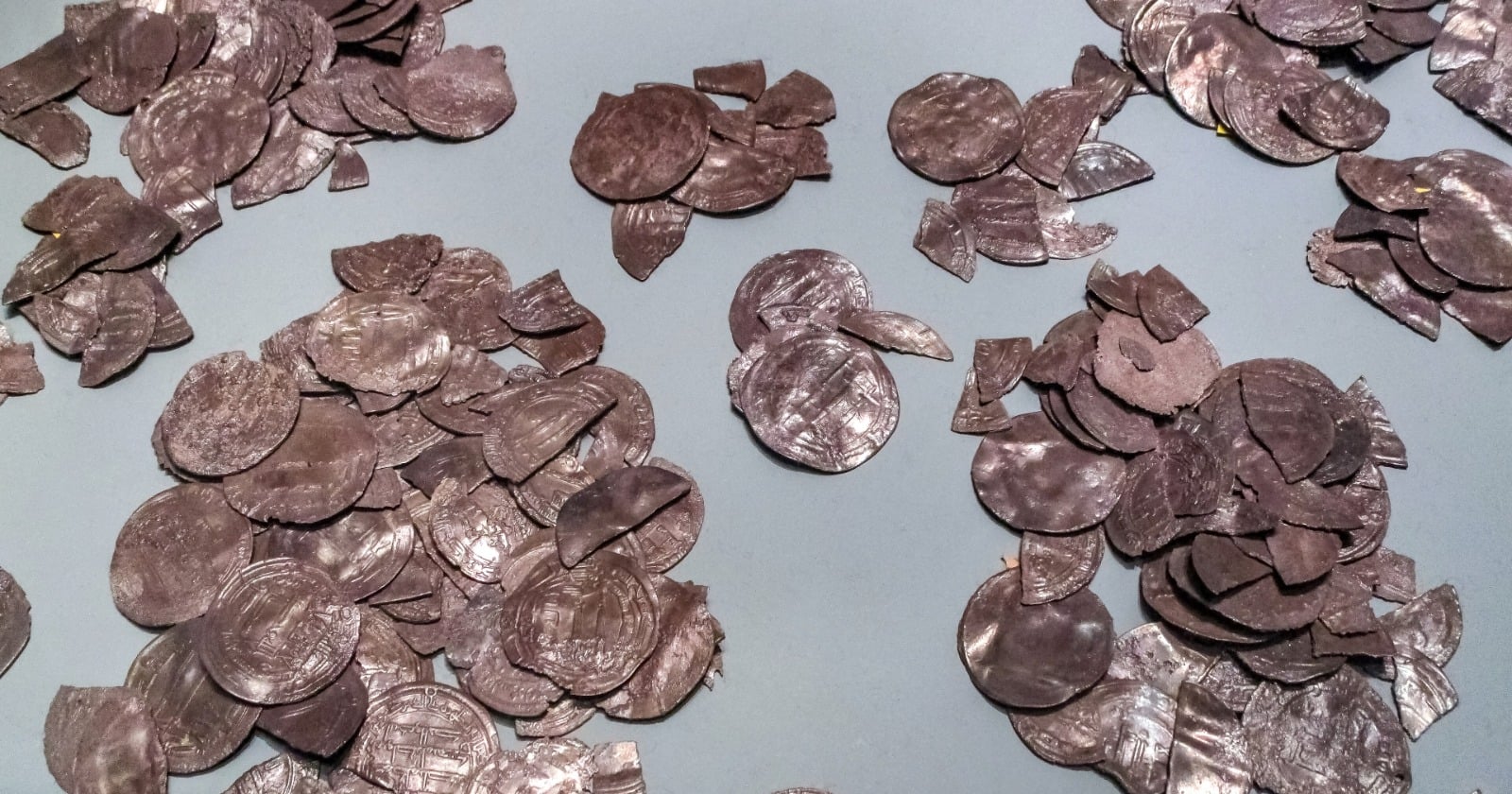
“First came a little disbelief, then the adrenaline and the feeling of success,” Kalle Lappinen told the Finnish broadcaster Yle. “The work paid off again.”
Lappinen is a metal-detector hobbyist, and what he had found, in ground near the church village of Sysmä in Päijät-Häme on Thursday 3 September, is what Lahti Museums describes as the largest late-Iron-Age coin-hoard find known from Finland to date. The museum inspected the site the following day. The coins weigh about 4.5 kilograms. They have not been cleaned, separated from one another, or counted.
From an ore signal to a hoard
The first signal Lappinen got, he started on and then abandoned. It came from so deep that he read it as an ore signal rather than a buried object. “I didn’t believe it could be any object of human origin,” he told Yle.
He moved on. About eight metres away, by Yle’s account, the detector gave him a second reading of the same kind, and this time he committed to it. “Then I had to dig right down to the bottom and find out what was there,” he said. About ten silver coins came up from the floor of that pit. Inspired by that, as Yle puts it, he went back to the first signal, and there were coins there too.
The digging is slower than that sounds. Lappinen works with a small spade, a planting tool and a mushroom knife; Yle describes the usual method as opening the ground until a handheld pinpointer can locate the target inside the hole, then taking the last ten centimetres more carefully. Even so, a birch-bark vessel that held silver objects came apart as he worked. He told Yle he regretted it, because it had been neatly made and he would have liked to know exactly how. Most of what the hobby turns up is nothing much: 99 per cent of his finds, he reckons, are junk or ore.
He reported the find to the Finnish Heritage Agency immediately. Who then did the excavating is described differently by the two sources, and nothing in either account reconciles them: Lahti Museums says the hoard was lifted under the direction of Esko Tikkala, the archaeologist of the regional responsible museum, while Yle says the Heritage Agency’s specialists dug the treasure fully out.
Birch bark rarely lasts this long
The 7 September announcement lists what came up. Alongside the coins there is a fragment of hack silver, the cut-up bullion that circulated by weight in this period, plus a silver bracelet, a silver fitting and a silver bead. All of it had been packed into two birch-bark containers, which were buried about 45 centimetres down between stones and roughly 12 metres apart from each other. Yle reports that same 12-metre separation for the vessels, and separately puts about eight metres between Lappinen’s two signals. It carries both figures without reconciling them.
Yle reports that the find vessel is significant too, and Tuulia Tuomi, museum director for the city of Lahti, told the broadcaster that a birch-bark box has been exceptionally preserved, organic material rarely lasting in Finnish conditions from prehistoric times. What the sources do not say is which of the two vessels she means. One birch-bark vessel came apart during Lappinen’s dig; a birch-bark box has survived. Nothing on the record establishes that those are two different boxes.
The spread of the coinage
Everything Tikkala says here comes from the museum’s follow-up statement of 17 September, and he spoke with the silver still uncleaned. Part of the silver coins, he said, can be dated to the decades between 1000 and 1050. The coins come from several countries, such as Sweden and the areas of present-day Britain and Germany. The most distant are dirhams from the area of what is now Turkey and Iran.
Tikkala, who has worked in the field for nearly thirty years, called it one of the biggest finds of his career, and said it adds to what is known about how significant a trading node Sysmä was. He also set it in context: the surrounding area has already produced a good deal of material from the same era, he said, and what is exceptional here is the size.
Islamic silver travelled to the Baltic along the eastern river routes, which is standard background rather than anything these sources establish. Tikkala’s own framing is that the coins will yield more about how far the period’s trading networks reached, and a deposit mixing dirhams with western European coin is a datapoint about that reach. The museum has named what it will look into next: the hoard’s more precise contents, its dating, and the geographic origin of the coinage. It expects that work to say something about where Sysmä and Päijät-Häme sat in the trade and cultural-contact networks of the late Iron Age. Separately, it lists the topics the international coverage took up, among them why a fortune this size was hidden in two separate places.
Nousiainen, 1895
The record deserves reading slowly, because the weights quoted on either side of it are not counting the same things.
Lahti Museums says the hoard found at Nousiainen in 1895 has been considered Finland’s largest known Viking-Age coin hoard until now, and describes it as about 1,700 coins plus other objects, “whose combined weight is about 2.2 kilograms”. Yle, reporting the same comparison, puts “a good two kilos” on the Nousiainen find as a whole. Neither figure is a weight for coins alone.
The Sysmä figure has a qualifier of its own. The 4.5 kilograms is a weight for the coins alone, recorded before anything was cleaned or separated, in the same breath as the museum’s statement that the exact weight, the number and the more precise dating will only emerge from further study.
None of that challenges the record, which is Lahti Museums’ to state and which it has stated plainly. It does mean neither release specifies what “largest” is measured in, weight or count, and that for Sysmä both quantities are still provisional: the exact weight waits on further study, and the museum has said only that there are thousands of coins.
After the story went round the world
The find travelled. Lahti Museums counted coverage on five continents, naming the New York Times, ABC News, Good Morning America, Smithsonian Magazine, Live Science, National Geographic Polska, Aftonbladet, Peru’s La República, the Times of India and the Chinese state agency Xinhua among the outlets that ran it.
The museum has used both period labels itself, and in the same announcement. Its 7 September release is headlined with the Viking-Age formulation, calling the find Finland’s largest Viking-Age silver coin hoard; the body of that same release states the new record in late-Iron-Age terms, and further down calls the record it displaces a Viking-Age one. The 17 September follow-up repeats the Viking-Age wording in its opening line. The Finnish late Iron Age and the Viking Age overlap as periods.
What the museum added on 17 September was a limit on the label. Several international pieces had examined the term, it noted, and it then stated plainly that a Viking-Age find does not in itself mean the hoard was the property of Vikings, or that Finland was Viking territory. None of these sources identifies who buried the coins.
Tuomi put the other half of it in the same statement. The reach of the story, she said, shows how widely archaeological heritage interests people, and responsible conduct by hobbyists at the moment of discovery enables valuable information to be preserved. Lappinen’s own conduct is the illustration: he reported it to the Heritage Agency immediately.
He has a standing ambition, he told Yle, which is to find a previously unknown inhumation cemetery somewhere around Sysmä. Almost none are known there, he said, so one would provide a good research base, and ancient-DNA work has moved fast in recent years. What he found instead was thousands of silver coins, part of them datable, Tikkala says, to the decades between 1000 and 1050, and some of them dirhams from as far off as the area of what is now Turkey and Iran. How wide a world was already reaching this corner of Päijät-Häme?