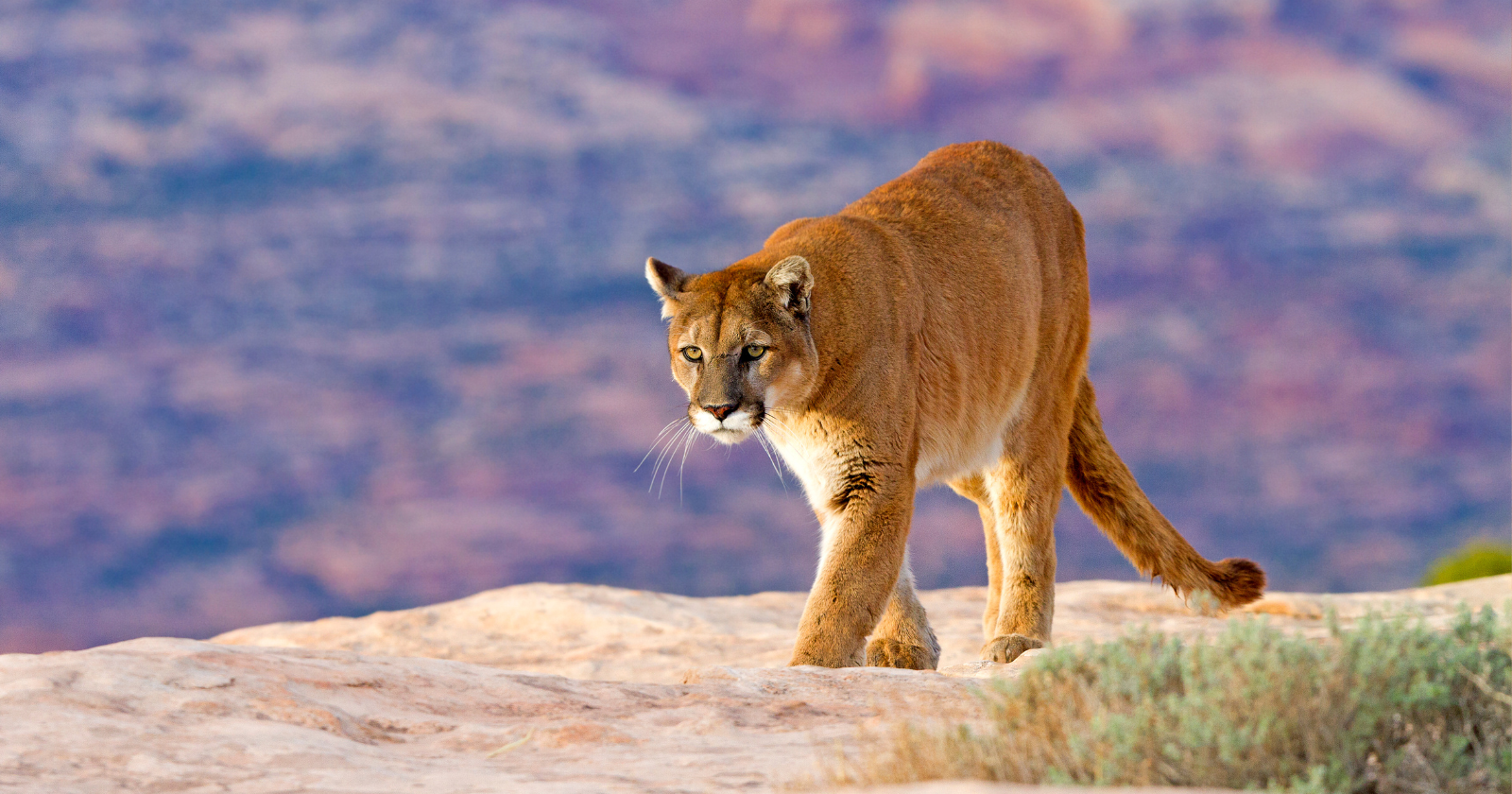
Here’s the thing. Every wildlife biology textbook will tell you that an adult male mountain lion needs somewhere between 150 and 400 square kilometres of territory to survive, because a big cat that size needs a huge patch of ground to find enough deer, find a mate, and stay clear of the other adult males who would happily kill him for encroaching on theirs. Territory is the whole game.
P-22 was collared by the National Park Service in March 2012 in a nine-square-mile patch of hillside called Griffith Park, roughly at the geographic centre of Los Angeles. That is about 23 square kilometres, a fraction of the space any adult male cougar is supposed to need, and he lived there anyway, for more than a decade, largely alone. By doing so, he accidentally became the reason California is now finishing the largest wildlife crossing in the world.
The crossing itself
Nobody quite knows the exact route he took. What is known is that P-22 was born in the Santa Monica Mountains to the west of the city, likely as the son of an adult male the NPS study had labelled P-1, and that somewhere around 2011 or early 2012 he left. He crossed the 405 freeway, one of the most heavily trafficked highways in the world, then made his way across the 101, which cuts through Los Angeles roughly east to west and carries about 300,000 cars a day, and ended up in a patch of chaparral in the middle of the Hollywood Hills, where he stayed.
No other adult male mountain lion in the twenty-year National Park Service study has ever made a comparable trip. Every attempt to cross those freeways that biologists know about has ended in death. P-22 got through both, and biologists still cannot tell you how.
P-22 got a freeway crossing built. The video below is about the predators credited with rewriting an entire national park: 14 wolves released into Yellowstone in 1995, what changed after they arrived, and why ecologists are still fighting over how much of that was really them.
The tiny kingdom
Once he was there, the story got stranger. According to the National Park Service’s official statement on P-22, he persisted for more than ten years in the smallest home range ever recorded for an adult male mountain lion anywhere in the study literature. He hunted deer and coyotes, kept almost entirely to a nocturnal schedule, and wandered occasionally into Los Feliz backyards and Silver Lake streets, sometimes into people’s crawl spaces, but always slipped back into the park before the morning traffic.
The most famous photograph of him, taken by Steve Winter for National Geographic using a remote camera trap, shows him in front of the Hollywood Sign at night. That image did more to change American thinking about urban wildlife than any research paper. Before P-22, mountain lions were something that happened elsewhere. After the photograph, they were something that walked past that same sign at 2 in the morning while you slept.
What he cost, and what he was worth
Look, P-22 was not a mascot. He was a wild cat living an impossible life, and along the way he almost certainly killed a koala at the Los Angeles Zoo, got mange from eating rodents that had eaten rat poison, was found once under a Los Feliz house on a startled homeowner’s Tuesday afternoon, and was captured multiple times over the years for medical treatment.
He also, by simply continuing to exist in the wrong place, became the most powerful piece of environmental advocacy that Southern California had ever produced. The National Wildlife Federation built an entire campaign around him. Beth Pratt of that organisation raised private money that eventually reached about ninety million dollars, most of it anchored by a twenty-five million dollar challenge grant from Wallis Annenberg herself, with state and federal agencies stepping in to add the rest.
The crossing being built now
The Wallis Annenberg Wildlife Crossing broke ground on Earth Day, 22 April 2022, at Liberty Canyon in Agoura Hills, roughly at the point on the 101 freeway that biologists identified back in 1990 as the single most important choke point for reconnecting the Santa Monica Mountains to the rest of the state’s wild country. According to Caltrans’s announcement in June 2025, the first phase of construction is now complete, involving more than twenty-six million pounds of concrete, eighty-two bridge girders, vegetated sound walls, and six thousand cubic yards of living soil, with the second and final phase, extending the crossing over Agoura Road, having begun that same month. Completion is expected in autumn 2026.
When finished, the crossing will span 64 metres over ten lanes of freeway and be planted with more than fifty native species. Berms and hollows built into its design are intended to make the animals using it feel as though they are moving through unbroken chaparral rather than across a piece of infrastructure. It will be the largest wildlife crossing in the world.
What this actually is
P-22 died on 17 December 2022, seven months after the groundbreaking. He was captured after appearing in a Los Feliz backyard, examined by a medical team, and euthanised due to organ failure and injuries consistent with a vehicle strike, at what NPS biologists estimated was around twelve years of age, making him one of the oldest male mountain lions the study has ever tracked.
He did not live to see the crossing finished. He would not have used it. He was too old to make the journey back, and the crossing is being built to help mountain lions on the other side of the 101 avoid becoming him. But every dollar that funded it, every acre of land acquired and permanently protected for the approach ramps, every legal agreement between six different partner agencies, was raised on the back of the story of a single cat who lived alone in Griffith Park for a decade in a territory too small for him. The crossing gets built because he was already there, and because the story of him being there refused to stay small.