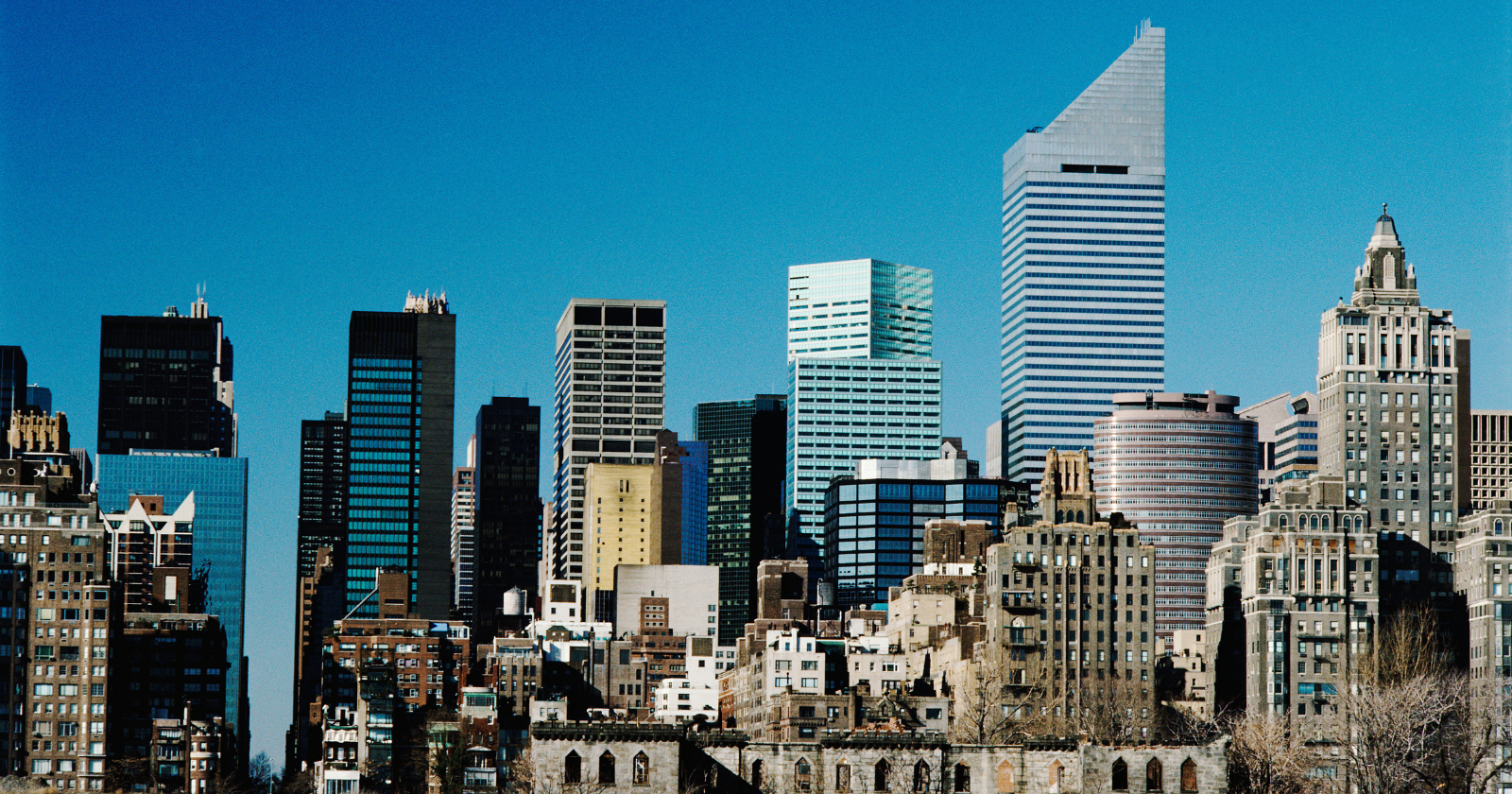
For three months in the late summer of 1978, the brightest thing above Lexington Avenue after midnight was a welding torch.
Beneath it, crews were fixing steel plates across the joints of Manhattan’s newest skyscraper, then clocking off at dawn before the bankers arrived. Staff at Citicorp Center were told the night shifts were routine maintenance. About a dozen people knew it had a measurable annual chance of falling into the streets below.
Why the tower stood on its edges
It started with a church.
St Peter’s Lutheran owned the north-west corner of the block Citicorp wanted, and would only deal if a new church went up on the same spot. Architect Hugh Stubbins and structural engineer William LeMessurier got around it by hoisting a 59-storey tower onto four stilts roughly 114 feet high, placed at the midpoint of each side rather than at the corners. Corners were cantilevered out over the church and the plaza with nothing underneath them.
A frame that light will sway, so LeMessurier hung a counterweight near the roof. In coverage by CNN, the device is a 400-ton concrete block riding on a film of oil, sliding opposite to the building’s motion to cancel the sway. Dampers like it are routine now, and this was among the first. It worked beautifully, and LeMessurier’s career took off.
The phone call
In June 1978, a student rang his Cambridge office with a question about wind.
In LeMessurier’s telling, the caller was a ghost, an unnamed young man whose professor thought the columns were misplaced. What surfaced later is better. Diane Hartley, a Princeton undergraduate writing a senior thesis on the building, had contacted the firm to ask about quartering winds, meaning wind that strikes a building diagonally, at its corners. Lee DeCarolis, a first-year architecture student at the New Jersey Institute of Technology, phoned separately to pass on his lecturer’s doubts. Writing in the Online Ethics Center, DeCarolis says he had no idea anything was wrong and only worked out his own role in 2011, from a book of technological oddities lent to him at work.
New York’s code at the time asked engineers to check wind hitting a square building face on, and the logic held. Most skyscrapers meet diagonal wind at their corners, which are the sturdy part. Citicorp Center had air there.
LeMessurier ran the diagonal case as a classroom exercise. Quartering winds raised the load on some chevron braces by as much as 40 per cent.
The joints nobody mentioned
His safety margins could have absorbed that. What ate them was a decision taken during construction by people doing their jobs properly.
Full-penetration welds had been specified for the joints in the wind bracing. Bethlehem Steel asked to use bolts instead, cheaper and code-compliant, and the firm’s New York office signed it off without telling him. Michael M. Greenburg’s book on the episode, reviewed for the American Society of Civil Engineers, notes the swap would have been unremarkable on a conventional building. Hundreds of joints in this one were now held by bolts sized against a load nobody had calculated.
LeMessurier traced the weakest one to the thirtieth floor. If that joint let go, the rest would unzip.
Weather records finished the picture. Joe Morgenstern’s New Yorker reconstruction of the crisis puts the failure threshold at a storm New York gets roughly every sixteen years, stretching to fifty-five years if the damper is running. Since the damper ran on mains power, and a serious storm is exactly what cuts mains power, sixteen was the number that counted. LeMessurier later wrote that, left alone, the tower would certainly have come down before the century was out.
Three months of night work
Welders started within days, torches lit once the tenants had gone home.
Contingency planning ran alongside: as documented by 99% Invisible, police drew up an evacuation plan covering ten blocks, 2,500 Red Cross volunteers went on standby, and three weather services watched the Atlantic around the clock. Hurricane Ella came up the coast in September and turned away.
Then the luck turned strange. LeMessurier was about to return a call from a New York Times reporter, which would have blown the secret, when he got a recording instead. The Times and most of the city’s other papers had just gone on strike. Welding finished in October, weeks before the presses restarted, and nobody picked the thread back up. Morgenstern broke the story seventeen years later.
What the numbers say now
So was the tower ever really going to fall?
Sejun Park, Dat Duthinh and colleagues at the National Institute of Standards and Technology went back to the question with data and computing power unavailable in 1973. With the original wind tunnel records still proprietary, they modelled a close analogue, and their technical note in the Journal of Structural Engineering found corner winds less punishing than face winds on every measure they took. Writing on NIST’s blog, Duthinh went further: a building safely designed for head-on wind was safe for the diagonal kind, bolts or welds, and the strengthening was never needed. That is one team’s reanalysis rather than a settled verdict, and the paper asks only that the history be looked at again.
None of which travels backwards. In 1978 LeMessurier had wind tunnel results from 1973, a slide rule’s worth of computing and a number that said one in sixteen, and he moved on it. Honesty under pressure is the lesson that gets taught. The more useful one sits earlier in the sequence, when a busy senior engineer decided an undergraduate’s question was worth an afternoon of his time.