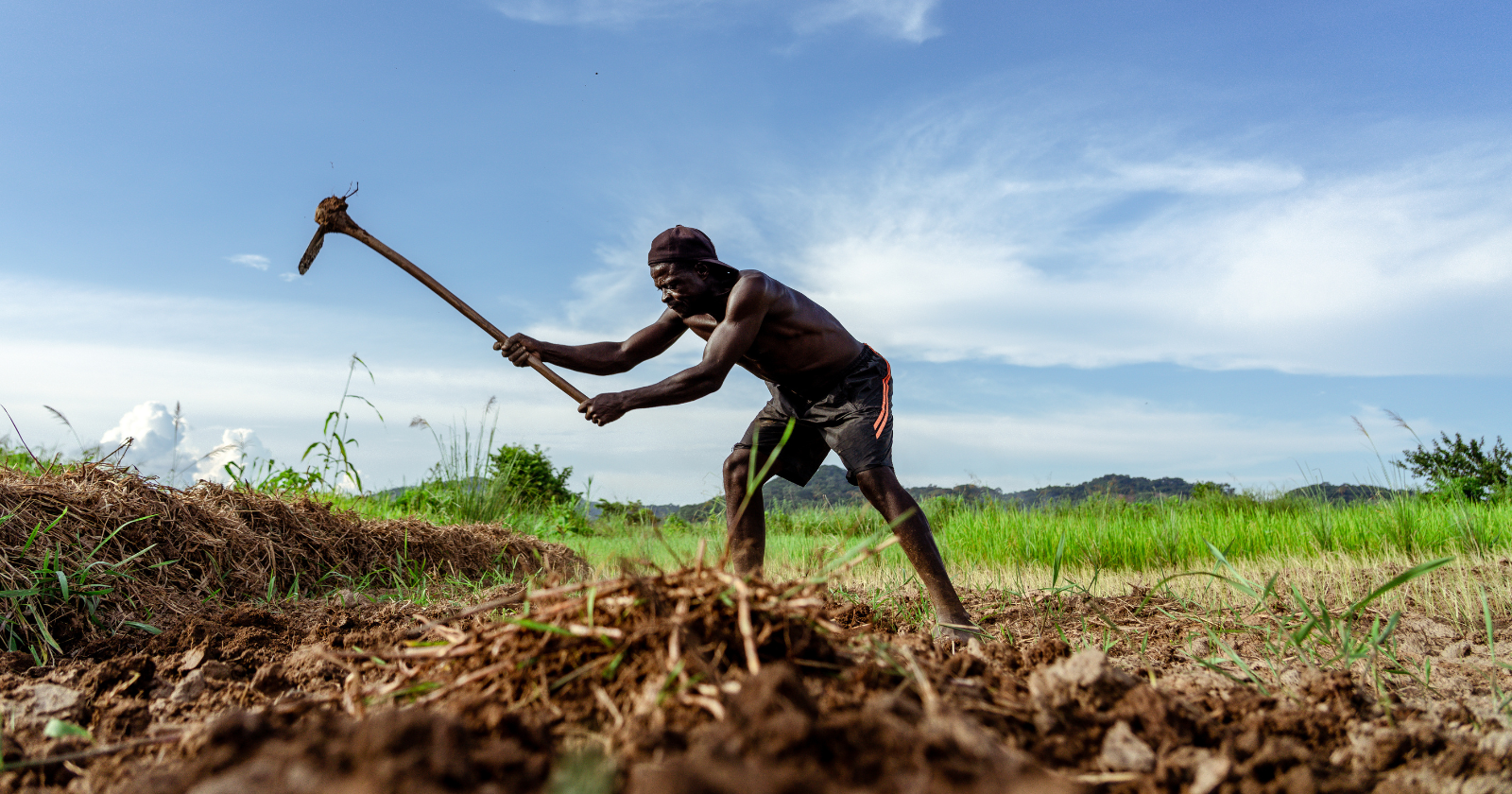
The Sahel is the wide strip of semi-arid grassland that runs across the width of Africa immediately south of the Sahara. It’s dry, exposed, and getting drier. Between 1972 and 1984 the region went through one of the worst prolonged droughts on record. Rainfall in some parts dropped by as much as 80 per cent. The topsoil hardened into a mineralised crust called laterite that essentially nothing could grow through. Hundreds of thousands of people died in the resulting famine, and hundreds of thousands more abandoned the rural areas and moved south into the cities. In one village called Gourga, in the northern Yatenga province of what is now Burkina Faso, most of the population left. An illiterate farmer named Yacouba Sawadogo did the opposite. He moved back to the village from the city, and started experimenting on a piece of land that everyone in the area had written off as dead.
The old technique
What Sawadogo did was pick up a traditional Mossi farming practice called zaï, which had fallen almost entirely out of use in the region. In Mossi the word means “to start early.” The practice involves digging small shallow pits into the surface of the ground and letting them collect rainwater during the growing season. Traditionally these pits had been dug at the start of the rainy season, when the ground was already soft enough to work with a hand tool. Traditionally they had been small. And traditionally they had been used to catch water, nothing else. The classic zaï had never been considered a very effective technique. Farmers who tried it during the 1970s drought had mostly given up on it.
Sawadogo fixed his own fields with a hoe. The video below is the continental version — the Great Green Wall, an 8,000-kilometre barrier of trees eleven countries are planting against the same desert. It covers how much of it actually exists today, why it’s running so far behind what was announced, and which stretches are working.
What he changed
According to the Right Livelihood Foundation’s official profile of Sawadogo, published after they awarded him their 2018 laureate prize (widely known as the “Alternative Nobel”), what Sawadogo did was change almost every part of the process. He started digging his pits during the dry season, months before the rains, when the ground was hardest but the labour could be done at his own pace. He dug them wider and deeper than the traditional design. He filled the bottom of each one with organic material (manure, compost, crop residues) before the rain arrived. And he added stones and rocks along the surrounding surface to slow water runoff and channel it into the pits when the rain finally came. Then he waited.
The organic material at the bottom of the pits attracted termites. The termites, in turn, did something that no shovel could do on that landscape. They tunnelled down into and through the hardpan crust below the pit, breaking the sealed mineral layer that had made the topsoil functionally impermeable. Once the termites had done their work, water could actually penetrate the soil profile rather than running off it, roots could reach downwards through the tunnels the insects had opened up, and nutrients from the composting organic material could work their way into the wider soil matrix. When the rain arrived, Sawadogo planted millet, sorghum, and maize seeds directly into the prepared pits. The seedlings grew.
The forest
Over the following decade Sawadogo repeated the process across the piece of degraded land he had inherited. He added tree seeds to the pits alongside the food crops. He built stone bunds to catch runoff on the sloping ground. He put out water pots for birds, who arrived and delivered further seeds from further afield. According to the United Nations Environment Programme’s profile of Sawadogo, published after they awarded him their 2020 Champions of the Earth prize for Inspiration and Action, over the course of forty years his methods produced a 40-hectare forest of more than 60 tree and bush species on what had been considered permanently ruined land. Yields on his cultivated pits ran between 100 and 500 per cent higher than yields on ordinary local fields. Groundwater in some nearby villages rose by 5 to 17 metres as the restored ground absorbed water it had previously been shedding.
How it spread
The neighbours who had called him a madman gradually came round. In 1984 Sawadogo began organising twice-yearly “zaï markets” on his land, where farmers from other villages could come and exchange seed varieties and observe the technique in practice. Attendance grew from small numbers to representatives from over a hundred villages per market day. In 1989 thirteen farmers from Niger’s Tahoua region visited his site and took the method home with them. The 1990 drought hit shortly after their return, and only the farmers who had adopted zaï managed a reasonable harvest, which converted the neighbouring holdouts within a single season. From there the technique radiated outward, eventually reaching farmers across a 6,000-kilometre stretch of Africa including Ghana, Chad, Mali, Kenya, and much of the wider Sahel. In Sawadogo’s own home region, roughly 95 per cent of farmers now practise some form of zaï.
Why it matters
Sawadogo died in December 2023 at the age of 77. His work is now formally integrated into the Great Green Wall, the pan-African programme to reforest a broad band across the southern Sahara. Inger Andersen, executive director of UNEP, described him at the 2020 award ceremony as “a pioneer who would not let people’s skepticism deter him from finding a solution to the challenges in his community.” The wider lesson of the case is that at least some of the tools for climate adaptation in the world’s most vulnerable regions already existed, in local knowledge that had been forgotten or dismissed, waiting for someone to reintroduce them. The tools happened to be pits, manure, termites, and patience. And the person who reintroduced them couldn’t read.