

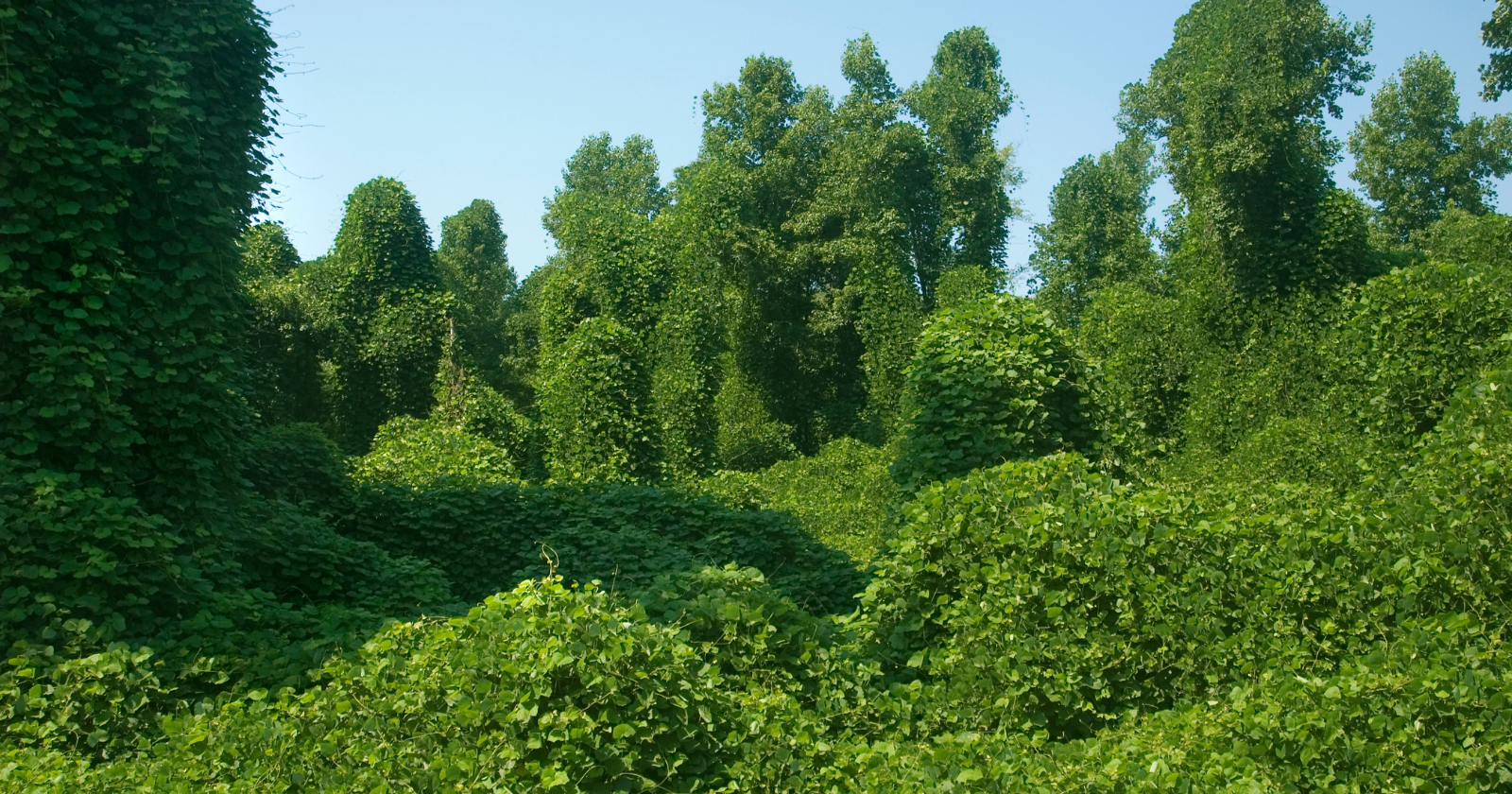
Drive any Southern highway in July and you’ll see it. Green sheets thrown over telephone poles, over dead trees, over whole hillsides, smoothing every hard edge into the same rolling shape.
That’s Kudzu; the vine that ate the South.
Ask many people how much of the region it covers and you’ll hear big numbers. It’s one of the most repeated environmental stories in America. And on the numbers, its often wrong.
The origin is true. The vine really came from Asia, the federal government really pushed it as a fix for eroding farmland, and by 1946 farmers really had planted it across roughly three million acres. What’s shaky is the ending everyone tells, the part where kudzu keeps swallowing everything in sight. Put the legend next to the field data and the two pictures barely match.
How the legend was built
Kudzu arrived as a decoration. It showed up at the 1876 Centennial Exposition in Philadelphia as an ornamental from Japan, a shade plant for porches. For decades it did nothing much. Then the Dust Bowl made soil erosion a national emergency, and the newly formed Soil Conservation Service went looking for anything with roots that could hold a hillside together.
Kudzu fit the brief. In the 1930s and 1940s the Soil Conservation Service grew 70 million seedlings, then paid farmers as eight dollars an acre to plant the vine. Atlanta Constitution columnist and radio host Channing Cope became its loudest believer, leading the Kudzu Club of America and telling readers the vine would make Southern farms “live again.” At its peak the club claimed 20,000 members.
By 1946, roughly three million acres had gone in across the Southeast. However, the vine meant to save Southern farming turned out to be a poor pasture crop and a nuisance in fields. The hero story flipped into the villain story, and the villain version is the one that stuck.
What the sampling actually finds
This is where the legend and the data part ways.
Using U.S. Forest Service sampling, the naturalist Bill Finch put kudzu’s forest footprint at about 227,000 acres. Set that against the seven-million figure people often repeat and the gap is enormous.
This is one careful accounting, built on Forest Service survey plots rather than a fresh census of every roadside. Read it as a serious correction to a wild number, not the last word on the plant. The direction is clear, and the spread rate gets the same treatment. Popular media has long claimed kudzu was swallowing 150,000 new acres every year. The Forest Service estimate has it growing at 2,521 acres a year.
Kudzu isn’t even the South’s worst invader by area. On the same sampling, Asian privet covers about 3.2 million acres, roughly fourteen times kudzu’s territory, and invasive roses take up more than three times as much ground as the vine. Neither has anything like kudzu’s reputation.
Why the two pictures diverge
So how does a plant covering a tenth of a percent of the forest become the vine that ate a region?
The answer seems to be where it grows, and how you tend to see it.
Kudzu is a sun plant. As Bill Finch argues, the vine is most aggressive along roads, railways, and forest edges, and it doesn’t reach far past those bright, sunny strips. Those are tendencies, not iron laws, but they explain a lot. The vine thrives exactly where a highway cuts a bright, disturbed strip through the trees.
Which means it grows in the one place you’re guaranteed to be looking: the roadside. Because kudzu is so hyper-visible in the age of the automobile, a thin green ribbon draped over the trees at the edge of the woods reads as a solid takeover of everything behind it. Drive past enough of those ribbons and you’ve convinced yourself the whole South is buried.
It has been called a good poster child for invasive plants precisely because it’s so easy to spot. The same trait that made kudzu a legend, its knack for showing off along every highway, is what makes it a poor measure of what invasive plants are really doing to Southern forests.
What the comparison leaves us with
None of this makes kudzu harmless. It’s a genuine invasive, it does smother what it climbs on, and where it takes hold it’s miserable to remove. Nobody sampling the forest is telling landowners to relax.
The correction is narrower than that: the plant is real, the seven-million-acre menace is not, and the two have been confused for the better part of a century.
What strikes us is the size of the gap between the two pictures. On one side, a green tide swallowing a region, growing faster than anyone can cut it. On the other, a plant hugging the sunny edges of a small slice of the forest, outdone many times over by a privet nobody has heard of. The image out the car window won, and it kept winning long after the numbers stopped backing it up. A good enough story, it turns out, can spread faster than the thing it describes.