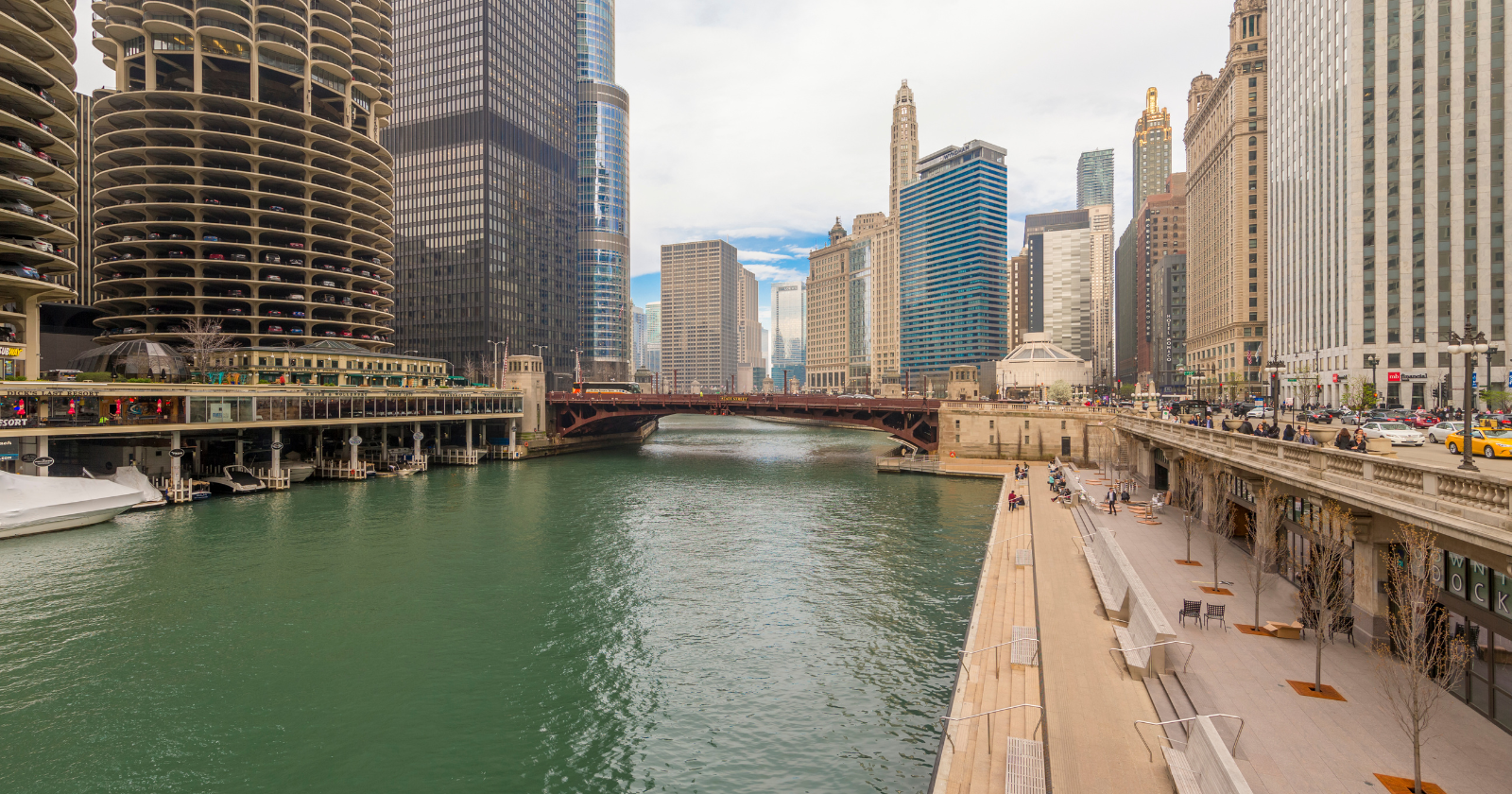
In the first days of 1900, a work crew pulled the last dam out of a ditch outside Chicago and a river quietly changed its mind.
No ribbon, no brass band, no mayor with a shovel.
The Chicago Sanitary and Ship Canal began filling on 2 January, a date chosen partly because Missouri’s attorney general was getting ready to ask a court to stop it. Water moved west. By the time the paperwork caught up, the Chicago River was running away from Lake Michigan, which was the entire point.
Why the river had to turn around
Chicago had built itself a closed loop of the worst kind. Drinking water came from intake cribs out in the lake. Sewage went into the Chicago River, and the Chicago River went into the lake. Big storms shortened the distance between those two ends of the arrangement, and typhoid, cholera and dysentery did the rest.
Illinois set up the Sanitary District of Chicago in 1889 to deal with it, and the fix it landed on was enormous: cut through the low ridge that separates the Lake Michigan basin from the Mississippi basin, then let lake water flow west and drag the city’s waste along with it. The American Society of Civil Engineers, which lists the reversal of the Chicago River among its historic engineering landmarks, records a finished channel 31 miles long and 26 feet deep, built for more than $70 million. Machines and earthmoving methods invented on that job later went to Panama.
Missouri sued that same month
St Louis took its drinking water from the Mississippi, downstream of where the Illinois River joins it. Chicago’s new plumbing pointed the city’s sewage in exactly that direction.
Missouri filed a bill of complaint in the US Supreme Court in January 1900, the same month the canal began filling, naming both Illinois and the Sanitary District and asking for an injunction. Illinois demurred in March, arguing that the court had no business refereeing a quarrel between states about a drainage ditch. In its 1901 ruling in Missouri v. Illinois, the court disagreed and ordered Illinois to answer the complaint.
How Missouri tried to prove the harm
Proving it was the hard part.
Nobody expected to fish a typhoid bacillus out of the Mississippi and hold it up as evidence, so Missouri’s experts ran a tracer experiment instead. They tipped 107 barrels of Bacillus prodigiosus, a red organism almost unknown in those waters, into the drainage canal and watched for it downstream.
Justice Oliver Wendell Holmes was unmoved. Writing for the court in the 1906 decision, he walked through the 357-mile journey, transit times of roughly eight to eighteen days, and two sets of experts who flatly disagreed about whether a typhoid bacterium could survive the trip. He also noted that Missouri towns were tipping their own sewage into the same river, and that a win for Missouri would invite a near-identical suit from whichever state sat further downstream. The bill was dismissed.
What the canal actually fixed
Chicago’s side of the ledger reads better. A National Bureau of Economic Research study of public health interventions in 25 American cities records Chicago closing its last lake-facing sewer outfalls by 1907, chlorinating its water supply from 1912, and tightening milk safety standards around the same time, on top of the canal’s earlier reversal. No single measure did it alone, and untangling how much credit belongs to the canal versus the rest is its own unsolved argument.
The ditch is still an argument
Cutting a permanent door between two continental watersheds turned out to have consequences nobody costed. Invasive carp have worked their way up the Mississippi and the Illinois River, and the canal is the one year-round route left into Lake Michigan.
So the US Army Corps of Engineers is now assembling a layered barrier of electric fields, sound, bubble curtains and a flushing lock at Brandon Road Lock and Dam near Joliet, on the same waterway. It carries a $1.15 billion price tag and a schedule already dented by a federal stop-work order, which ran from late July until the Corps lifted it in early September, a restart confirmed in a statement from Ohio congressman Dave Joyce.
Nobody digging that channel in the 1890s was thinking about fish. They had a city to stop from poisoning itself, and one river they were willing to spend.