

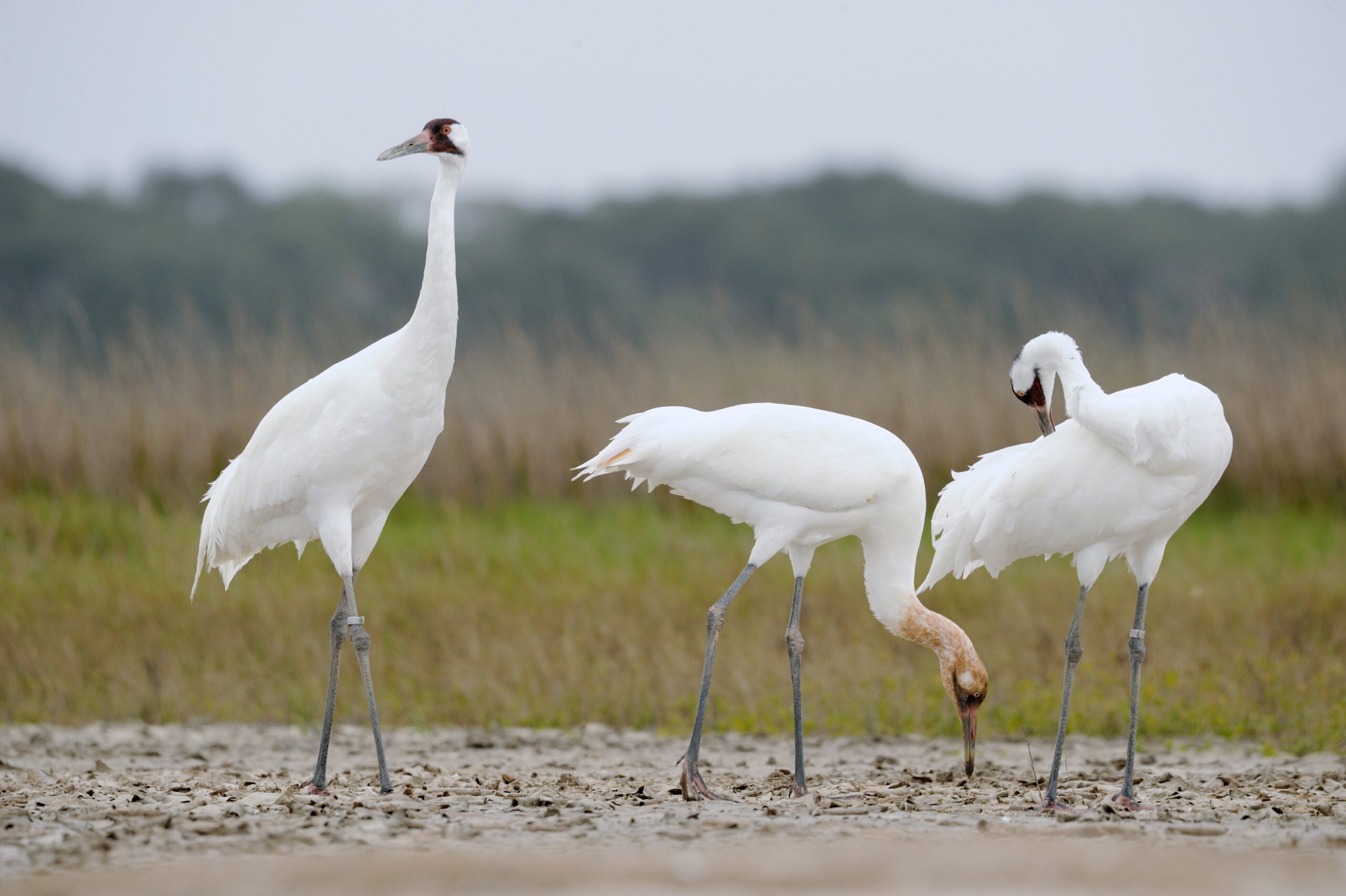
Fourteen adult whooping cranes wintered on the Texas coast in 1941. In the winter of 2024–2025, biologists flying the marshes and tidal flats around Aransas National Wildlife Refuge estimated 557 of them, including at least 41 tawny juveniles, according to the U.S. Fish and Wildlife Service’s survey announcement. The agency’s 2024–2025 whooping crane status report gives the estimate as including 193 adult pairs. It was the first time the agency had estimated the Aransas–Wood Buffalo population above 550 individuals.
The number is an estimate, not a hand tally. Whooping cranes are five feet tall and white enough to read against green cordgrass from a thousand feet up, but they move, they hide behind live oak motts, and no aerial pass catches every bird in every acre. What the Service publishes is a statistical estimate with uncertainty attached, and the 2024–2025 figure of 557 carries a 95% confidence interval of 478.7 to 645.1 birds, with a coefficient of variation of 0.137.
What the January flights measured
The survey work happened in a narrow window. Crews flew a Quest Kodiak over roughly 170,500 acres of primary survey area six separate times between January 22 and January 31, 2025, then covered about 85,250 acres of secondary area twice on February 1 and 2. The underlying Butler et al. survey report says abundance was estimated from the aerial surveys using hierarchical distance sampling, with the confidence interval expressing the uncertainty around that estimate rather than a simple difference between repeated passes.
Inside that estimate, the age and pairing structure matters as much as the total. The survey put the population at 193 adult pairs, with a 95% confidence interval of 167.5 to 221.4, and at least 41 juveniles, birds hatched in summer 2024 and still carrying rusty cinnamon feathering across the head and neck. Recruitment worked out to 8.1 chicks per 100 adults, with an interval of 6.3 to 10.5. Juveniles are the part of the count that cannot simply be carried over from an earlier winter estimate. Each one is a bird that hatched, fledged, and completed a first southbound migration.
The Canadian Wildlife Service reported at least 33 chicks fledged on the northern breeding grounds in summer 2024. The winter estimate of 41 juveniles sits above that. The joint status report says the discrepancy is likely caused by differences in survey methodology and detectability of young between the breeding-ground and wintering-ground surveys; the Butler report also notes that juvenile plumage can become less distinct by late January.
From 14 adults to a 4.33% climb
The 1941 low is the baseline against which the recovery is often described. Service biologist Matthew Butler, lead author on the survey, makes the point plainly in the agency’s announcement: today’s whooping cranes descend from the 14 adults that remained on the Texas coast that year. The species had been reduced to a single wild migratory flock wintering on a strip of Gulf coast marsh, with its northern breeding grounds not identified until later.
Those breeding grounds were in and around Wood Buffalo National Park, roughly 2,500 miles north in Canada. The Aransas–Wood Buffalo flock makes that roughly 2,500-mile migration twice each year, north toward the nesting grounds and south toward the Texas coast, threading the Central Flyway through the Great Plains.
Measured from the winter of 1938–1939 to the winter of 2024–2025, the population has grown at an average rate of 4.33% per year. That figure summarizes the long recovery record; it is an average across eight decades, not a claim that the flock grew at exactly 4.33% every year. Kevin McAbee, the Service’s Whooping Crane Recovery Coordinator, credits the long climb in the announcement to decades of cooperative work across the flyway rather than to any single intervention.
Beyond the survey box
Cranes do not restrict themselves to the polygons drawn on a survey map. During the 2024–2025 effort, observers documented 68 additional whooping cranes outside the designated primary survey area. Those birds are not simply added to 557, and the Service is careful about why. Some may represent birds not otherwise counted; some may have moved in and out of the survey boundary. The overlap is unknown, which is exactly the reason the 68 stays separate from the primary-area estimate.
What the beyond-area observations do suggest is that wintering whooping cranes are using ground beyond the refuge core, a pattern the Service has tracked as the population has grown. The annual survey itself is a cooperative operation, drawing on the Fish and Wildlife Service’s National Wildlife Refuge System Region 2, the Migratory Bird Program and Ecological Services, the Guadalupe-Blanco River Authority in Texas, and the Canadian Wildlife Service.
The recovery record still runs through a very narrow gate. Every one of the estimated 557 birds in the primary survey area in winter 2024–2025, every one of the 193 adult pairs, and every one of the at least 41 juveniles counted after arriving from Wood Buffalo traces back to the tiny remnant flock represented by those 14 adults on the Texas coast in 1941. Eight decades later, the same wild migratory population was being measured again from the air, with six passes over 170,500 acres between January 22 and January 31, 2025.