

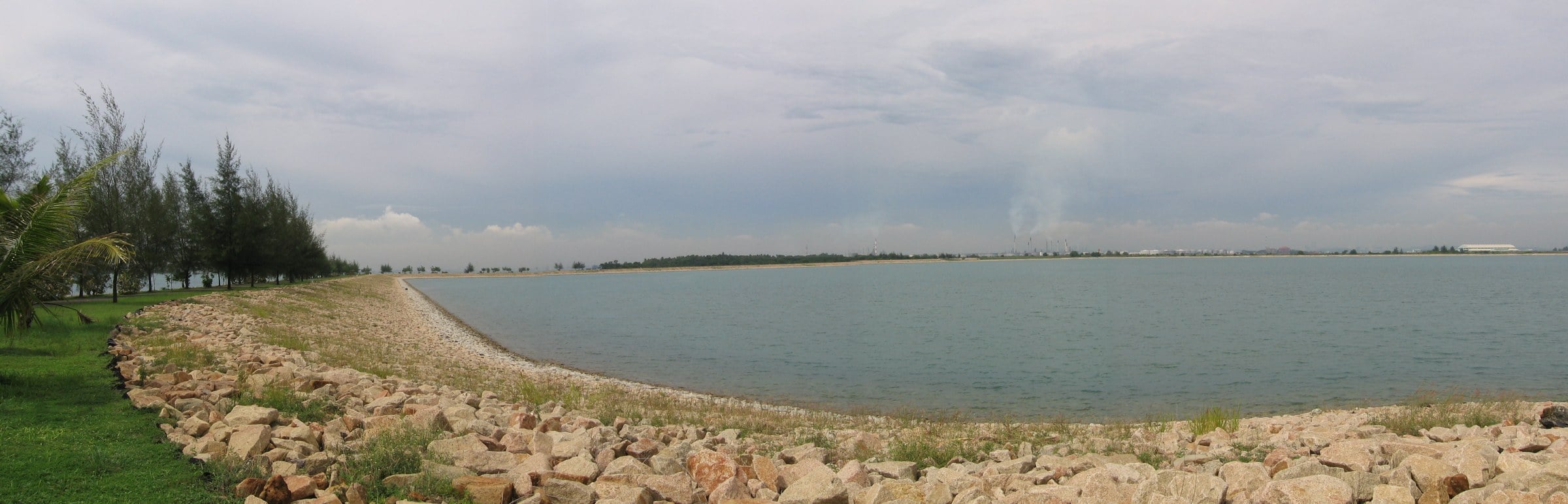
On 1 April 1999, Singapore opened a landfill that sits in the sea. Two islands roughly 8 kilometers south of the main island, Pulau Semakau and Pulau Sakeng, were joined by a 7-kilometer perimeter rock bund that enclosed about 350 hectares of the water between them, according to the National Environment Agency’s Semakau Landfill page. That enclosure became Phase I, with a landfill capacity of 13.6 million cubic meters. Sixteen years later, on 11 July 2015, Phase II opened inside the same bunded space, adding 14.5 million cubic meters and bringing the total to about 28 million cubic meters, per NEA’s factsheet marking 20 years of Semakau Landfill.
The arithmetic is the story: a seawall first, then the volume it defends, counted twice.
The bund came before the waste
Semakau did not begin as a pit dug into land, because Singapore does not have the land. It began as a wall. The rock bund traces a 7-kilometer perimeter around and between the two islands, and the sea it enclosed, roughly 350 hectares, became the working volume. NEA describes the bund as lined with an impermeable membrane and a layer of marine clay, so that leachate, the liquid that percolates through deposited material, stays inside the enclosure rather than moving into the surrounding strait.
That lining is the whole engineering argument. A landfill on land relies on depth, compaction, and a liner beneath it. An offshore landfill relies on a continuous barrier standing in seawater, holding a hydraulic boundary in both directions, and doing so for decades while material is added on the inside. NEA’s 20-year factsheet notes Semakau as the first man-made offshore landfill in the region, a careful phrasing worth keeping as written.
Phase I held 13.6 million cubic meters. What fills it is not household bags. Incineration ash and non-incinerable waste are barged out from the Tuas Marine Transfer Station, unloaded, and placed into cells within the enclosure. When a cell is filled, it is covered and greened, which is why aerial images of Semakau show grass and scrub where volume has already been consumed. The landfill grows sideways and upward inside its own wall, cell by cell, rather than outward into new water.
NEA’s annex material puts Phase I construction at about $610 million in 1999, a figure worth attributing rather than leading on, since the interesting number here is cubic meters, not dollars.
Phase II, and the corals that were moved first
Phase II opened on 11 July 2015, announced by NEA as ready for use. The 20-year factsheet gives Phase II a capacity of 14.5 million cubic meters, which added to Phase I’s 13.6 million yields roughly 28 million cubic meters in total. NEA’s 2015 release cited a larger additional figure; the agency’s later 20-year accounting is the cleaner arithmetic to carry, and it is the one used here.
Phase II differs from Phase I in method as much as in volume. Rather than subdividing the remaining lagoon with more internal bunds and filling compartments one at a time, the design opened up the remaining space, which reduced the amount of new construction required. NEA’s annex places Phase II cost at about $36 million, roughly a sixteenth of Phase I, a ratio that reflects how much of the hard infrastructure was already standing from 1999.
Before the fill could proceed, the biology inside the lagoon had to be dealt with. Between September 2014 and January 2015, NEA reports that over 700 coral colonies were harvested from the Phase II area and transplanted to the Sisters’ Islands Marine Park. Those colonies spanned 42 hard-coral genera and represented about 60 square meters of live coral cover. That is a small area by reef standards and a substantial one by transplant standards; moving hundreds of individual colonies is diver work done colony by colony, with each piece detached, transported, and secured at the receiving site.
What 28 million cubic meters does not settle
Capacity is a stock, not a plan. NEA’s public material has framed Semakau’s remaining life against projections, but a projected fill year is a forecast that moves with waste volumes, recycling rates, and incineration efficiency, and it is not a fact about the island. The facts about the island are the bund, the lining, the cells, and the counted volume.
The mitigation record predates Phase II. During Phase I construction, about 13.6 hectares of mangroves were replanted, according to NEA, a response to the mangrove stands affected when the bund was built and the islands joined. Mangrove replanting and coral transplanting are different kinds of intervention, one a habitat rebuilt in place, the other a population relocated, but both are entries in the same ledger: the cost side of enclosing 350 hectares of sea.
Containment is also not a one-time act. An impermeable membrane backed by marine clay is a system that has to keep performing while the mass behind it grows and while seawater works at it from outside. Monitoring of water quality around the enclosure, maintenance of the bund itself, and the sequencing of cell closure and cover are ongoing operational work rather than finished construction. Semakau’s biodiversity, including the reef flats and seagrass outside the bund, is frequently cited in NEA’s own materials, which makes the boundary condition unusually visible: the wall is the difference between a landfill and a strait.
The physical deed stands on its own terms. A 7-kilometer rock bund enclosed about 350 hectares of sea in 1999. Phase I gave 13.6 million cubic meters; Phase II, opened 11 July 2015, gave 14.5 million more, for about 28 million cubic meters in total. Over 700 coral colonies were lifted out and resettled at Sisters’ Islands Marine Park before the second phase filled. It remains Singapore’s only landfill.