

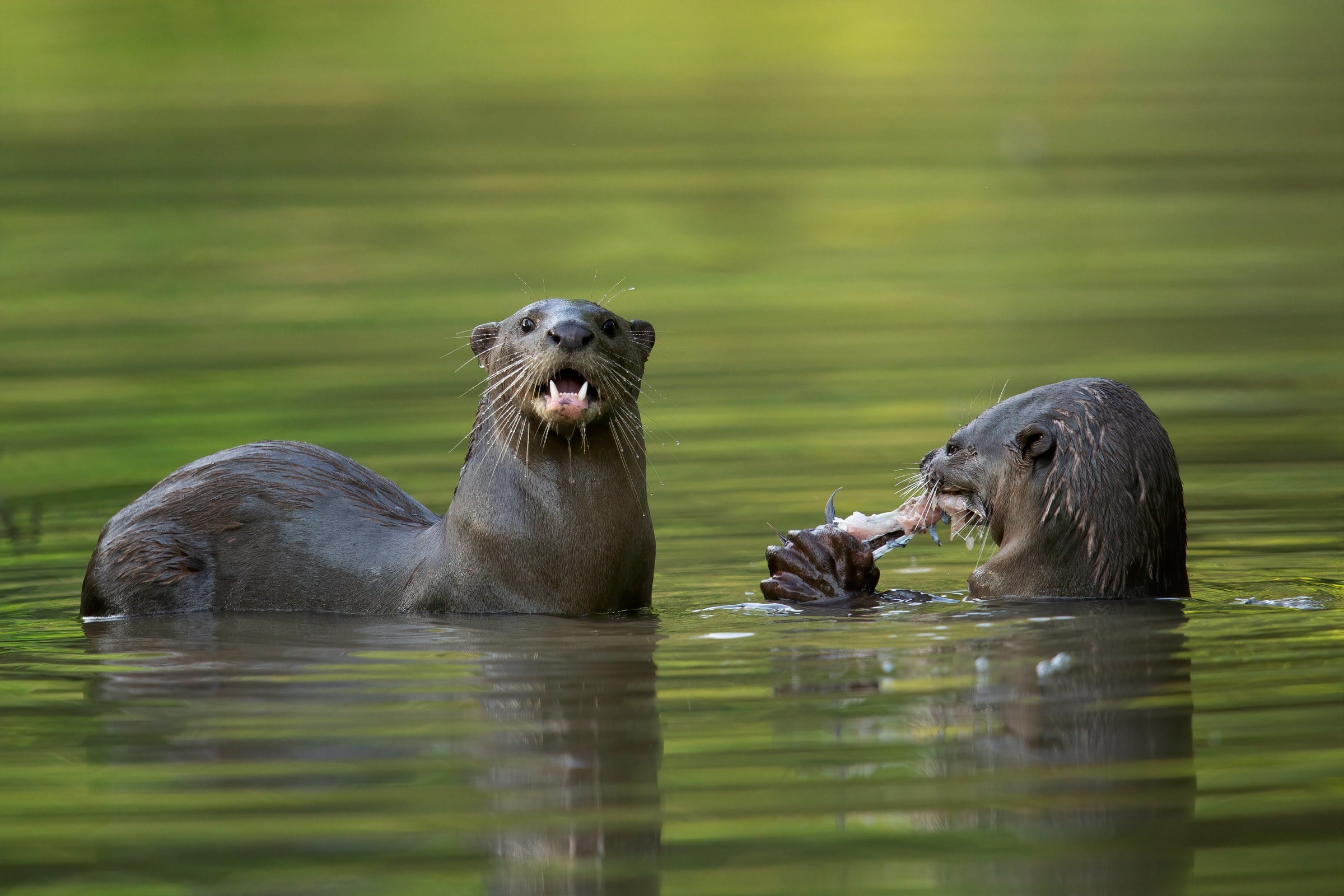
A resident pair of smooth-coated otters holding a stretch of tidal mangrove at Sungei Buloh in 1998 is the starting line for Singapore’s documented resident population. By early 2021, researchers had located a minimum of 17 groups and 170 individuals of the same species, with groups ranging from 2 to 24 animals, according to Shivram et al. in the Journal of Mammalogy. The midpoint of that climb is itself a published floor: a survey running from August 2016 to January 2017 documented at least 79 individuals in 11 groups, reported by Khoo and Sivasothi in the IUCN Otter Specialist Group Bulletin. Two animals at Sungei Buloh in 1998, then at least 79 across Singapore by early 2017, then at least 170 by early 2021.
That word “minimum” matters more than the headline arithmetic. The 2016 to 2017 work combined land and boat surveys, camera traps and verified observational records, while the 2020 to 2021 study drew on otter-watchers, photographic and video evidence, field surveys and verified social-media sightings. Both approaches were deliberately conservative about which groups and individuals entered the final totals. What the numbers document with confidence is direction, and the direction through early 2021 was up.
The empty decades, and a pair that came back
Singapore has two native otter species. Theng and Sivasothi, reviewing the historical record in the IUCN Otter Specialist Group Bulletin, found no verified records of either species in the 1970s and 1980s, while sightings of individual smooth-coated otters began to re-emerge in the early to mid-1990s. Those decades also coincided with intensive coastal development: Singapore’s coastline was heavily reclaimed, major river mouths were sealed to form reservoirs, and much of the original mangrove habitat had already disappeared.
Then, in 1998, a pair of smooth-coated otters, Lutrogale perspicillata, re-established themselves at Sungei Buloh Wetland Reserve in the island’s northwest mangroves. Shivram et al. describe the species as transient in Singapore before one resident family group was observed in 1998, “presumably having recolonized from Peninsular Malaysia.” That qualifier matters. The literature presents recolonization from Peninsular Malaysia as the likely explanation; it does not document the animals’ crossing directly.
Breeding followed quickly. Theng and Sivasothi record pups or sub-adults at Sungei Buloh in every year from 1999 through 2003, evidence that the reserve was hosting an established breeding population rather than occasional visitors. A resident pair is one observation. Repeated records of young animals across successive years show something more durable taking hold.
Eleven groups, 79 animals, and the move into the canals
The August 2016 to January 2017 survey is the moment the recovery acquired a structure that could be checked. Khoo and Sivasothi reported at least 79 smooth-coated otters distributed across 11 groups, with an average group size of 7.2 and a range from 2 to 14 animals. The age breakdown is the part worth sitting with: 46 adults, 21 sub-adults and 12 pups. That is not a remnant assemblage of survivors aging out. It is a population containing adults, younger animals and pups.
The geography had changed too. These otters were no longer confined to northwest mangroves. The survey recorded them using mangroves, coasts, reservoirs, rivers and canals, which is to say much of the engineered hydrology of a dense city. The authors describe smooth-coated otters in Singapore as urban adapters, surviving and reproducing while using heavily modified environments. Their records even extended into highly urban sites such as Gardens by the Bay.
Adaptability of that kind is not free. Moving through a city sometimes means leaving the water, and that brings otters into contact with roads and other infrastructure.
Seventeen groups by 2021, and the edits a road makes
By early 2021, Shivram et al. put the minimum at 17 groups and 170 individuals, with group sizes spanning 2 to 24. Compared with the 2016 to 2017 floor, that is six more groups and at least 91 more animals, while the upper end of recorded group size had also grown substantially. Both census figures remain conservative floors rather than claims that every otter in Singapore had been found.
The same work identifies vehicle collisions as the leading recorded cause of mortality during the study period. Of 35 reported deaths from January 2019 to August 2021, 17 were classified as roadkill, and vehicle collisions accounted for 14 of the 27 carcasses for which a cause of death could be verified. Several roadkills occurred where roads crossed or ran beside waterways, including two at Yishun Dam, a barrage separating the coast from an inland reservoir.
The peer-reviewed record establishes the population trajectory through early 2021, but counting did not stop there. Singapore conducted a third smooth-coated otter census in 2024. In February 2026, CNA reported that the census was undergoing scientific review. Until those results are formally available, the 170 animals in 17 groups remains the most clearly published nationwide census figure from the studies cited here.
The rebound does not resolve the problems that come with sharing a dense city. Otter groups still enter managed ponds and landscaped waterfronts, while road mortality remains a threat to animals moving between habitats. And even a sharp rise from the numbers documented in 2017 does not turn 170 animals into an enormous population. The significance lies in the trajectory and in the persistence of family groups across an intensely urbanized landscape.
The persistence is the finding. A pair at Sungei Buloh in 1998, pups or sub-adults recorded there year after year from 1999 through 2003, a documented minimum of 79 animals across 11 groups by early 2017, and a documented minimum of 170 across 17 groups by early 2021. The literature describes the 1998 residents as a probable natural recolonization from Peninsular Malaysia, followed by a population that spread into mangroves, reservoirs, canals and urban waterways. What happens next depends partly on the same roads, dams and shared waterfronts that now sit inside the otters’ range.