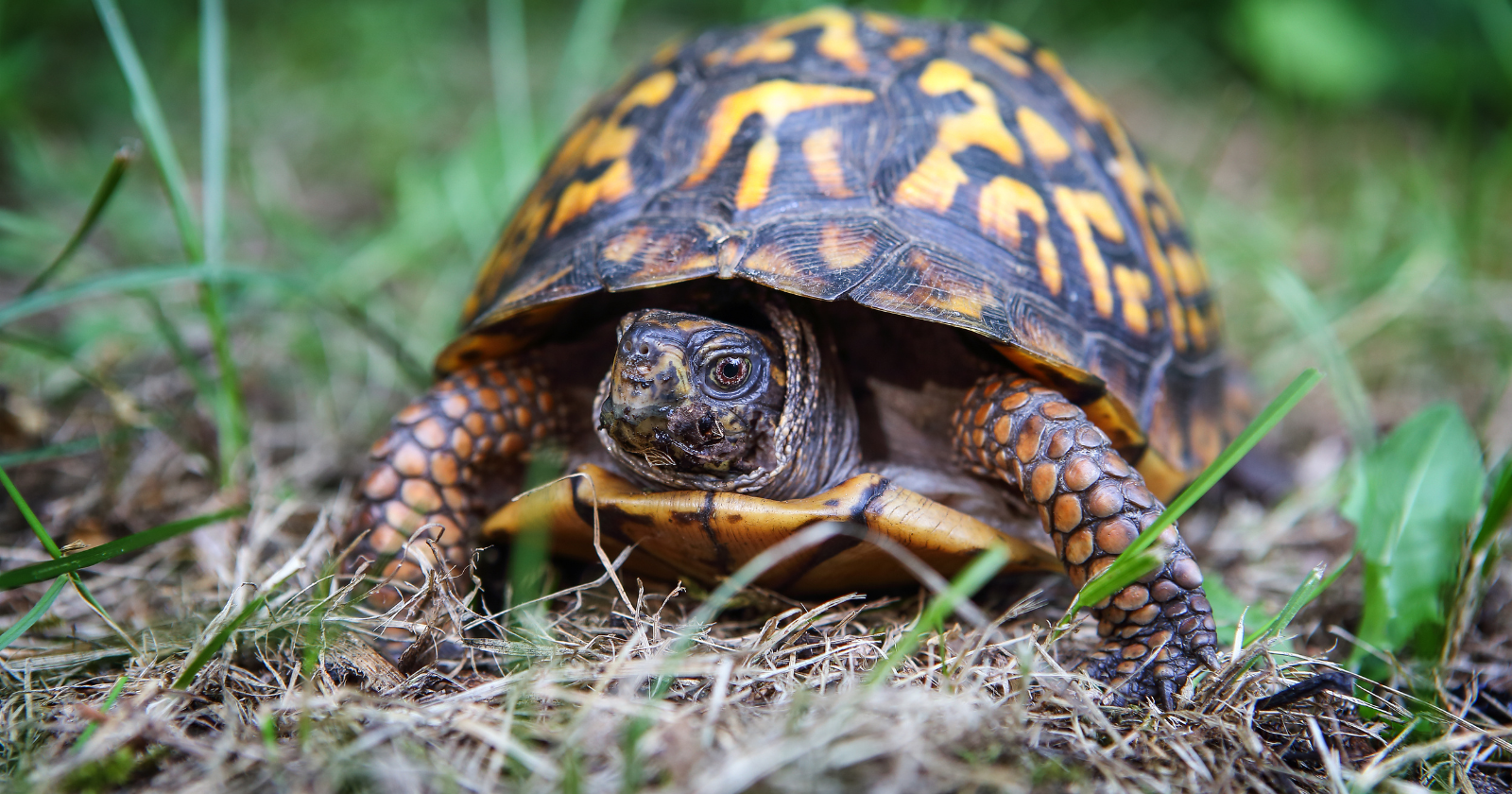
Pedro went over the fence and stayed gone for months, and when he finally turned up at the back door he was one leg lighter than when he left.
He had been adopted as a three-legged box turtle in the first place. According to CNN, which interviewed the vet school’s Ginger Guttner, nobody ever pinned down exactly how he lost the fourth leg while he was gone.
By the time she brought him to the Veterinary Teaching Hospital at Louisiana State University, the wound had closed on its own. Nothing else was wrong with him.
Wheels won out over 3-D printing
Kelly Rockwell, the zoological medicine intern who took the case, first raised the problem with Mark Mitchell, the clinician on duty that week. As WAFB reported, the pair weighed up 3-D printing a prosthetic before deciding that wheels made more sense for a turtle who was going to live indoors from then on.
How the rig went together
A Lego car kit supplied the wheels, but the stock axles were too short for Pedro’s body. Rockwell and Sarah Mercer, a fourth-year veterinary student, cut down syringe cases and glued them onto the axles to extend them to size, as documented by Today’s Veterinary Nurse. A flat Lego plate was glued to the underside of the shell with animal-safe epoxy, the same stuff farriers use on horseshoes, WBRZ in Baton Rouge reported. The whole rig snaps off again so he can be washed.
Rockwell said plastic bricks won out for one simple reason: they weigh next to nothing, which matters when an animal has to drag its own prosthetic around. She said the hardest part was sizing the thing, and that once the design existed it was easy to fit. Within minutes of being set down, Pedro was reversing and turning.
Baltimore had already tried it
The previous year, a zoo employee in Baltimore picked up a wild eastern box turtle in Druid Hill Park with the plastron, the flat lower half of the shell, broken in several places. Garrett Fraess, then a veterinary extern at the Maryland Zoo, told WCVM Today, the University of Saskatchewan’s veterinary publication, that the repaired shell had to be held clear of the ground while it knitted, and that nobody manufactures a wheelchair that small. So he sketched one and sent the drawings to a friend in Denmark who collected Lego. Plumber’s putty held the finished frame on.
Ellen Bronson, the zoo’s senior director of animal health, said in the same piece that reptiles mend far more slowly than mammals and birds because their metabolism runs slower. That turtle was expected to need its frame through the winter and into spring.
Why a box turtle can absorb this
Losing both hind legs would finish most animals. Box turtles are unusually well set up to survive it. They are ectotherms with modest energy budgets, they forage slowly over small patches of ground, and a hinge in the plastron lets them shut themselves away when something threatens, a defence that has nothing to do with running away.
They also know exactly where home is. The Maine Department of Inland Fisheries and Wildlife collects the older research on this in its species assessment. A 1939 study recorded close to 90 per cent of adults returning to their home range after being carried up to 1,200 metres away. A 1957 experiment had half of them heading in the right direction the moment they were released, from as far as nine kilometres out. Geomagnetic and solar cues are thought to play a part.
Those are small, decades-old studies and a long way from settled consensus, though they match what field biologists keep reporting about the species. They also explain how Pedro got himself home.
He knew the address.
Improvising is most of the job
Guttner made the same broader point to CNN: patients in her building range from two grams to nearly a tonne, and most of the specialised equipment they use has been built or rebuilt for one particular animal.
What Rockwell hoped for was modest. She said she wanted the case to push vets who rarely handle reptiles toward being a bit more creative. Two hours, a toy kit and a few cut-down syringe cases got a turtle moving again. The next clinician who runs into the same problem gets to start from a written-down answer.