

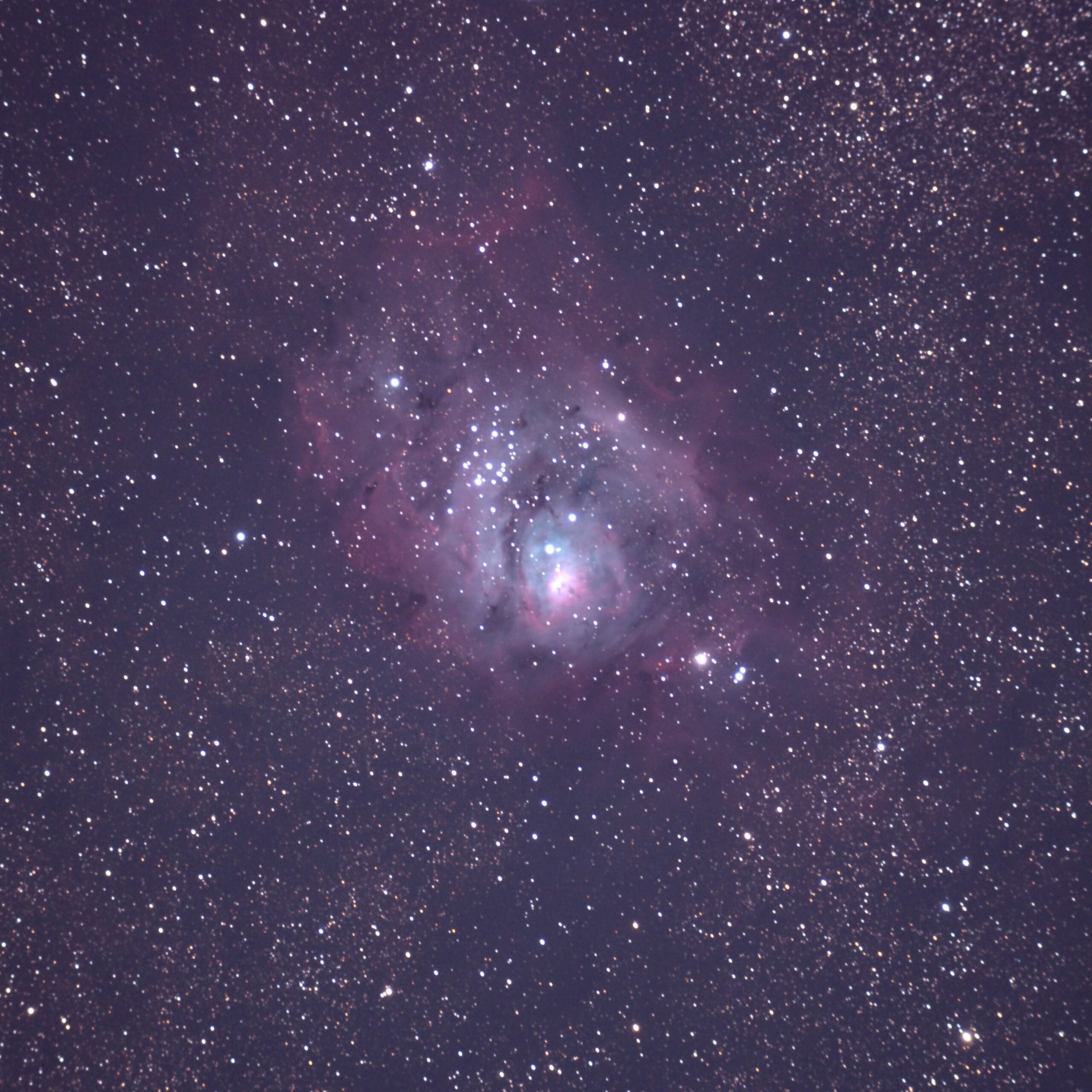
One of the nearest molecular clouds to the Sun hid across a patch of sky about 20 degrees wide. That is roughly 40 times the apparent diameter of the full Moon. It was not identified until a 2025 study looked for molecular hydrogen in a way that most cloud surveys do not.
The crescent-shaped cloud was named Eos, after the Greek goddess of dawn. Rutgers University’s discovery account compares its projected width with 40 Moons. This is not a story about a tiny object that slipped below a telescope’s resolution. It is a lesson in how astronomy can overlook something large and nearby when the object does not emit strongly in the wavelength normally used to find its class.
A large cloud close to the Sun
The discovery paper in Nature Astronomy places the near side of Eos about 94 parsecs from the Sun, or roughly 307 light-years. Three-dimensional dust maps trace the cloud along the same sightline out to about 130 parsecs, around 424 light-years. The familiar 300-light-year description is therefore a rounded distance to its nearest portion, not a single precise distance for every part of the structure.
On the sky, the fluorescent feature spans Galactic longitudes of approximately 25–45 degrees and latitudes of 40–63 degrees. Its characteristic width is about 20 degrees. Because the Moon appears about half a degree across, 40 full-Moon widths is a fair visual measure of Eos’s angular extent.
That comparison describes appearance, not physical size. The Moon is a solid body only 384,000 kilometres away. Eos is a diffuse interstellar complex hundreds of light-years away, and the discovery team used a radius of about 25 parsecs, or 82 light-years, in its physical models.
Why cold hydrogen is difficult to see
Molecular hydrogen, H2, is the principal molecule in cold interstellar clouds and the raw material from which stars and planetary systems form. Yet cold H2 is exceptionally reluctant to advertise its presence. The two atoms in the molecule are identical, so H2 lacks the electric dipole transitions that would produce convenient rotational emission lines at the temperatures inside a typical cloud.
The first excited state capable of producing emission corresponds to a temperature of about 511 kelvin, while dense molecular-cloud interiors are often near 10 kelvin. Most of the hydrogen is therefore too cold to radiate through that channel. Absorption observations can detect H2 along selected sightlines toward bright background sources, but those narrow beams do not automatically yield an easy all-sky mass map.
This is a recurring problem in astronomy. The most abundant material is not always the most observable material. Researchers often infer an otherwise quiet component from a rarer species whose emission is stronger and easier to measure.
Carbon monoxide as an astronomical proxy
For molecular clouds, that proxy is usually carbon monoxide. CO is vastly less abundant than H2, but it has low-energy rotational transitions that produce bright radio emission under cold cloud conditions. A NASA account of Planck’s all-sky CO map explains why carbon monoxide became the leading tracer for the dense, cold regions in which stars are born.
Astronomers measure CO brightness and apply a conversion factor to estimate the amount of molecular hydrogen. The technique has mapped giant clouds across the Milky Way and other galaxies. It is a powerful physical shortcut, but it is not a direct census of H2.
Molecular hydrogen can protect itself from destructive ultraviolet photons through self-shielding before carbon monoxide becomes abundant enough to survive and glow clearly. At the translucent edges of clouds, H2 may therefore be present where CO emission remains faint or absent. Astronomers call this component CO-dark molecular gas.
What “CO-dark” means in Eos
CO-dark does not mean that Eos is a completely black patch of sky or that it contains no carbon monoxide. It means that most of its molecular gas is not traced by detectable CO emission in the conventional way.
The discovery team estimated an H2 mass of about 3,400 times the mass of the Sun. Adding atomic gas and heavier elements gives a total cloud mass around 5,500 solar masses. By contrast, the CO luminosity of a small feature called MBM 40 corresponds to only about 20 solar masses under the standard conversion, with plausible variations raising that to roughly 40.
If MBM 40 belongs to Eos, the CO-bright estimate represents only about 0.6 to 1.2 per cent of the cloud’s molecular mass. In that quantitative sense, almost all of Eos is CO-dark. The calculation depends on distance, the CO-to-H2 conversion and the physical association of MBM 40, so the percentage should not be mistaken for an exact chemical inventory.
The ultraviolet signal that revealed it
Eos appeared through far-ultraviolet fluorescence from molecular hydrogen itself. H2 molecules absorb ultraviolet photons in the Lyman-Werner energy bands, jump into excited electronic states and then release a characteristic cascade of ultraviolet lines as they relax. The emission is strongest in irradiated boundary layers, making it a way to trace the transition between atomic and molecular gas.
The measurements came from FIMS-SPEAR, the primary payload on South Korea’s STSAT-1 satellite. The mission archive at the Space Telescope Science Institute describes it as the first large-area spectral imaging survey of the far-ultraviolet sky. The instrument combined imaging with spectroscopy, recording not just where ultraviolet light came from but how it was distributed by wavelength.
FIMS-SPEAR observed more than 70 per cent of the sky at spatial resolution down to about five arcminutes and spectral resolving power near 550. For the Eos analysis, researchers used a map in which stellar photons, continuum background and atomic lines had been removed, isolating the broad blended features of H2 fluorescence.
The cloud appears as a coherent fluorescent crescent with an average line intensity of about 20,000 photons per square centimetre per second per steradian. Its outline also agrees with a boundary seen in neutral atomic hydrogen, reinforcing the interpretation that the ultraviolet glow traces an atomic-to-molecular transition.
Old photons, a 2025 discovery
The satellite collected the relevant observations from 2003 to 2005, nearly two decades before Eos was named. The modern data products became publicly available through the archive in 2023. The cloud emerged when researchers revisited those observations using a map designed to separate molecular-hydrogen fluorescence from the rest of the far-ultraviolet sky.
That timeline makes 2025 the year of identification and publication, not the year the photons reached a detector. The paper appeared online on April 28, 2025. The Korea Astronomy and Space Science Institute highlighted the finding as evidence of the long scientific life of observations from South Korea’s first astronomy satellite.
Archival discoveries are not accidents in the ordinary sense. New calibration, new maps, better models and different questions can reveal signals that the original mission was not organized to catalogue. FIMS-SPEAR had already recorded Eos; recognizing the shape required choosing hydrogen fluorescence rather than carbon monoxide as the defining view.
At the rim of the Local Bubble
Distance estimates place Eos near the surface of the Local Bubble, a low-density cavity of hot gas that surrounds the Solar System. The team did not rely on one ruler. It combined three-dimensional dust mapping with the absorption of soft X-ray background emission and tracers of hot gas such as ionized oxygen.
Eos follows the high-latitude side of the North Polar Spur, a prominent radio and X-ray structure. In X-ray maps, its outline absorbs background emission and leaves a bright apparent rim. The cloud also appears as one distinct concentration in the three-dimensional dust reconstruction, with no other cloud along the same direction capable of producing the fluorescent shape.
Those cross-checks matter because a two-dimensional sky map can superpose unrelated structures at very different distances. Dust, ultraviolet emission, atomic hydrogen and X-ray absorption together place Eos in a physical neighbourhood rather than merely at a pair of celestial coordinates.
A cloud between assembly and destruction
Molecular clouds are associated with star formation, but detecting one does not prove that stars are forming inside it. The discovery team’s global calculation described Eos as marginally supported against gravitational collapse. Its estimated molecular dissociation rate exceeded its formation rate, leading to a predicted photoevaporation timescale of about 5.7 million years.
A separate Gaia study of stars toward Eos searched for young populations and shared motion over distances of 70–150 parsecs. It found no convincing population younger than tens of millions of years and no unusual spatial or kinematic clustering associated with recent substantial star formation.
That result does not prove every part of Eos will remain sterile. Molecular clouds are uneven and hierarchical. The small CO-bright MBM 40 condensation could evolve differently from the diffuse whole, and magnetic fields, turbulence and local density all affect whether a region collapses. The follow-up authors concluded that more detailed gas dynamics are needed.
How much molecular gas surveys can miss
Eos provides a nearby laboratory for the stage between diffuse atomic gas and the denser molecular structures that may form stars. It also exposes a selection effect: a catalogue built from one chemical proxy is a catalogue of what that proxy can reveal.
This matters well beyond one cloud. SpaceDaily recently examined the broader uncertainty in how galaxies turn atomic hydrogen into star-forming molecular gas. If diffuse H2 is missed because CO has not yet formed or survived, estimates of molecular reservoirs, cloud lifetimes and gas-conversion efficiency can all shift.
The proposed Eos space-telescope concept would extend far-ultraviolet mapping of molecular hydrogen and other tracers across the gas cycle in the Milky Way and nearby galaxies. It is a concept intended for a future NASA opportunity, not an approved observatory, but it shows the scientific opening created by the cloud’s discovery.
Eos was not hidden because it was small, distant or empty. It was hidden because the standard chemical beacon was nearly absent. Change the beacon, and a cloud 40 Moon-widths across comes into view.