
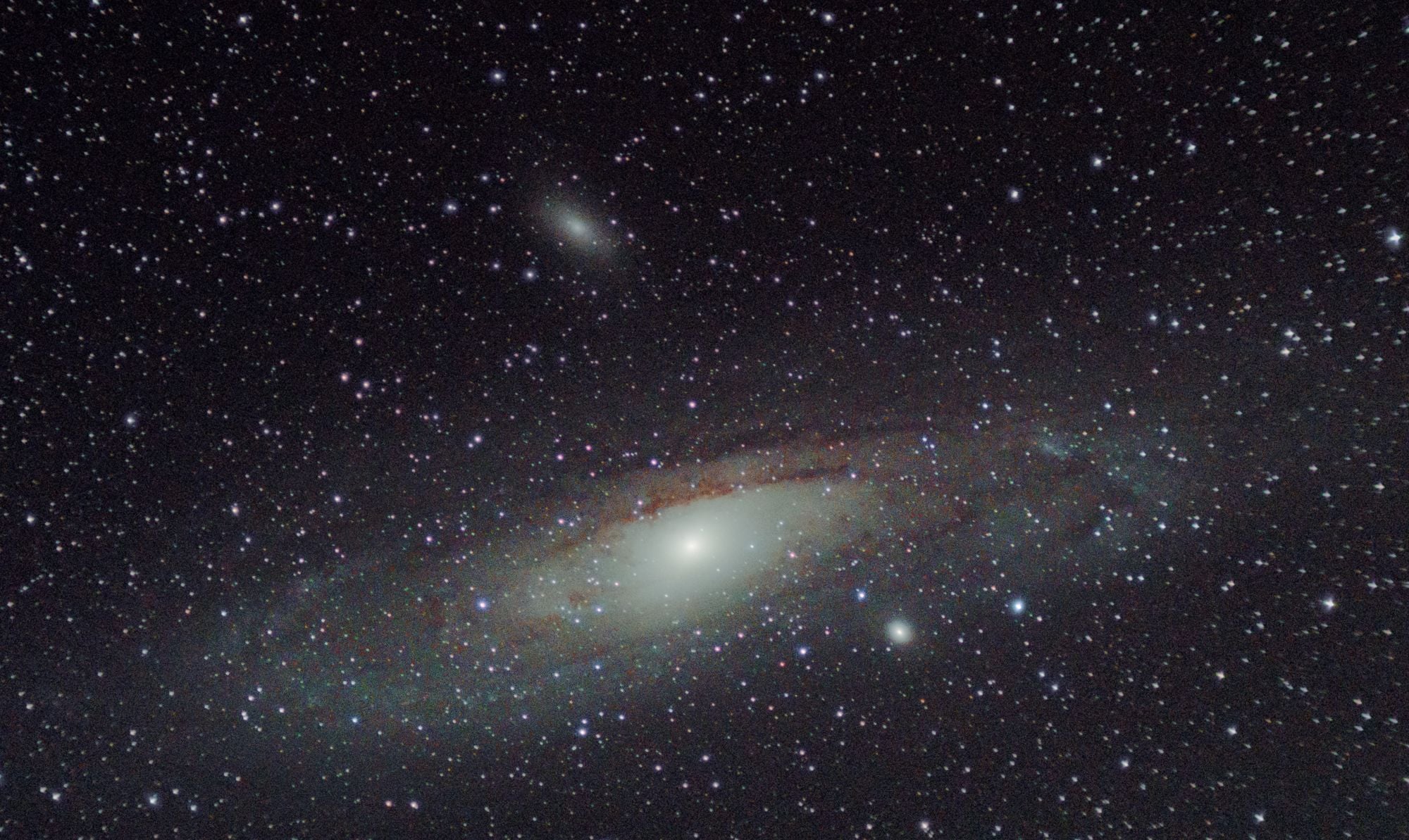
Andromeda can be found without a telescope under a sufficiently dark sky, even though its light has travelled about 2.5 million years. That sounds like an argument for astronomical eyesight. It is really an example of how much changes when light from an entire galaxy is added together.
The faint blur is not one impossibly luminous object. It is the blended output of a vast stellar population, with the bright central bulge contributing much of what an unaided observer detects. Reverse the problem and ask for one small planet beside one ordinary star in that galaxy, and the helpful accumulation disappears.
An Earth-Sun analogue in Andromeda would combine two of the hardest quantities in observational astronomy. The planet would be roughly ten billion times fainter than its star in visible reflected light. At the widest part of its apparent orbit, the planet and star would be separated by only about 1.3 microarcseconds. No existing telescope can directly image that pairing.
A galaxy can be visible while its stars are not
NASA’s panoramic Hubble account places Andromeda, or M31, about 2.5 million light-years away and says it holds more than a trillion stars. Its enormous Hubble mosaic resolves an estimated 200 million stars hotter than the Sun, yet NASA emphasizes that these are still only a fraction of the galaxy’s total population.
The naked eye does not resolve those stars. It registers their accumulated surface brightness across a small, hazy patch, mainly the galaxy’s luminous inner region. Long-exposure photographs reveal far more of the disk because a detector can collect photons for minutes or hours and processing can lift weak structure above the background.
“Hundreds of billions of stars” is therefore a statement of scale, not an exact census or a claim that every star contributes equally. Current estimates can exceed a trillion, while cool dwarfs, dust-hidden stars and faint outer populations add much less to a visible-light view than luminous giants and the crowded bulge.
One astronomical unit becomes 1.3 microarcseconds
The separation in the title follows from a compact piece of geometry. One parsec is the distance at which one astronomical unit, the mean Earth-Sun distance, subtends one arcsecond. Andromeda’s 2.5 million light-years convert to roughly 766,500 parsecs.
Place a one-AU radius at that distance and its angle is 1 divided by 766,500 arcseconds. The result is about 0.00000130 arcseconds, or 1.30 microarcseconds. A microarcsecond is one millionth of an arcsecond; an arcsecond is already only 1/3,600 of a degree.
That 1.3-microarcsecond figure is a maximum projected separation for a circular Earth-sized orbit viewed at a favourable phase. An inclined orbit can project a smaller gap. At conjunction, when the planet lies in front of or behind the star, the apparent separation falls toward zero. “Earth-like” here means a deliberately specific Earth-Sun analogue, not every rocky planet that might receive the label.
The planet loses by 25 magnitudes
NASA’s Haystacks project gives a useful local benchmark. Seen from ten parsecs, Earth is about ten billion times fainter than the Sun at visible wavelengths and lies at most 0.1 arcseconds from it. Moving the system to Andromeda preserves the planet-to-star contrast while shrinking the apparent orbit by about 76,650 times.
A brightness ratio of ten billion corresponds to a difference of 25 astronomical magnitudes. Using the Sun’s standard visual luminosity and Andromeda’s distance gives another back-of-the-envelope comparison: an unobscured Sun-like star there would appear around magnitude 29, while its Earth twin would be near magnitude 54 at a favourable illuminated phase.
Those magnitude estimates are not measurements of a real Andromeda system. Dust, phase, cloud cover, surface reflectivity and wavelength all change the planet’s brightness. The ten-billion contrast is the familiar visible-light Earth-Sun reference. In thermal infrared, a temperate planet emits more favourably relative to its star, but longer wavelengths make diffraction-limited angular resolution harder for a given aperture.
Direct imaging must solve two problems at once
A telescope needs enough collecting area and exposure time to register the planet’s sparse photons. It must simultaneously remove the parent star’s light with extraordinary precision. NASA’s Exoplanet Exploration Program puts Earth-like worlds between ten million and ten billion times fainter than their stars, depending on whether they are observed in the mid-infrared or visible.
Coronagraphs place carefully shaped masks in an optical path to reject a star’s central glare. Deformable mirrors correct tiny wavefront errors that would otherwise scatter starlight into the dark search area. A separate starshade could block a star before its light enters a telescope. None of these devices can reveal a planet that remains buried inside the system’s angular-resolution and inner-working-angle limits.
Contrast and separation multiply each other’s difficulty. Suppressing a star by ten orders of magnitude in a laboratory dark region is not the same as doing it 1.3 microarcseconds from the star on the sky. Thermal drift, pointing motion, imperfect optics and detector noise all create signals far larger than the hypothetical planet.
Webb’s working angles show the gulf
The published high-contrast limits for the James Webb Space Telescope provide a concrete comparison. Depending on instrument, mask and wavelength, the smallest listed inner working angles begin around 0.089 arcseconds and rise from there. NIRCam’s coronagraphic masks operate at roughly 0.14 to 0.89 arcseconds across their specified configurations.
The most generous 0.089-arcsecond number is 89,000 microarcseconds, almost 70,000 times wider than the Earth-Sun angle in Andromeda. This comparison does not mean Webb could detect the planet if only the orbit were enlarged. Its contrast and photon rate are also far beyond reach. It simply gives the angular mismatch an instrumental scale.
NASA’s overview of direct imaging with the Roman Space Telescope explains the current frontier: direct images favour enormous, young super-Jupiters that still glow with formation heat and orbit far from nearby stars. Cooler, smaller planets close to Sun-like stars require capabilities beyond existing observatories.
A filled optical aperture would approach 100 kilometres
A simple diffraction calculation makes the separation problem more vivid. Using 500-nanometre green light and the Rayleigh criterion, resolving 1.3 microarcseconds calls for a filled aperture roughly 96 kilometres across. That is only the nominal split between two ideal point sources, not a complete exoplanet observatory.
A practical coronagraph normally needs a planet to sit several diffraction widths from the star before useful light passes its mask. It also needs an exquisitely stable wavefront and enough mirror area to collect a magnitude-54 target. The effective requirement would therefore be more demanding than the 96-kilometre classroom result.
A space interferometer could synthesize comparable angular resolution with widely separated collectors instead of one solid mirror. It would still need to combine optical phases with extreme precision, suppress the star, reject galaxy background and gather enough planet light. Radio interferometers can reach microarcsecond scales, but angular resolution at radio wavelengths does not supply the missing visible photons from an Earth twin.
Andromeda adds a crowded field behind the glare
The hypothetical system would not sit against an empty black detector. Neighboring stars, unresolved populations, diffuse galaxy light and interstellar dust would occupy the same field. At Andromeda’s distance, one arcsecond spans roughly 12 light-years, so even a fine astronomical image can pack many unrelated sources into the area surrounding the target.
Hubble’s ability to identify hundreds of millions of Andromeda stars is remarkable, but the stars it resolves most readily are intrinsically luminous or favourable in colour and crowding. A Sun-like star is far fainter. Its planet would occupy an unresolvable fraction of the same point-spread function while contributing one ten-billionth as much visible light.
The galaxy’s total naked-eye visibility is no help at that scale. Integrated light improves detection of the galaxy as a whole; it makes decomposition into one particular star and one adjacent planet harder. The observation changes from adding every available photon to assigning a vanishingly small fraction of them to the correct source.
Indirect detection is a different question
“Beyond direct imaging” does not mean that no planet could ever be inferred in another galaxy. Gravitational microlensing can briefly magnify a background source and reveal the influence of a foreground star or planet without separating their light. NASA’s overview of exoplanet methods distinguishes such indirect signals from photographs. In principle, unusually favourable transits or variability might also disclose companions statistically.
Those methods answer different questions and face their own severe limits in crowded extragalactic fields. A microlensing event is usually a one-time alignment. A transit needs the orbit to cross the star from our viewpoint, and an Earth analogue would produce a tiny dip only once per year. Neither method normally returns a resolved photograph of the planet or the reflected-light spectrum needed to study its atmosphere.
The title does not claim that an Earth-like planet is known in Andromeda. It describes a hypothetical one to expose the scale difference between detecting a galaxy and isolating a world. Even identifying a convincing Earth analogue indirectly at that distance would be a separate achievement from imaging it.
Future Earth imagers are built for the cosmic neighborhood
NASA’s proposed Habitable Worlds Observatory is intended to identify and directly image potentially habitable planets, with a central objective of finding 25 such worlds. Its practical hunting ground is the population of nearby stars, where Earth-sized orbits appear tens of milliarcseconds wide and planetary photons are vastly more plentiful.
Distance is why SpaceDaily’s account of the candidate GJ 251 c treats 18 light-years as an asset. That is still remote for travel, but it gives future telescopes a plausible angular separation and photon budget. Moving an otherwise identical system to Andromeda erases both advantages.
Andromeda’s soft glow and an invisible Earth twin are therefore not contradictory. They demonstrate opposite sides of the same optical rule. A galaxy becomes visible when the light of an immense population is allowed to blend; a planet disappears when one mote of reflected light must be pulled back out from beside one of those suns.