

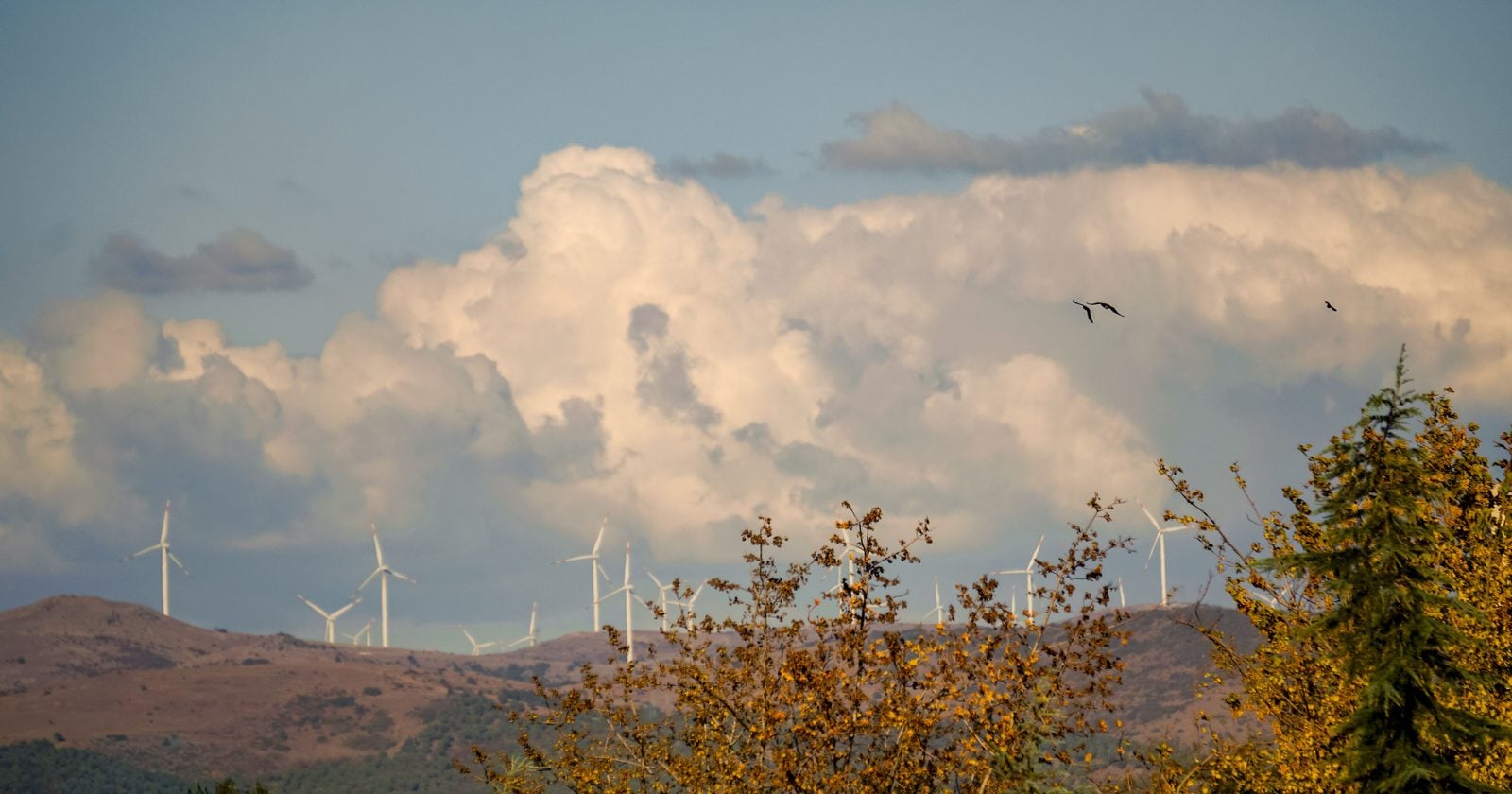
There’s a line that comes up whenever wind power gets argued about, usually from someone who wants to slow it down: those spinning blades are shredding birds out of the sky. It’s a vivid image, and it does useful work for the person using it. It turns a clean-energy project into a killing field. The trouble is that the numbers behind the image don’t hold up. What’s left standing is a much more uncomfortable fact about the ordinary buildings we live and work in.
We’re not wildlife biologists, and this is a piece of reading and reflection on the research, not a verdict on anyone’s energy policy. The figures below are modeled estimates with wide ranges, not exact body counts, and we’ve tried to keep that uncertainty visible throughout.
What the turbine number actually is
The most-cited estimate for how many birds American wind turbines kill comes from a 2013 study led by Scott Loss, then at the Smithsonian and now at Oklahoma State University.
In the authors’ own words: “between 140,000 and 328,000 (mean = 234,000) birds are killed annually by collisions with monopole turbines in the contiguous U.S.”
That’s the whole country, every year. The team also worked out a per-turbine rate: roughly three to eight birds per turbine annually, more for taller towers. Two things are worth holding onto. The estimate covers the tall single-tower kind of turbine, not every structure ever called one. And 234,000 is the middle of a wide modeled range, not a number anyone counted. Even at the high end of 328,000, it stays in the low hundreds of thousands.
What the glass number is
The comparison is stark. In a 2014 paper in The Condor, Loss and colleagues estimated that “between 365 and 988 million birds (median = 599 million) are killed annually by building collisions in the U.S.”
Turbines kill 234,000 a year. Windows kill 599 million, which works out to roughly 1.6 million birds a day. Seven full years of turbine deaths add up to about that same 1.6 million, meaning a single day of birds flying into American glass kills as many as every turbine in the country kills over seven years.
Why glass is so much deadlier
The reason is almost dull once you hear it. Windows are nearly everywhere, and birds cannot see them. Daniel Klem Jr. of Muhlenberg College has studied bird-glass collisions since the 1970s. In his account, a pane simply doesn’t register as a solid thing. Klem’s view is that “their behaviour and our knowledge of their visual systems inform us that the glass is invisible to them.”
Birds can’t learn to avoid it, either, because most collisions are fatal or close to it. Klem describes the pane as “an indiscriminate killer that takes the fit as well as the unfit of a species’ population.” A turbine sits in one place; a bird has to fly through that airspace to be at risk. Glass is in every house, office, and storefront a bird might pass, which is what makes the number so large. It’s also why the count almost certainly runs low: by some estimates only about 20% of window-killed birds are ever found, the rest carried off by scavengers or dying out of sight.
The distribution surprises people too. It isn’t glass towers doing most of the damage. Loss and colleagues found that roughly 56% of building deaths happen at low-rise buildings and 44% at homes, with under 1% at high-rises. The ordinary house matters more than the skyscraper.
Where turbines actually rank
Set the turbine figure against the full list of human-caused bird deaths and it nearly disappears. The single largest source isn’t windows at all. The same team’s 2013 study in Nature Communications concluded that free-ranging cats kill “1.3–4.0 billion birds and 6.3–22.3 billion mammals annually,” often cited around a midpoint of 2.4 billion birds. The authors judged this likely the biggest single human-linked cause of bird deaths in the country. That’s another modeled estimate with real uncertainty, driven mostly by how many stray cats there are, but even its low end swamps everything else.
Cats, in the billions. Glass, in the hundreds of millions. Turbines, in the hundreds of thousands. The turbine number is smaller than the others by factors of thousands, not by a bit. Turbines do kill birds, and placing them in the wrong spot, on a ridgeline in a raptor’s flight path, can concentrate harm in ways the national average hides. But as a share of the total, they’re a rounding error next to the pane of glass behind you.
What the comparison should change
None of this settles the wind-power debate on its own, and it isn’t meant to. There are real questions about where turbines go and which species pass through those places, and those deserve careful, site-by-site attention rather than a wave of a national statistic.
But if the case against a wind project rests mainly on dead birds, the numbers say the argument is aimed at the wrong target by a factor of thousands. Followed honestly, the concern would point first at cats and then at ordinary windows, long before it reached a turbine.
Which leaves the glass figure sitting there, asking something of the rest of us. The birds dying in the largest numbers aren’t hitting some distant industrial machine. They’re hitting the window over the kitchen sink, the sliding door onto the deck, the storefront on the corner. Any homeowner can actually do something about that, with screens, patterned film, or something so a bird reads it as solid.