

A nationwide effort to sequence the DNA of everything caught in a network of insect traps across Germany has produced one of the largest single biodiversity datasets ever generated for a single country’s insect fauna, and it is reshaping how scientists think about the scale of monitoring needed to track insect decline. Researchers positively identified 10,803 insect species from the collected material, and statistical modeling of the results suggests that a more exhaustive survey using the same method could eventually detect close to 32,000 species — a number that helps explain why insect declines are so difficult to quantify with traditional methods, and why so much of the country’s smallest wildlife remains genetically uncatalogued even in a heavily studied nation like Germany.
The study, led by Dominik Buchner of the University of Duisburg-Essen together with 25 co-authors from institutions across Germany, was published in the journal Molecular Ecology Resources under the title “Upscaling biodiversity monitoring: Metabarcoding estimates 31,846 insect species from Malaise traps across Germany.” An earlier preprint version of the work circulated on bioRxiv in 2023, and the peer-reviewed paper is also archived in full at the National Library of Medicine’s PubMed Central.
How the sampling worked
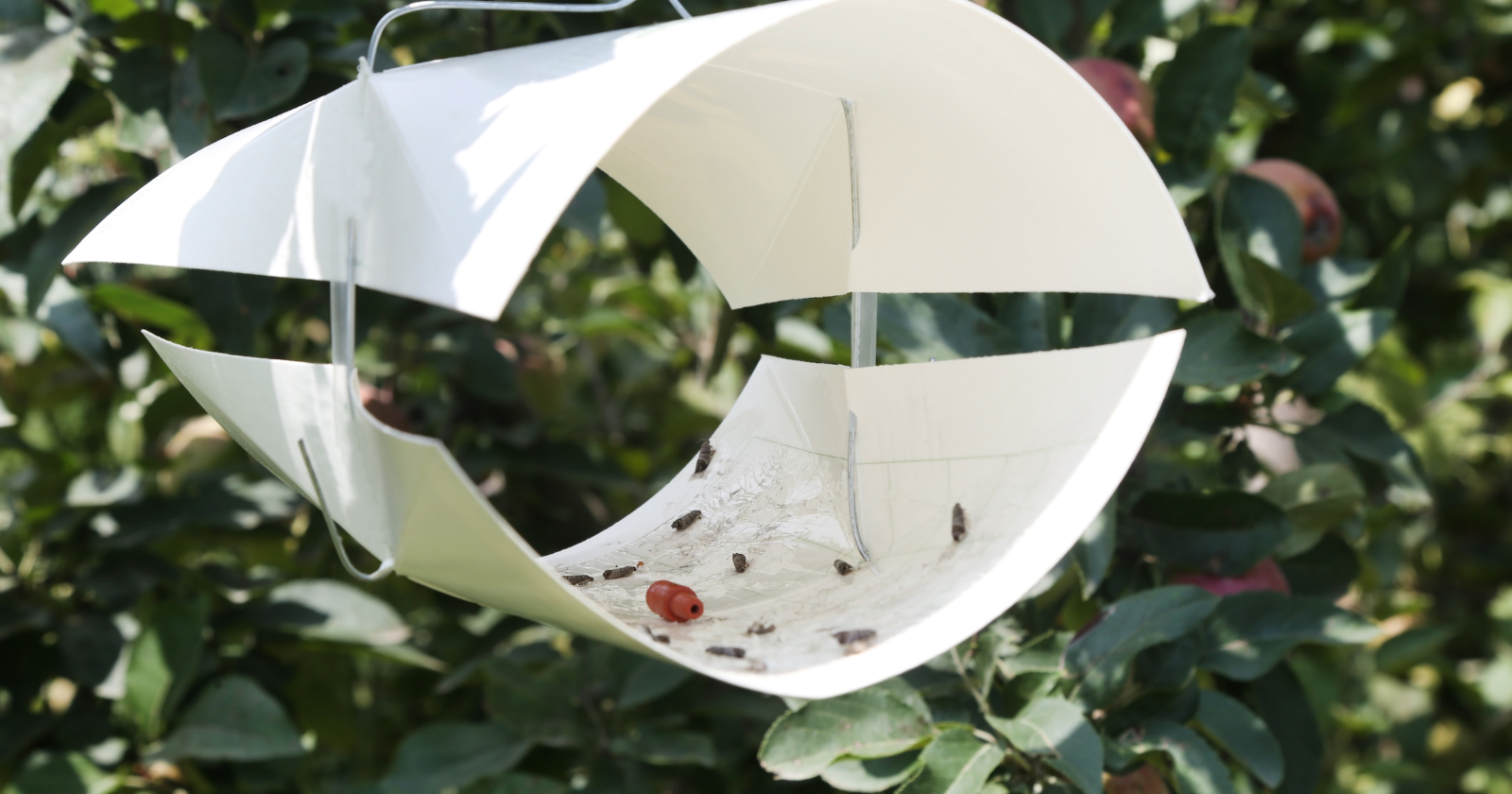
The data came from the German Malaise Trap Program, a monitoring effort that has run since spring 2019 under Germany’s Long-Term Ecological Research network (LTER-D), in partnership with the Verein Nationale Naturlandschaften, the Senckenberg Society for Nature Research, and the University of Duisburg-Essen. Malaise traps are tent-like structures that passively intercept flying insects and funnel them into a collecting jar; they are a standard tool in entomology because they sample continuously over weeks without requiring a researcher to be present.
For this study, 75 traps were deployed across a range of German habitats — agricultural land, semi-natural forests, floodplain forests, grasslands and other protected landscapes — producing 1,815 bulk samples over the 2019 and 2020 field seasons (775 samples in 2019 and 1,040 in 2020).
Rather than sorting and identifying each insect by eye, which would be impossibly slow at this scale, the team used DNA metabarcoding: every sample was homogenized and its bulk DNA extracted, then a short, standardized stretch of the mitochondrial gene cytochrome c oxidase I (COI) — the same “DNA barcode” region used across the animal kingdom for species identification — was amplified and sequenced en masse. That process generated just under four billion demultiplexed sequence read pairs (3,999,082,169, to be precise), averaging roughly 1.4 million reads per sample. Each unique DNA sequence variant recovered from that sequencing run was then clustered into an operational taxonomic unit, or OTU, and compared against reference DNA barcode libraries such as the Barcode of Life Data System (BOLD) to assign a species name wherever a matching reference sequence existed.
What the numbers mean — and what they don’t
The screening effort recovered 52,981 raw OTUs, of which 50,087 were classed as insects. Of those, the researchers could confidently attach a validated species name to 10,803 species, drawing on 15,042 of the OTUs. That figure alone is significant: it represents about 33.5 percent of the roughly 35,500 insect species formally documented in Germany, and — more tellingly for judging the method’s power — about 83 percent of German insect species for which a reference DNA barcode currently exists in public databases. In other words, among species that can in principle be identified this way, the traps and sequencing run picked up the large majority of them in just two field seasons.
The remaining insect OTUs could not be matched to a named species, either because no reference barcode for that species has yet been deposited in the databases the team searched, or because the organism may be new to science altogether — so-called “dark taxa.”
The oft-cited estimate of “nearly 32,000 species” is not a count of things directly identified, and it is not a projection of what future sampling might eventually find, either — both common misreadings of the number. It comes from a different calculation entirely: the researchers compared, within each of 20 insect taxonomic orders, how many OTUs typically corresponded to a single validated species, then applied that ratio to the roughly 35,000 insect OTUs their sequencing had already recovered but could not match to a named species. That produced an estimate of 21,043 additional “plausible species” likely already sitting in the collected samples — organisms that are either known to science but lack a reference DNA barcode, or genuinely new to science.
Add those to the 10,803 directly validated species and the total comes to 31,846. A separate calculation in the same paper, using rarefaction to model what substantially more trapping at the same sites would add, found the payoff would be modest: only about 934 additional validated species, an 8.6 percent gain. In other words, the gap between 10,803 and 31,846 is mostly a reference-database and dark-taxa problem, not a sampling-coverage one — and the 31,846 figure should not be read as evidence Germany harbors more insect species than are already known to science, since it remains below the roughly 35,500 species already formally described in the country. The real headline is that a two-year trapping and sequencing campaign, covering a modest 75 sites, came within reach of nearly nine in ten of Germany’s known insect fauna — a scale of coverage that traditional taxonomic survey work, done by hand, would take decades or longer to approach.
Why this matters for tracking insect decline
Concern about insect decline has grown steadily since a widely cited 2017 study reported major drops in flying-insect biomass in German nature reserves, work that was itself carried out using Malaise traps. The challenge scientists have faced since then is that biomass trends alone say little about which species are actually being lost, since a decline could reflect fewer individuals of common species, the disappearance of rare ones, or both. Species-level data of the kind generated in the new study lets researchers track changes at that finer resolution, making it possible in future survey rounds to see whether particular habitat types, regions or insect groups are losing species faster than others.
The tens of thousands of unassigned “dark taxa” OTUs also point to a more basic gap: large stretches of German insect diversity, particularly among small-bodied and less-studied groups such as parasitic wasps and midges — the two orders (Hymenoptera and Diptera) where fewer than one in five OTUs could be matched to a named species — still lack any reference DNA barcode at all, meaning they cannot yet be identified even when their genetic signal is captured. Beetles and moths, by contrast, were comparatively well covered by existing reference libraries. Closing that reference-library gap, the authors argue, is now as urgent a task for biodiversity science as the trapping and sequencing itself.