
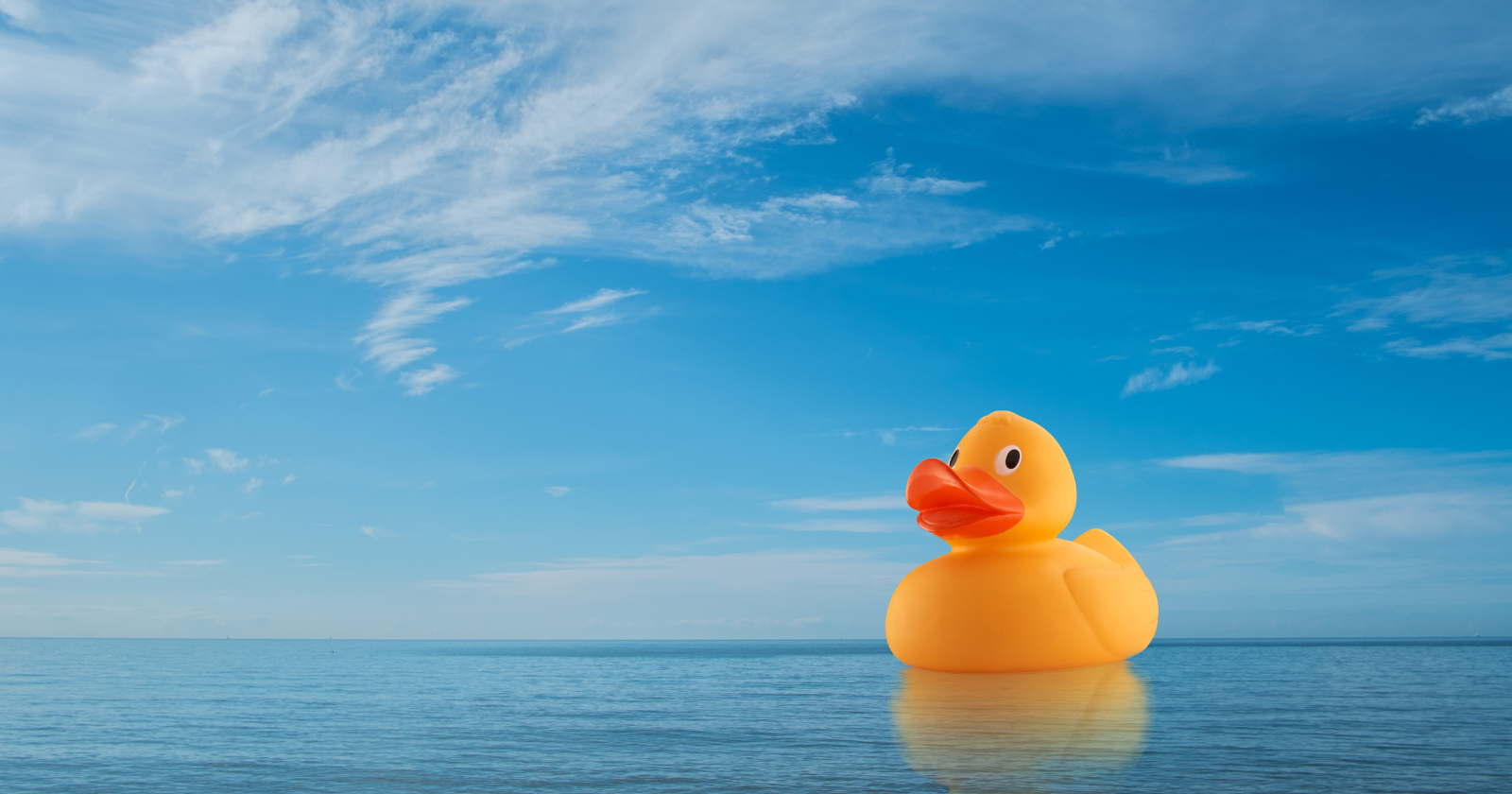
The container ship Ever Laurel, operated by Evergreen Marine, was three days out of Hong Kong on 10 January 1992, bound across the North Pacific for the port of Tacoma, Washington, when a severe winter storm caught the vessel near the International Date Line. Twelve 40-foot intermodal shipping containers slid off the deck during the storm. Eleven of them presumably sank, or drifted, or broke apart and released their contents into the ocean without generating any documented consequences. The twelfth, which was carrying a consignment of children’s bath toys manufactured in China for the American company The First Years Inc., opened at some point during the incident and released 28,800 plastic ducks, beavers, turtles, and frogs into the Pacific Ocean at roughly 45 degrees north latitude and 178 degrees east longitude. And the toys began, on the direct action of ocean currents alone, to drift.
What made the twelfth container’s cargo more consequential than any of the other eleven was that the toys were physically well-suited to serve as accidental scientific instruments. Unlike most children’s bath toys, they had no holes anywhere in their bodies for water to enter, meaning they remained buoyant indefinitely rather than sinking after a few weeks in seawater. They were also identifiable at a glance, coming in four distinct animal shapes and four bright primary colours that, even after prolonged exposure to sunlight and salt water, could be recognised from a distance. And the manufacturer had produced them with an embossed “The First Years” logo on the base of each toy, meaning that any confusion about the origin of a beached duck could be resolved by turning it upside down. Which meant that, for the first time in the history of oceanography, a single well-defined event had released tens of thousands of identical, dated, traceable, buoyant objects at a precisely known location in the open ocean. That was the accidental scientific opportunity. Two Seattle oceanographers took it.
What Ebbesmeyer and Ingraham did with the ducks
According to the Wikipedia entry on the Friendly Floatees spill, drawing on the peer-reviewed Ebbesmeyer and Ingraham 1994 paper published in the journal Eos: Transactions of the American Geophysical Union and reporting by The Times of London, the Financial Times, and Harper’s Magazine, the two oceanographers who first recognised the significance of the spill were Curtis Ebbesmeyer, who had spent decades studying ocean flotsam as a research sideline, and James Ingraham, who was maintaining a numerical model of North Pacific ocean surface currents called OSCUR (Ocean Surface Currents Simulation). The OSCUR model had been built to predict fisheries movements using historical air pressure and wind data dating back to 1967. Ebbesmeyer and Ingraham realised that a mass release of 28,800 identical objects at a known point offered a scale of validation data that the model had never previously had access to. The standard oceanographic technique for tracking ocean currents up to that point had involved releasing 500 to 1,000 numbered glass drift bottles at a chosen location and waiting for coastal beachcombers to find them, at typical recovery rates of 2 per cent. The rubber ducks, if the same recovery rate held, would produce roughly 600 confirmed sightings, which was more than an order of magnitude greater than what any single previous experiment had generated.
The two scientists began a coordinated recovery campaign that ran through the following two decades. They contacted coastal wildlife agencies, environmental groups, beachcombers’ associations, harbourmasters, and Coast Guard stations across the North Pacific rim. They set up telephone hotlines. They ran newspaper advertisements. They asked The First Years Inc. to offer a small monetary reward for confirmed recoveries. And they logged every reported sighting into a database that fed directly into the OSCUR model, giving Ingraham the empirical validation he needed to refine the model’s prediction of surface current flow across the region.
The first recoveries came in ten months after the spill. On 16 November 1992, a beachcomber near Sitka on the Alaskan coast recovered ten of the ducks about 3,200 kilometres east-northeast of the release point. Twelve days later, another beachcomber found twenty more. By August 1993, roughly 400 Floatees had been recovered along an 850-kilometre stretch of the Gulf of Alaska coastline, giving Ebbesmeyer and Ingraham the 1.4 per cent Pacific recovery rate they had estimated in advance. The OSCUR model, when validated against the actual Alaskan landfall pattern, proved to be substantially accurate. Which meant that its predictions for the subsequent drift of the remaining ducks were probably also worth taking seriously.
The routes the ducks eventually traced
Those predictions were remarkable. The OSCUR model suggested that the North Pacific subpolar gyre, which is the great counterclockwise ocean current that circulates through the Gulf of Alaska, the Aleutian Islands, the Kamchatka coast, and back across to Hawaii, would carry many of the surviving Floatees on a multi-year loop that would eventually deposit some of them on the coasts of Japan, back to Alaska, and then, for a subset carried north through the Bering Strait, into the Arctic Ocean. From there, the model predicted, the ducks would freeze into the polar ice pack, drift slowly across the Arctic Basin at the speed of the ice itself, and eventually reach the North Atlantic five or six years later when the Greenland Sea currents released them from the melting ice. Which is where the story got genuinely interesting.
According to IFLScience’s 2021 detailed reporting by senior science writer Rachael Funnell, drawing on Ebbesmeyer’s own published work and interviews with beachcombers involved in the recovery effort, the OSCUR model’s predictions turned out to be, in the main, correct. Recoveries in Washington state followed in 1996. Recoveries along the coasts of Hawaii and Japan followed through the late 1990s. Ducks that had drifted north through the Bering Strait were reported frozen into Arctic ice in the early 2000s, and by 2007 a small number of Floatees, bleached white by fifteen years of sunlight and salt water but still identifiable by their embossed logos, had washed up on the southwestern shores of the United Kingdom, meaning they had completed a journey of roughly 27,000 kilometres from their release point in the mid-Pacific to the beaches of Devon and Cornwall. One recovered duck had, on the reconstruction of its likely route, floated directly over the site where the Titanic had sunk.
The scientific significance of the Ebbesmeyer and Ingraham data set has been substantial. Their subsequent papers on the Floatees spill, along with a related analysis of an earlier 1990 spill of 61,000 Nike running shoes from a different container ship, contributed to the empirical validation of the OSCUR model and its successor OSCURS, which is now one of the standard reference models for North Pacific surface current prediction. The models are used today to forecast the drift of oil spills, the dispersal patterns of marine debris, the likely landfall locations of missing vessels, and the movement of larval fish and juvenile marine organisms. The predictive framework that emerged from tracking rubber ducks across the ocean now underpins a substantial part of contemporary ocean current modelling in the North Pacific.
Ebbesmeyer subsequently coined the term flotsametrics to describe the discipline of using accidental spills of identifiable objects to map ocean current pathways. His research programme continued through the 2000s and 2010s, incorporating data from a wide range of subsequent container spills, and formed the basis of Donovan Hohn’s 2011 book Moby-Duck, which followed the story of the Friendly Floatees across the Pacific and into the Arctic. The ducks were later featured in the BBC’s Blue Planet II documentary. And by the time the last confirmed Floatee recoveries were logged in the mid-2010s, roughly two decades after the original spill, the container’s contents had produced a validated ocean current model, an accepted subfield of oceanography, a bestselling non-fiction book, and one of the more counterintuitive contributions to twentieth-century marine science.
None of which would have happened if the container in question had gone to the bottom of the Pacific along with the eleven that presumably did on the same night. The scientific value of the spill came from the physical properties of the specific cargo the twelfth container was carrying, from the recognition by two Seattle oceanographers that an accidental release of 28,800 identical drifters was a research opportunity that no funding agency would ever have authorised deliberately, and from the twenty-year commitment of a distributed international network of beachcombers to log and report the recoveries as the toys arrived. What began as a routine maritime incident in a winter storm on the trans-Pacific shipping lanes became, over the following two decades, one of the largest and most productive natural experiments in the history of physical oceanography.
