

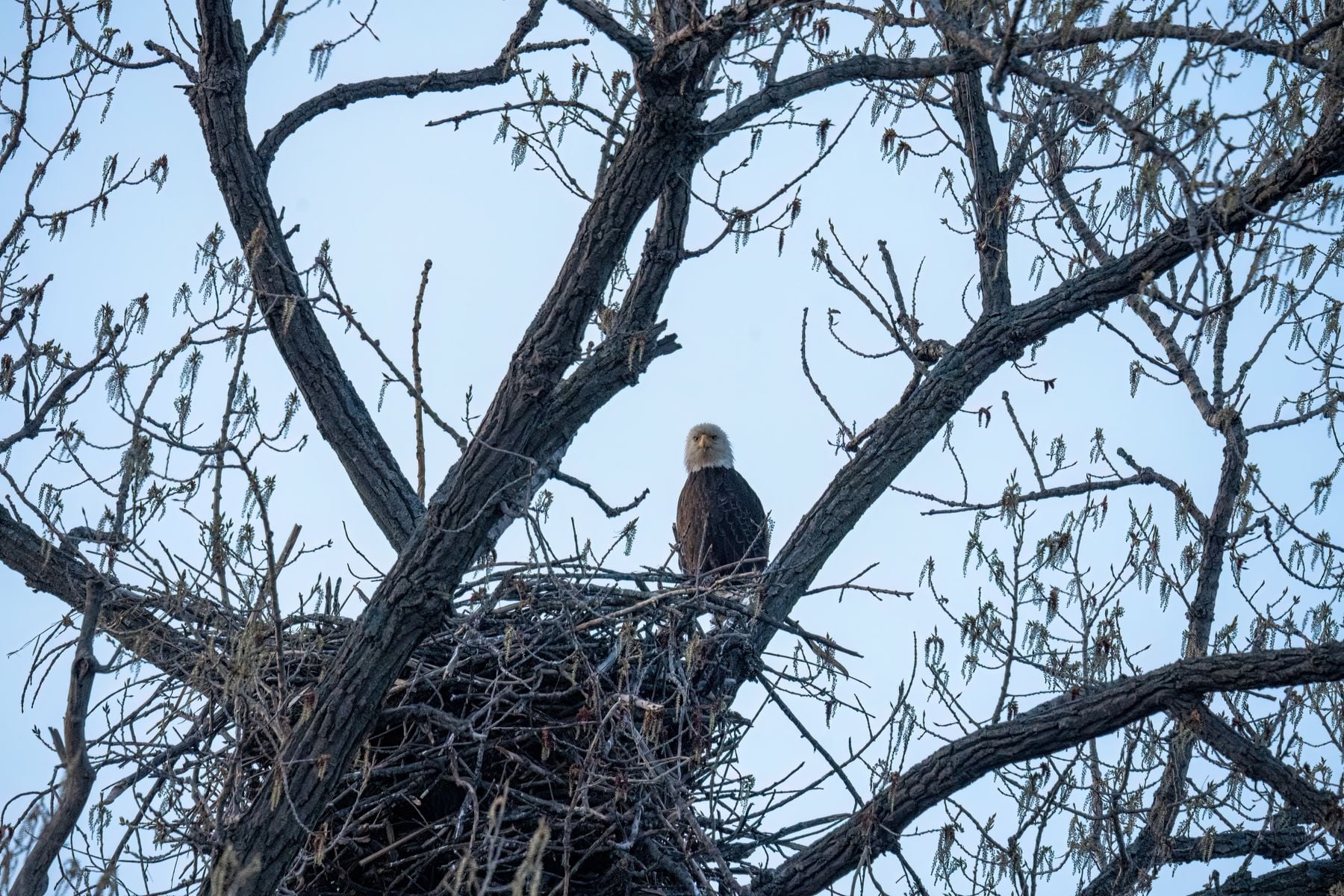
A bald eagle’s nest beside Kennedy Parkway is part of the working landscape of NASA’s Kennedy Space Center in Florida. NASA has documented nesting birds a few kilometres south of the Vehicle Assembly Building, in the same broad coastal property that contains launch pads, crawler routes and electricity-generating solar arrays.
The arrangement began with the land acquisitions for the space programme. NASA needed room for launch facilities, but most of the surrounding territory did not need to be developed. An agreement with the U.S. Fish and Wildlife Service in 1963 gave those areas a second role as habitat.
The familiar figure of roughly 140,000 acres includes land and lagoon waters, rather than an uninterrupted expanse of dry ground.
How a space centre acquired a refuge
The Fish and Wildlife Service’s history of Merritt Island dates NASA’s acquisition of lands and waters beside Cape Canaveral to 1962. The agency built its launch complex and supporting facilities while leaving much of the acquired area undeveloped.
On 28 August 1963, the two agencies signed the agreement establishing Merritt Island National Wildlife Refuge. Its conservation purposes included migratory birds and habitat for threatened and endangered wildlife.
The landscape also had a human history before NASA. Families lived and farmed there, and the refuge’s history records surviving foundations and canals, particularly around Haulover Canal. Describing the land simply as empty space before the rockets would erase that earlier occupation.
Today’s management arrangements include another institution: Canaveral National Seashore, established in 1975. The Department of the Interior manages most of Kennedy’s undeveloped areas through the refuge and seashore.
One property, several kinds of habitat
The refuge’s current description calls it an overlay of Kennedy Space Center. It also states the ordering of the arrangement: the lands and waters primarily serve the space programme, with refuge or park uses secondary. NASA’s continuing operational role is therefore part of the conservation story.
Coastal dunes, saltwater marshes, managed impoundments, scrub, pine flatwoods and hardwood hammocks make this a varied landscape. A nesting eagle occupies one part of that habitat mosaic. Treating the whole property as a single forest would miss the wetlands and shorelines that occupy so much of it.
The built features have their own geography. NASA’s account of Kennedy’s crawler-transporters describes the machines carrying rockets and spacecraft towards the pads. These transport corridors sit within the larger property; their presence does not mean that every eagle nest stands immediately beside an active launch platform.
The pine trees have a documented nesting history
NASA’s February 2023 account of a well-known eagle pair described a replacement nest near Kennedy Parkway, a couple of miles south of the Vehicle Assembly Building. The earlier nest had been built in 1973 and used almost every year from 1975 until 2022.
Storm damage eventually helped force the move. The original tree had already died following damage from storms and pine bark beetles, but the birds continued using it until part of the nest collapsed. Their new site was within about 100 yards of the old one.
A nest that persists for decades does not imply that the same two birds occupied it for all that time.
The 2023 report also described helicopter surveys that recorded whether nests were occupied, how many eaglets were produced and whether young birds fledged. Its figures for active or potentially active territories were a dated survey result, not a permanent count of the centre’s eagle population.
The pine-tree detail is explicit in an earlier NASA report from April 2013. Ecologists found three nests blown out of dead pine trees after a thunderstorm and arranged care for two eaglets. Wildlife management here includes responding when individual nests fail.
Solar arrays serve more than one electricity customer
Solar generation adds another use of Kennedy land, but electricity produced within the boundary is not necessarily electricity consumed by NASA. That distinction appears in NASA’s January 2017 report on solar-farm expansion.
At that time, the agency described a one-megawatt installation in the industrial area supplying the centre and a ten-megawatt facility farther south producing electricity for Florida Power & Light. The installations dated to late 2009 and early 2010, respectively. These figures describe the facilities in that historical report, rather than a complete inventory for 2026.
The same account discussed rooftop and parking-canopy panels as well as larger arrays. Their siting matters because energy generation and wildlife habitat both use physical space. A photograph of panels on Kennedy property cannot, by itself, establish the share of launch operations powered by solar electricity.
Coexistence requires changes on the ground
Space Daily’s 2007 coverage of Operation Dark Dune offers a practical example of how the relationship works. After hurricanes eroded parts of the protective dunes, workers positioned 25 railcars along a coastal rail line to shield nesting sea turtles and hatchlings from launch-pad lighting.
It was a response to a specific conflict between a working facility and nearby wildlife. The railcars did not make the spaceport disappear; they changed how one of its effects reached the beach.
Eagle surveys, nest rescues and adjustments to lighting reveal the work behind the shared landscape. Conservation at Kennedy is carried out at that scale: a nest checked, an injured bird treated, or light kept off a stretch of nesting beach.