

Years before pointed ears and a raised eyebrow made him one of the most recognizable faces in American television, Leonard Nimoy turned up in a small ABC Western as Little Hawk, an Apache man wrongfully accused of stealing horses, in the third-season Tombstone Territory episode “Indian Giver” — a credit revisited this month by SlashFilm, whose Witney Seibold digs into one of the least-discussed Western series of the late 1950s and finds a pre-Star Trek Nimoy at the center of a lynch-mob plot. The role sits in a stretch of Nimoy’s résumé that is documented but rarely revisited: episodic guest work, one town at a time, on the frontier sets that dominated network schedules in the years before the Enterprise had a bridge.
The Epitaph’s version of a horse theft
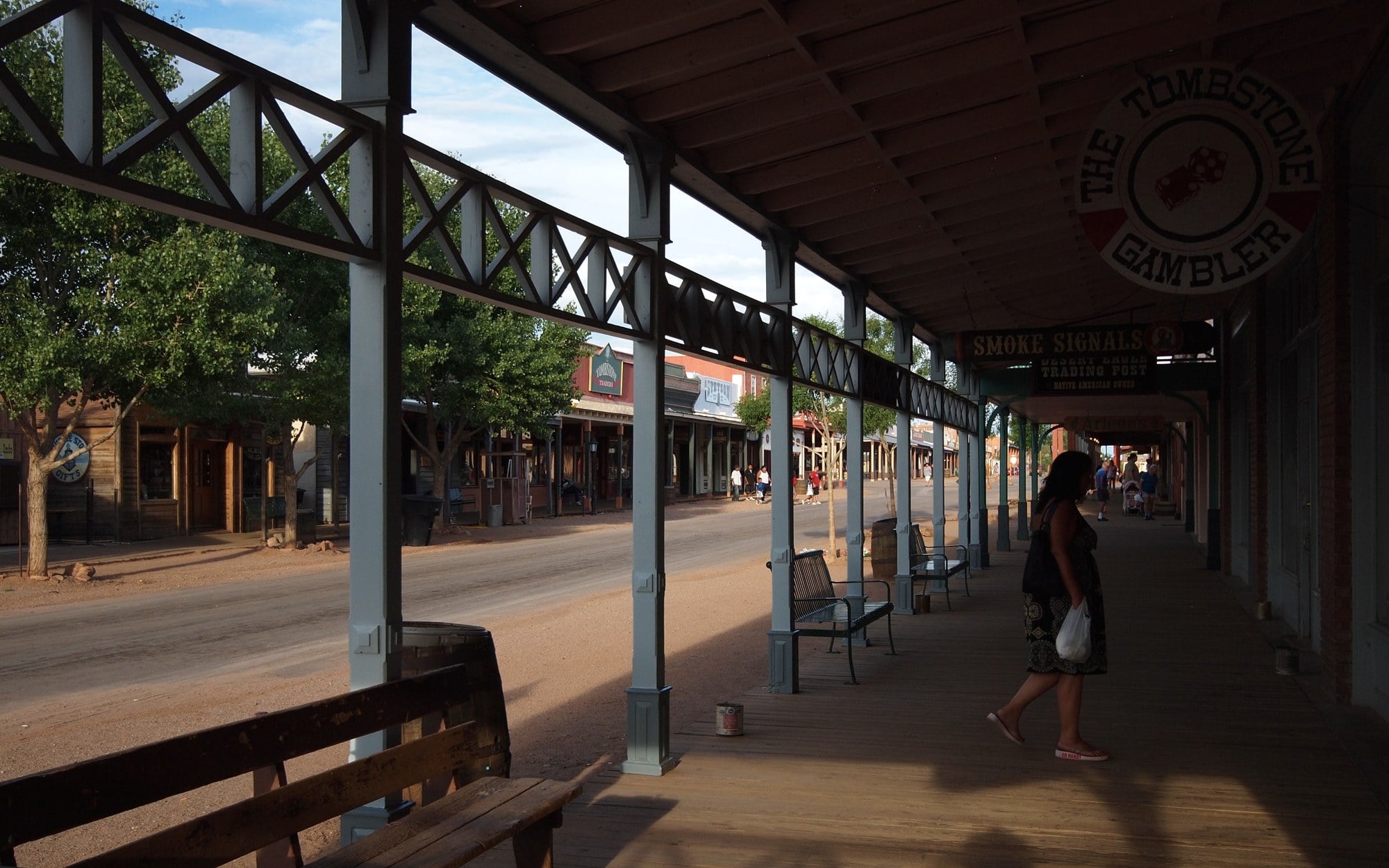
Tombstone Territory set itself in Tombstone, Arizona, the town that has never stopped being defined by the Gunfight at the O.K. Corral, and built its house style around the local paper. Pat Conway starred as Sheriff Clay Hollister; Richard Eastham co-starred as Tombstone Epitaph editor Harris Clayton Claibourne, who also narrated, framing each week’s events as though the audience were reading them off the front page. SlashFilm notes the series went further than atmosphere, attaching an on-screen claim of historical accuracy credited to Epitaph editor Clayton A. Smith and historian D’Estell Iszard — a chyron-level guarantee that the week’s shooting, swindle, or standoff had some grounding in the record.
“Indian Giver” runs that machinery through a familiar frontier scenario. Nimoy’s Little Hawk is accused of horse theft he did not commit, and the accusation is enough to draw a mob. Hollister’s job for the episode is protective rather than investigative in the usual sense: he has to keep Little Hawk alive long enough to reach a fair trial, which means standing between a prisoner and the townspeople who have already decided the case. SlashFilm observes that the episode’s racism is written into the plot rather than left as background texture, with the show’s principals arguing on Little Hawk’s behalf — the moral architecture of a great many late-1950s Western scripts, in which the lawman’s authority is tested by his own community.
A working actor on the Western circuit
The Tombstone Territory appearance was not an outlier. Through the late 1950s and into the early 1960s, Nimoy moved across the genre the way most jobbing television actors of the period did, taking single-episode parts wherever casting offices were hiring. SlashFilm lists Broken Arrow, Wagon Train, Gunsmoke, Bonanza, and The Virginian among his credits — a spread that covers the anthology-style road show, the long-running CBS institution, the ranch saga, and the 90-minute prestige Western, which is to say nearly every format the genre had produced by then.
That pattern is worth reading as labor history rather than as foreshadowing. Westerns were the volume business of network television in those years, and a New England–born actor with stage training and no fixed screen persona could reasonably expect to spend a decade in dusty wardrobe, playing a different name in a different town every few months. The temporal contrast is the interesting part: the same performer who would later be identified worldwide with a single character was, in this period, defined by interchangeability — hired, credited, and released, episode by episode, across a genre that consumed guest actors at industrial scale.
Why 91 episodes went quiet
Tombstone Territory ran three seasons from 1957, totaling roughly 91 episodes, and its guest list reads like a roll call of mid-century screen character work: John Carradine, Lon Chaney Jr., Alan Hale Jr., Angie Dickinson, William Conrad, James Coburn, Michael Landon, Elisha Cook, Lee Van Cleef, and Bing Russell, father of Kurt Russell. Dell Comics issued an adaptation around 1960, drawn by Dan Spiegle. By the arithmetic of episode count and cast density, this should be a series people still argue about. It is not. SlashFilm reports that around 39 episodes have circulated via Streampix and Prime Video, with “Indian Giver” not among them, and that DVDs existed in the 2010s — an availability picture that helps explain the silence more than any judgment on the show’s quality does.
The casting question is the other reason the episode reads awkwardly now. Nimoy was not of First Nation descent; he was born in Boston to Ukrainian Jewish parents, and SlashFilm registers a sigh at both the episode title and the practice of putting a non-Native actor in the role, noting that the arrangement does not meet modern standards of cultural sensitivity even as the script itself sets out to condemn the prejudice its plot depends on. That is the source’s framing, and it is worth leaving as such: a period credit described accurately, with the tension between intention and execution left visible rather than resolved.
There is a small loop to close. Nimoy would return to Tombstone by another route in the Star Trek episode rendered in various listings as “Spectre of the Gun” or “Specter of the Gun,” in which the Enterprise crew is dropped into a reconstruction of the O.K. Corral confrontation — which means, as SlashFilm puts it, that he visited the town twice. The pairing is a coincidence of genre inventory rather than a career arc, and it does not need to be more than that. “Indian Giver” survives as a documented stop on a working actor’s schedule: a third-season hour of a barely remembered ABC Western in which the future Spock played a man the town wanted to hang, and the sheriff kept him alive for court.