

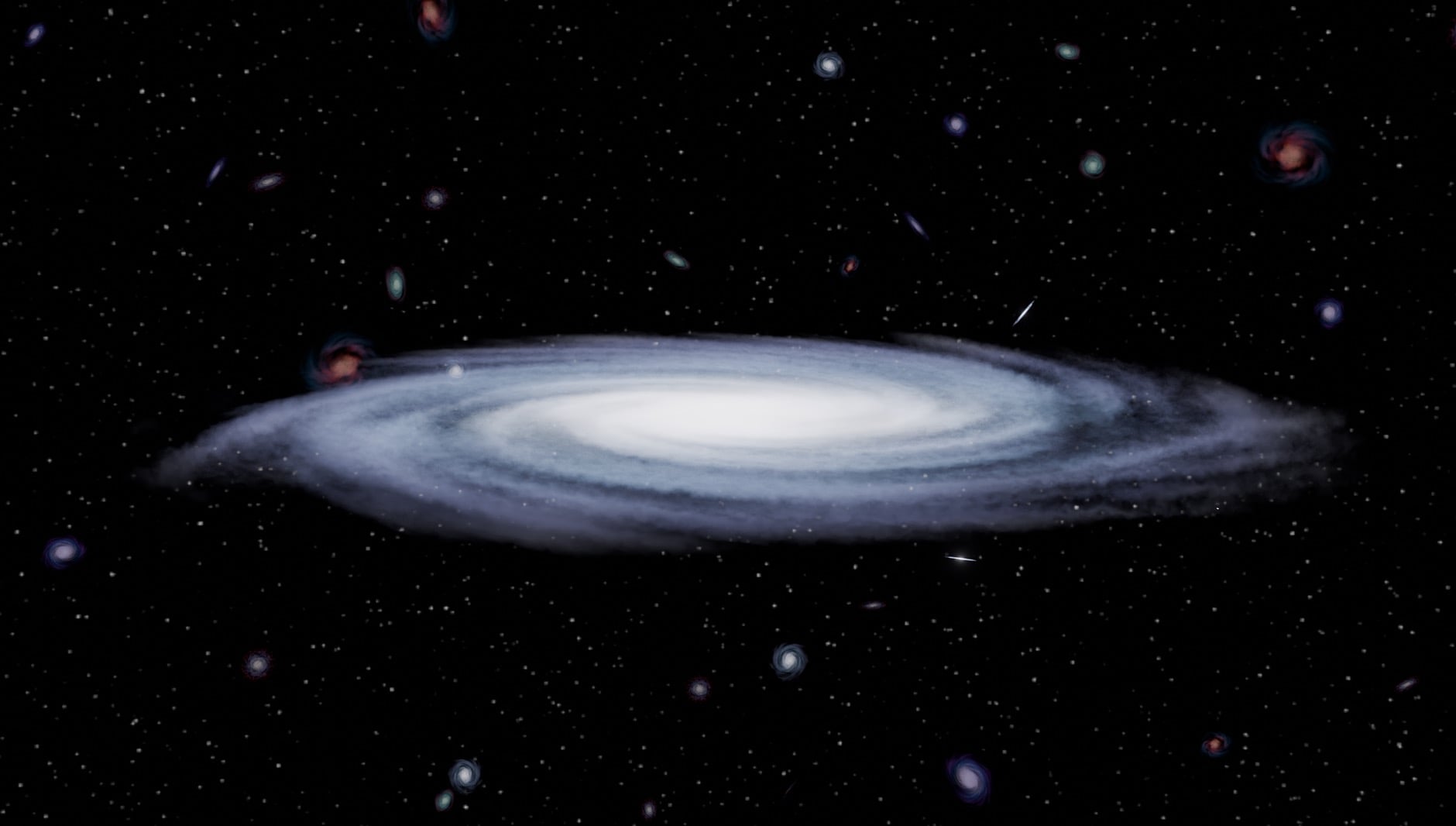
JADES-GS-z14-0 already contained oxygen when the universe was less than 300 million years old. Two teams reported the detection using ALMA, the telescope array in Chile, in studies publicised in March 2025. Webb had discovered the galaxy and established its extreme distance; ALMA added a clear chemical signature and a much more precise redshift.
The oxygen implies that stars had already made heavier elements and released them into surrounding gas. The suggestion of successive generations of massive stars is physically plausible, but the observation does not count those generations or identify individual ancient supernovae.
Webb provided the first clues
In NASA’s May 2024 discovery account, Stefano Carniani and Kevin Hainline described almost ten hours of observations with Webb’s Near-Infrared Spectrograph. The spectrum placed the galaxy at a redshift near 14, within the first few hundred million years of cosmic history.
Webb’s Mid-Infrared Instrument supplied another clue. The galaxy was brighter at longer wavelengths than a simple continuation of its shorter-wavelength light would suggest. The team interpreted that excess as evidence for strong emission from ionised gas, including hydrogen and oxygen.
That was an inference from brightness measured across a wavelength band. Detecting an individual oxygen line would provide a more specific test.
ALMA measured a particular oxygen transition
Sander Schouws and colleagues, writing in The Astrophysical Journal, reported a 6.6-sigma detection of the [O III] 88-micrometre line. The notation refers to oxygen atoms that have lost two electrons. Expansion stretched this far-infrared emission into the millimetre wavelengths that ALMA measures.
The line gave a redshift of 14.1793, with an uncertainty of 0.0007. That greatly narrowed the earlier Webb estimate while keeping the galaxy firmly within the era before the universe reached 300 million years of age.
Carniani’s team, in Astronomy & Astrophysics, obtained a closely matching redshift of 14.1796 from its analysis of the oxygen emission. As ESO’s announcement explains, two teams reached the detection through independent analyses of ALMA data. This agreement strengthens the interpretation of the signal; it is not evidence from two different galaxies.
This is ionised oxygen in galactic gas, not a detection of a breathable atmosphere.
Massive stars can finish their lives quickly
The early universe began with matter dominated by hydrogen and helium. Substantial oxygen enrichment requires later nuclear processing in stars. ESO describes the sequence behind the finding: stars produce heavier elements, then spread them through their surroundings when they die.
The relevant clock is very different from the Sun’s. NASA’s guide to stellar types explains that stellar lifetimes vary enormously with mass. Massive stars consume their fuel quickly and can complete their lives on timescales of millions of years. Their evolving interiors produce heavier nuclei, and supernova explosions can eject enriched material into space.
A galaxy therefore does not need billions of years to acquire oxygen. It needs stars to form early enough, some of them to evolve rapidly, and their products to reach the gas being observed. The abundance and distribution of that material depend on how much is produced, mixed, retained or expelled.
In our earlier discussion of why Webb’s apparently mature galaxies do not automatically imply impossible ages, the distinction was between chemical development and elapsed time. Oxygen provides evidence of processing. It is not a stopwatch with a fixed number of stellar generations marked on it.
How much enrichment remains a modelling question
Schouws’s team combined the ALMA measurement with Webb information and gas-emission models to estimate a heavy-element abundance roughly five to twenty per cent of the Sun’s. Carniani’s modelling favoured about seventeen per cent of the solar value. These are estimates of chemical abundance relative to a reference composition, not claims that seventeen per cent of the galaxy’s mass is oxygen.
The oxygen detection is firmer than every detail of the reconstructed history.
Carniani and colleagues also considered whether earlier outflows had removed gas. Such an interpretation depends on estimates of stellar mass, gas content and star-formation history. The authors’ proposed history should remain distinct from the directly measured emission line.
The Sun formed billions of years later
NASA dates the formation of our Solar System to about 4.6 billion years ago. The cloud that formed it already included elements made in previous stars. JADES-GS-z14-0 shows that this broader process of stellar manufacture and enrichment was operating far earlier, near the beginning of galaxy formation.
The comparison is chronological. It does not establish that oxygen detected in this remote galaxy became part of the Sun or Earth.
The next task is to reconstruct the enrichment
Our coverage of Webb’s challenge to early galaxy-formation models described the wider problem: bright, active systems appear early, and explaining them requires careful treatment of star formation, gas, dust and feedback. A measured chemical signature adds another constraint to that work.
For JADES-GS-z14-0, Carniani’s team identified deeper Webb spectroscopy as a route to a better carbon-to-oxygen measurement. Comparing those elements would help test which stellar populations enriched the gas and how quickly that enrichment occurred.