
A newly described microbe from Scottish waters has been given a name that will be easier to remember than to pronounce: Caledochytrium aldermaii, a single-celled organism whose offspring develop inside the body of the parent, and whose offspring sometimes carry offspring of their own before any of them ever see open water. The release comes when the outer cell ruptures. The work, reported by Heriot-Watt University and carried by Phys.org in early September 2026, describes a new genus and species published in the journal Protist by Jane L. Polglase and colleagues, placing it within the Labyrinthulomycetes — specifically the thraustochytrids, a group of marine protists that most people have never heard of and that most seawater has plenty of.
The name carries two dedications. Caledochytrium nods to Caledonia, the classical name for Scotland, where every known sample so far has come from. The species epithet honors Dr. David Alderman, the CEFAS scientist whose cultures kept the organism alive long enough to be studied properly — a reminder that a good deal of microbiology depends on somebody maintaining a flask for years while the rest of the field moves on. The description emerged from a consortium spanning Heriot-Watt, the Heriot-Watt spinout Strameno, CEFAS Weymouth, and the Institute of Aquaculture at Stirling University.
The chamber, the daughters, and the burst
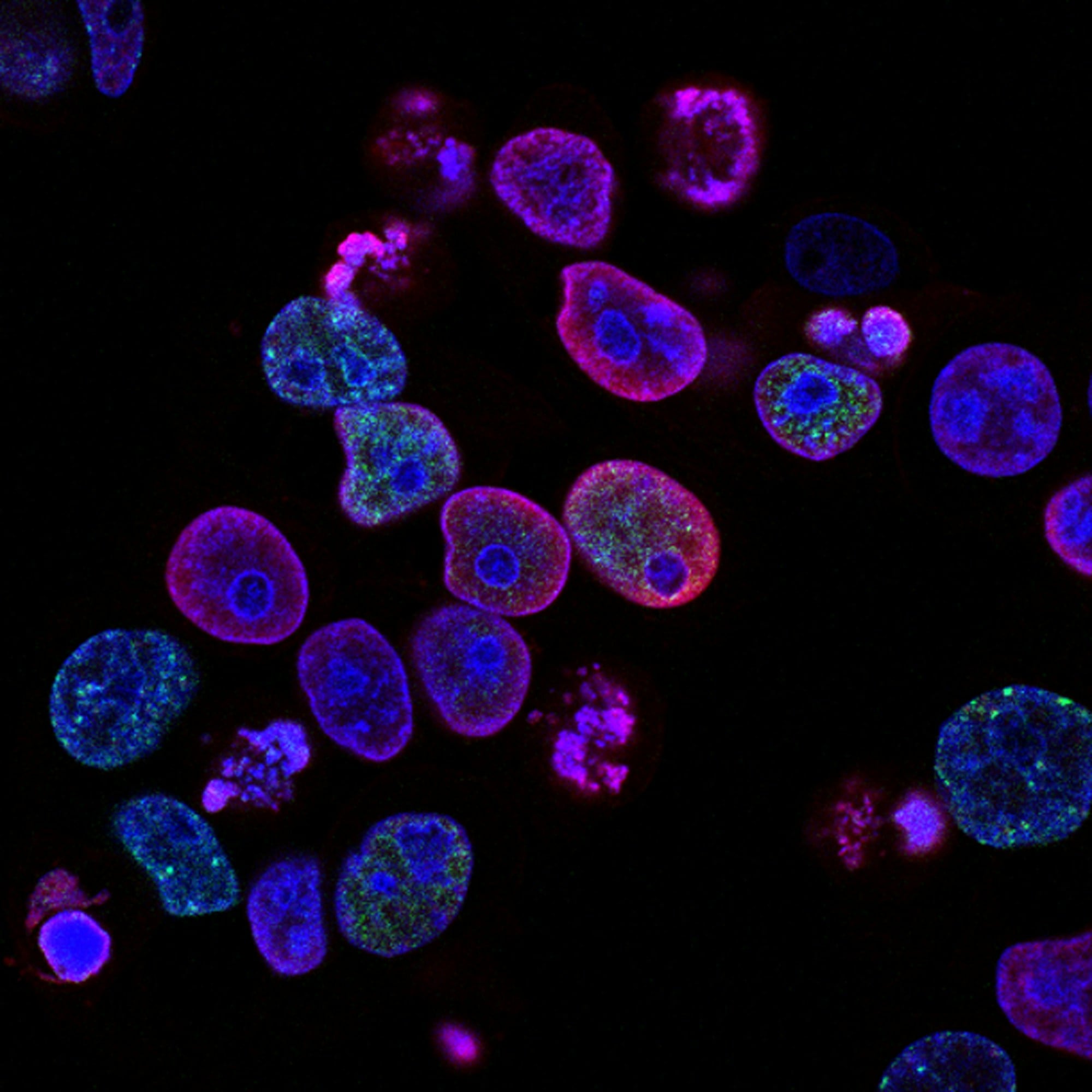
What distinguishes Caledochytrium aldermaii is not that it reproduces by dividing internally — thraustochytrids commonly produce spores inside a parent cell wall — but the architecture and the timing of it. As the cell matures, it develops a large internal chamber, a vacuole-like space that becomes the nursery. Daughter cells form and grow within that chamber rather than budding outward. They remain enclosed, packed inside the parent, until the mother cell ruptures and scatters them.
The detail that earned the organism its headlines is what some of those daughters are already doing while still inside. In at least some cells, a daughter has begun forming its own internal generation before release — a grandmother, a mother, and the beginnings of a granddaughter stacked inside one cell wall. Professor Peter Morris of Heriot-Watt reached for greenfly as a comparison, since certain aphids are born already carrying developing embryos, and described the microbe in similar terms as a kind of "pregnant grandmother." It is an analogy, not a claim of shared machinery: aphids and thraustochytrids sit on wildly separate branches of the tree of life, and the resemblance is in the nesting, not the biology underneath it.
The rupture itself is the punchline the press could not resist — the university's own announcement leaned on a certain 1979 science fiction film — but the more interesting point is that the whole sequence was documented, not inferred. Dr. Jane Polglase, who has studied these organisms for decades and co-founded Strameno with Alderman and Dr. Lydia Brown, was able to capture the process on the electron microscope because the team was watching cells behave rather than reading their genomes alone.
Octopus lairs, a trout, and a salt marsh
Where the organism turns up is its own small puzzle. According to the Heriot-Watt account, it has been found three times in Scotland: in association with Scottish octopuses and their lairs, in association with rainbow trout, and on its own in a salt marsh on Scotland's east coast. That is a description of encounters, not a survey — nobody is claiming to know how abundant it is, how widely it ranges, or whether those three settings represent a preference or an accident of where researchers happened to be sampling.
The broader group offers context. Labyrinthulomycetes are among the sea's recyclers, breaking down dead organic material in marine and salty waters and returning it to circulation. They move and feed by way of an ectoplasmic net — a branching external filament system that extends from the cell, anchors it, draws in nutrients, and helps regulate buoyancy. It is a strange piece of equipment: an organism that essentially externalizes part of its digestive and locomotor apparatus into the surrounding water. The paper notes that members of this group can act as opportunist pathogens where hosts are already stressed, but the recycler framing is the one the researchers lead with, and the association with an octopus lair or a trout does not by itself establish that this microbe was doing any harm.
Why looking still pays
The methodological note may outlast the imagery. Modern microbial discovery leans heavily on sequencing, which is superb at telling you that something unfamiliar is present and considerably worse at telling you what it does. A nested three-generation reproductive cycle does not announce itself in a gene list. Polglase's point — that attention to behavior and morphology is what allowed the team to catch and image the process — is a quiet argument for keeping cultures, microscopes, and patience in the toolkit alongside the sequencer.
There is applied interest, too, though it deserves to be stated carefully. Thraustochytrids are already of commercial curiosity because they accumulate omega-3 fatty acids, including DHA, along with carotenoids, and can run to roughly 50% protein. The researchers believe an organism like this one could attract attention from aquaculture and related industries. That is a possibility under investigation, not a product, and nothing in the Protist description changes what is currently on a shelf.
What the paper does establish is narrower and more durable: a reproductive strategy of this kind, with nested generations released by rupture of the parent cell, is newly documented in this group. Somewhere off Scotland, cells are presumably doing it right now, and have been for a very long time, unwatched.