
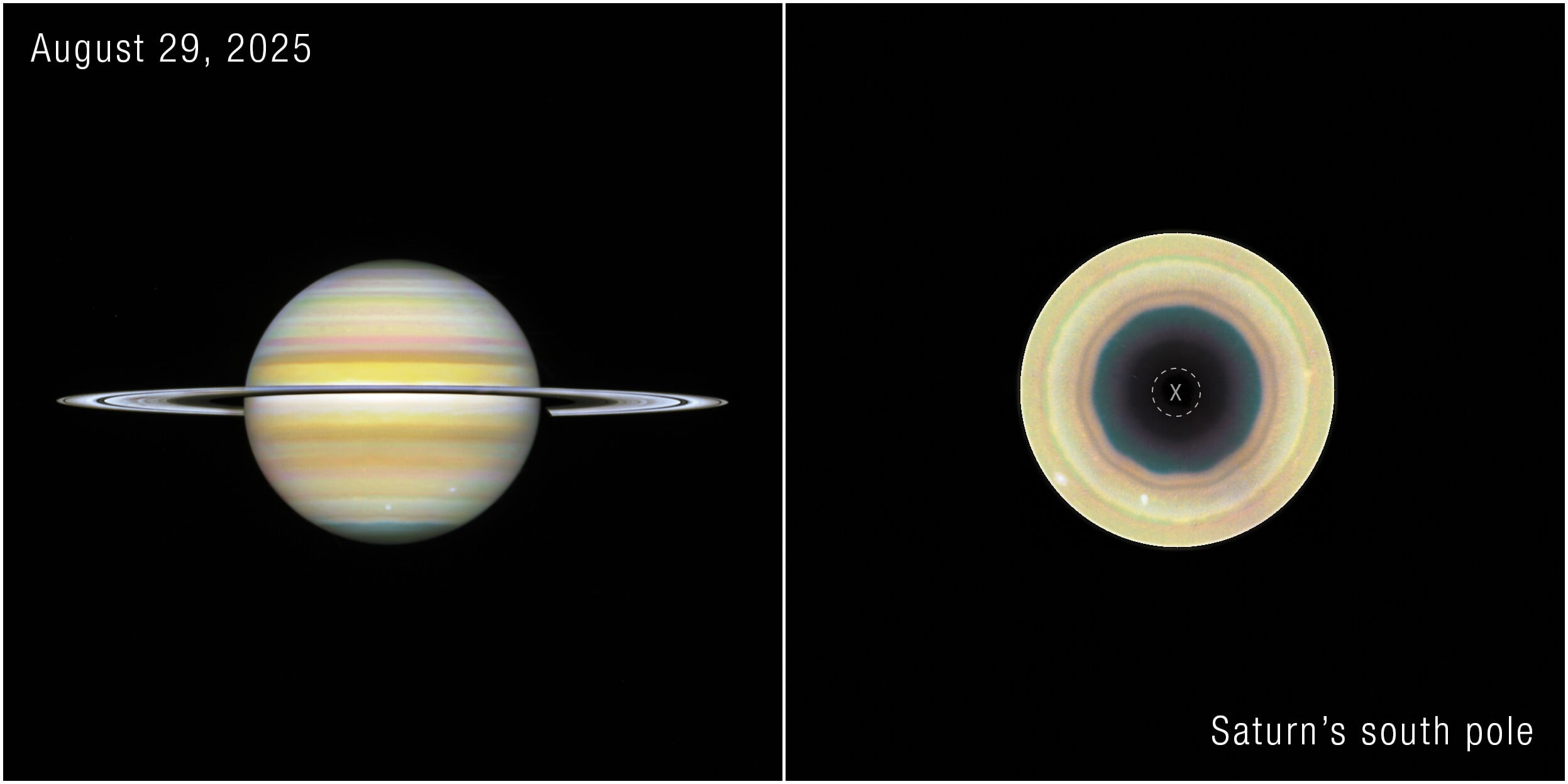
Saturn has a second polygon. Astronomers working with the NASA/ESA Hubble Space Telescope report a ten-sided wave — a decagon — encircling the planet's south pole, roughly 104,000 miles across, each straight-looking side running on the order of 10,000 miles. It is the geometric counterpart, though not the duplicate, of the six-sided jet that has ringed Saturn's north pole since Voyager spotted it more than forty years ago. The finding, described by NASA and detailed in a paper published in Science Advances in early September, was led by Agustín Sánchez-Lavega of the University of the Basque Country (UPV/EHU) in Bilbao, Spain, with colleagues including Amy Simon of NASA's Goddard Space Flight Center and Mike Wong of the University of California, Berkeley.
The precise numbers, as reported by Space.com, come out to about 104,250 miles (167,820 km) across, with sides of about 10,425 miles (16,782 km) apiece — figures worth holding loosely, since the pattern is a wave in a moving atmosphere rather than a drawn shape with fixed corners. For scale, the whole structure could swallow a dozen Earths laid end to end. It sits centered near 63 degrees south latitude, riding a fast circumpolar jet, and it appears to have been strengthening rather than fading.
A pattern that showed up when the pole came back into view
Part of the reason nobody caught this earlier is geometry. Saturn's axial tilt and long orbit mean each pole hides for years at a stretch; from Earth, the south pole was effectively out of useful view from roughly 2012 to 2023. The Cassini mission, which orbited Saturn from 2004 to 2017 and had excellent southern coverage in its early years, recorded a warm polar vortex and a cyclone at the south pole, but no long-lived polygonal jet to match the northern hexagon. Whatever this decagon is, it does not appear to have been a permanent southern fixture waiting to be noticed.
The trail begins with amateurs. Ground-based images contributed by observers including Trevor Barry in Australia and Jean-Paul Oger, coordinated through the Planetary Virtual Observatory Laboratory, showed suggestive structure at the south pole across 2024 and 2025 — the kind of hint that is easy to dismiss in a single frame and hard to ignore in a series. Going back through Hubble's archive, the team found the pattern already faintly present in 2023 imagery, and more pronounced in the years that followed.
Those Hubble frames come from OPAL, the Outer Planet Atmospheres Legacy program, which Simon leads. OPAL exists precisely for this: a yearly, consistently calibrated portrait of Jupiter, Saturn, Uranus, and Neptune taken with Wide Field Camera 3, in the same filters, year after year, so that changes reveal themselves rather than hiding inside differences of technique. A decade of matched images is what turns "there seems to be something at the pole" into a measurable wave with a countable number of sides.
Ten sides, stacked through the clouds
The decagon is not a surface marking. It is the visible expression of a wave locked into a powerful eastward jet stream, and the team finds it extends vertically through more than one layer of Saturn's atmosphere. The evidence for that is subtle and satisfying: when the same feature is imaged through different filters, its apparent position shifts slightly. Each filter samples a different depth in the hazes and clouds, so a shape that leans with altitude will appear to slide as you change wavelength. The polygon, in other words, is a column, not a decal.
That is the strongest structural echo of the northern hexagon, which Cassini showed to be similarly deep-rooted, its corners persisting through changing seasons and a shift in atmospheric color from blue to gold. The hexagon has now been tracked for over four decades — long enough that planetary scientists came to treat it as a singular oddity of Saturn's north. The core implication of the new work, as Sánchez-Lavega has framed it in coverage of the paper, is that the hexagon may not be a one-off after all: if a jet at the opposite pole can organize itself into a regular polygon, then polygon-making is something Saturn's atmosphere does, given the right conditions, rather than something that happened once.
The differences matter too. Six sides versus ten is not a cosmetic distinction; the number of lobes in this kind of wave relates to the width, speed, and shear of the jet that carries it, so a decagon implies a southern jet configured differently from its northern sibling. Laboratory experiments with spinning fluids have produced similar polygons for decades, and the underlying physics is thought to involve instabilities in a strong circumpolar flow — but no one is claiming this specific decagon is explained.
Why now, and how long
The open questions are the interesting ones. Why did the pattern emerge in the 2020s, when Cassini's earlier southern survey found nothing like it? Is it seasonal, keyed to the slow swing of sunlight across Saturn's poles over a 29-year orbit? Will it settle into decades-long permanence like the hexagon, drift, change its number of sides, or dissolve entirely?
Answering that requires exactly what OPAL was designed to provide: more years of the same measurement. Continued Hubble monitoring can track whether the sides sharpen or blur and whether the whole pattern drifts in longitude. The James Webb Space Telescope, working at infrared wavelengths that probe temperature and deeper structure, can test how far down the feature reaches. Numerical models of Saturn's jets will have to reproduce both a hexagon and a decagon, in opposite hemispheres, at the same time.
For now the accounting is simple and incomplete: a ten-sided wave, roughly 104,000 miles across, in the southern jet of a planet that has apparently been doing this in more than one place all along.