

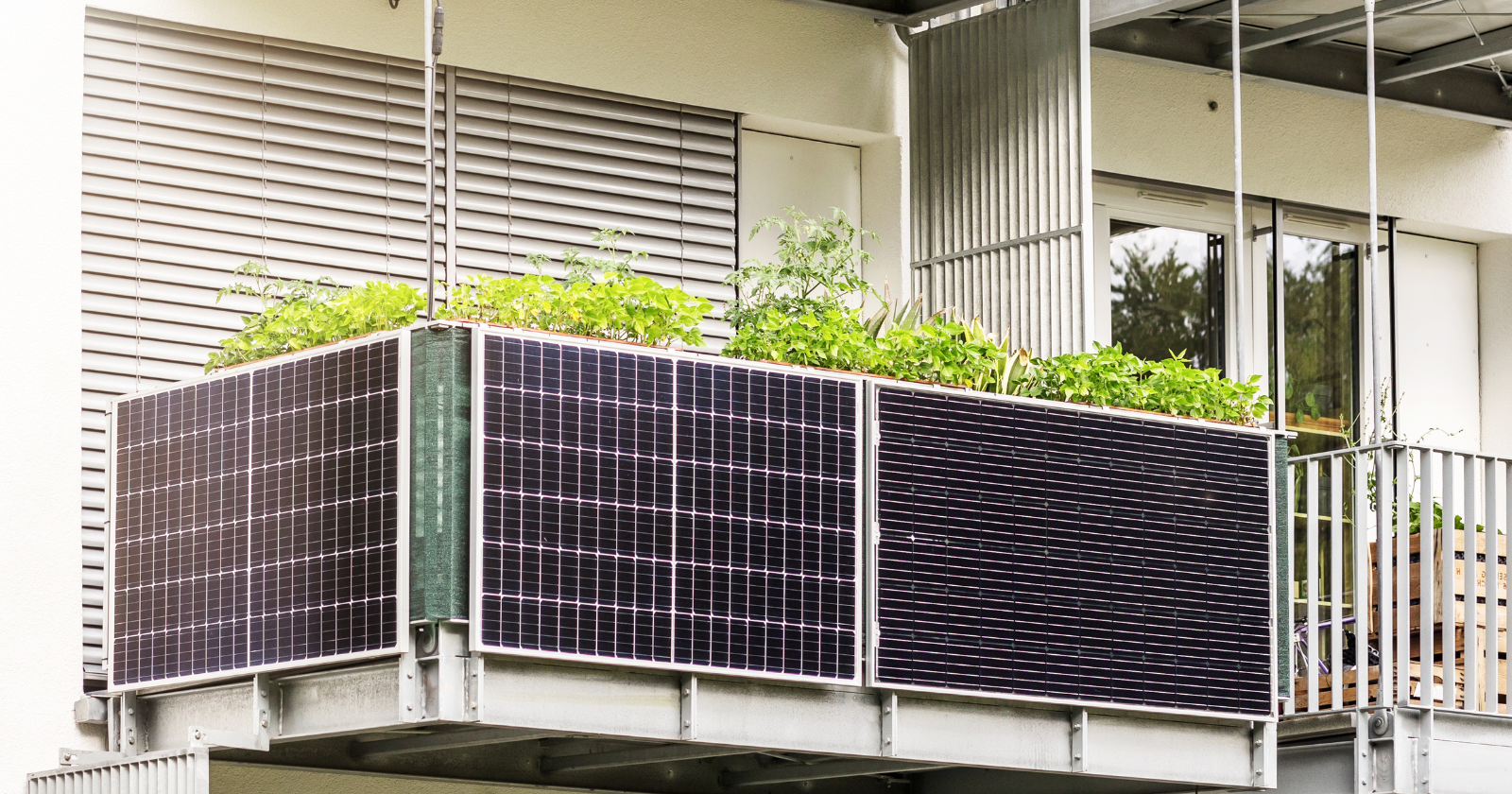
The most successful solar program in Europe right now involves no roofs, no installers, no permits and no ladders.
It is sold in German supermarkets for around 500 euros, comes in a box, and installs like a bookshelf: bolt one or two panels to the balcony railing, clip on a microwave-sized inverter, and plug the cable into an ordinary wall socket. From that moment, sunlight flows backward through the outlet, quietly running whatever the apartment happens to have switched on.
Germans call it a Balkonkraftwerk — a balcony power plant — and by mid-2025 the country’s official registry had passed one million of them, with community estimates counting millions more sold, half a nation’s railings slowly turning photovoltaic.
Why the balcony, of all places
The boom makes no sense until you look at who lives in Germany, and how.
Roughly 55 percent of German households rent — the highest share in the EU — and a renter is locked out of the standard solar story. The roof belongs to the landlord. The renter can’t drill it, finance it, or take it along when the lease ends.
What a tenant does control is the balcony. And German law, rewritten in stages to encourage exactly this, turned that sliver of controlled territory into a legal power station: plug-in solar is treated not as an electrical installation but as something closer to an appliance. No electrician required, no grid-operator paperwork — since the 2024 Solarpaket reforms, a single free online registration taking under half an hour. Landlords and homeowner associations, once the great veto, are now legally restricted in their ability to refuse tenants the panels. When you move, the power plant unbolts and moves with you.
Add Europe’s most painful electricity prices — around 32 to 35 cents per kilowatt-hour — plus zero VAT on the hardware and city subsidies up to 500 euros in Berlin and Munich, and the arithmetic closes in a few years. After that, the railing pays rent.
The meaning of 800 watts
The number in the law is the system’s signature. Each balcony plant may feed at most 800 watts into the apartment — deliberately modest, sized to what old apartment wiring can safely absorb through a socket, and to keep the whole category simple enough to need no inspections.
Eight hundred watts is not a household’s power. It is, as the coverage likes to put it, a fridge and a laptop — the background hum of domestic life. A typical system yields 600 to 900 kilowatt-hours a year, trimming perhaps 10 to 25 percent off a small household’s bill and saving on the order of 300 kilograms of CO2 annually.
Trivial, per balcony. Then multiply by a million-plus and rising: hundreds of megawatts of capacity added in single half-years, small battery packs now joining a quarter of new kits so the midday sun can run the evening, and a solar constituency that now includes people who will never own a roof. The panels’ most measurable output may not even be the electricity — it is normalization, the energy transition made visible at eye level on ordinary streets, one railing convincing the next.
The fine print, honestly
The regime has real edges. The 800-watt cap applies to the inverter’s output; panel capacity can legally run higher — up to 2,000 watts-peak — though a newer German safety standard caps what a standard household socket connection may carry, and battery-equipped systems fall outside the simplified rules entirely. Purists note that a socket-fed panel mostly offsets daytime use and exports its surplus to the grid for free, which is why the little batteries are spreading. And a north-facing balcony in Hamburg is, was, and remains a bad power station.
But the design’s genius is exactly its refusal to be ambitious per unit. Every other solar policy asks: how much power can we get from a building? Germany’s balcony law asked a different question: what is the largest solar system that requires permission from absolutely no one? The answer turned out to be 800 watts, hanging off the one architectural surface a tenant rules — and a million households took the deal. The energy transition’s grandest structures are the gigawatt farms. Its most democratic one plugs into the wall, next to the toaster.
