

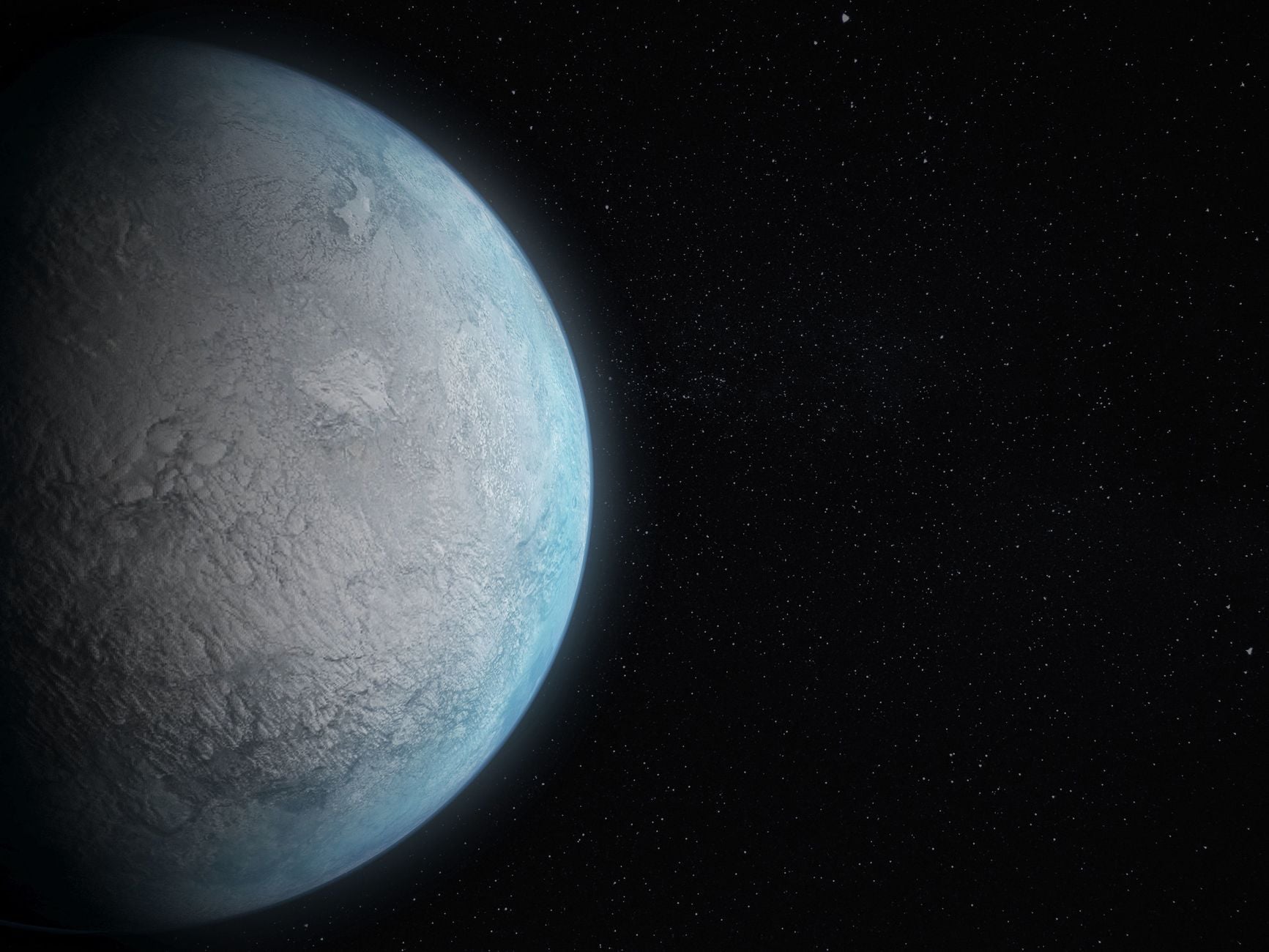
Voyager 2 reached Uranus on 24 January 1986 and remains the only spacecraft ever to have visited the planet. Its brief passage discovered the Uranian magnetic field and supplied the in-situ measurements behind almost every subsequent account of the planet’s magnetosphere.
There was always a danger in turning one flyby into a permanent portrait. A reanalysis published online on 11 November 2024 found that Voyager arrived while an unusually forceful solar wind was compressing the dayside magnetosphere. Conditions producing a boundary as close to the planet as Voyager observed are estimated to occur only about 4 per cent of the time in the comparison data.
The result does not make the encounter mistaken or useless. Voyager measured what was there. The problem is one of typicality: a rare, heavily compressed state may have been interpreted for nearly four decades as Uranus’s normal magnetic environment.
The strange Uranus Voyager revealed
Before Voyager 2, nobody knew whether Uranus possessed an internally generated magnetic field. The flyby established that it did, and that its geometry was unlike the relatively orderly arrangement familiar at Earth.
NASA’s current Uranus guide describes a magnetic axis tilted nearly 60 degrees from the rotation axis and offset from the planet’s centre by about one-third of its radius. The field strength consequently varies sharply around the planet. Combined with Uranus’s sideways rotation, that geometry twists the distant magnetotail and continually changes which part of the field faces the solar wind.
Those structural findings remain. The 2024 reanalysis concerns the state of the surrounding magnetosphere during the encounter, not whether the underlying field is tilted or off-centre.
Voyager also found a puzzling combination. Uranus had electron radiation belts of extraordinary intensity, second only to Jupiter’s in the NASA account, yet much of the magnetosphere seemed almost empty of plasma. The five large moons inside the magnetic bubble should have released water-derived ions from their icy surfaces, as moons do elsewhere. Their apparent absence helped build a picture of geologically inactive moons inside a strangely depleted system.
Eight days of solar-wind data changed the interpretation
Jamie Jasinski of NASA’s Jet Propulsion Laboratory and colleagues revisited the plasma measurements taken as Voyager approached Uranus. Their open-access paper in Nature Astronomy followed the solar-wind dynamic pressure through the days around the encounter instead of treating the few hours immediately upstream as ordinary background conditions.
Eight days before the flyby, the dynamic pressure was about 0.001 nanopascals. It reached a minimum of 0.00078 nanopascals, then climbed sharply. Near Voyager’s inbound crossing it was about 0.018 nanopascals, roughly 18 to 23 times the values measured during the quieter interval. By the outbound crossing, it was higher still, around 0.028 nanopascals.
Dynamic pressure here combines the solar wind’s density and speed. A denser or faster stream pushes harder against a planet’s magnetic field. The dayside magnetopause settles where the outward magnetic and plasma pressures inside the magnetosphere balance the incoming solar wind.
The boundary therefore moves. The researchers estimated that Uranus’s subsolar magnetopause lay about 28 Uranus radii from the planet on 16 January, about 22 radii on 21 January, and approximately 17 radii when Voyager arrived on 24 January. The spacecraft entered a system that had been squeezed steadily for days.
What the 78 per cent figure actually measures
The change from 28 to 17 Uranus radii represents a contraction of roughly 40 per cent in the subsolar standoff distance. That is a one-dimensional measure from the planet towards the Sun. It is not the same thing as volume.
Jasinski and colleagues also estimated how much the dayside volume changed by treating that region as a simple hemisphere. Because volume scales with the cube of a characteristic radius, a 40 per cent reduction in standoff distance produces a much larger volumetric change. Under that approximation, the dayside magnetosphere was reduced by about 78 per cent.
This boundary is essential to the headline. Voyager did not directly map a three-dimensional shell and watch exactly 78 per cent disappear. The calculation uses an idealised hemispherical dayside. Nor does it mean every part of Uranus’s magnetosphere, including the long magnetotail, contracted by one universal percentage.
The estimate is still physically meaningful. It expresses just how different the space available on the sunward side may have been a little over a week before the flyby. But it should be read as a modelled dayside-volume change, not as a measurement of the entire magnetic environment in one number.
Why the encounter state appears to be rare
The researchers compared the flyby conditions with solar-wind measurements Voyager 2 collected while it was travelling at roughly the orbital distances occupied by Uranus. From the pressure distribution, they calculated the magnetopause locations that Uranus would be expected to have experienced.
The average subsolar standoff distance in that analysis was about 22.2 Uranus radii. A boundary at 17.3 radii or closer, comparable to what Voyager observed, appeared only 4 per cent of the time. The paper describes the flyby state as present less than 5 per cent of the time; NASA’s summary rounds the result to 4 per cent.
That percentage also needs a boundary. It is inferred from a finite set of Voyager measurements at Uranus-like distances during the solar-minimum conditions of that era. It is not a continuous, multi-decade weather record from an instrument parked beside Uranus. The number strongly supports an atypical encounter, but it should not be promoted into an exact probability valid for every phase of every solar cycle.
The phrase “a bad day” is similarly shorthand. Uranus did not suffer atmospheric weather in the terrestrial sense, and nothing went wrong with the planet. It was exposed to an unusual upstream solar-wind pressure at precisely the time humanity’s only visiting spacecraft arrived.
A temporary compression can solve two old puzzles
The reanalysis offers a plausible connection between the intense radiation belts and the missing plasma. Compression can energise the magnetosphere and inject electrons into the belts, temporarily raising their flux. At the same time, the enhanced solar wind can drive existing plasma out of the system.
That would let Voyager observe strong electron belts inside an otherwise plasma-poor magnetosphere without requiring both features to be permanent. The apparent contradiction may have recorded different consequences of the same external disturbance.
The moon question changes as well. If plasma had recently been swept away, the failure to detect water-group ions does not prove that Ariel, Umbriel, Titania, Oberon and Miranda were producing none. Some may have been supplying material before the encounter.
This is not confirmation of active plumes, oceans or present geological activity. It removes one old argument against activity. As SpaceDaily’s earlier report on the Uranian moons noted, even the inventory of small satellites continued changing when Webb detected a 29th moon in 2025. The system is constrained by short visits and distant follow-up, not by continuous local observation.
What remains securely Uranian
It would be an overcorrection to conclude that the textbooks are simply wrong about everything Voyager found. The magnetic field’s 59-degree tilt and large offset are properties of the internal field model supported by the spacecraft measurements. Solar-wind compression does not make those features disappear.
Uranus should also have a highly variable magnetosphere even under ordinary upstream conditions. Its rotation axis is nearly in the orbital plane, while the magnetic axis points far away from that rotation axis. The planet turns once in a little over 17 hours, carrying the magnetic geometry through radically changing orientations relative to the solar wind.
That underlying arrangement is examined from another direction in SpaceDaily’s account of Uranus’s 97.77-degree axial tilt. The planet’s sideways posture, the tilted internal field and external solar-wind pressure all matter. The 2024 paper revises how strongly the last of those distorted the particular configuration Voyager entered.
The safest distinction is between anatomy and state. Voyager discovered the magnetosphere’s unusual magnetic anatomy. The plasma depletion, radiation-belt intensity and compressed boundary were at least partly the state of that anatomy under rare forcing.
Why an orbiter would change the argument
NASA’s Voyager fact sheet places closest approach 81,500 kilometres above Uranus’s cloud tops. The flyby returned observations that no telescope at Earth could have supplied, but it could not wait for the solar wind to relax and repeat the same traverse.
An orbiter could watch the magnetopause expand and contract, measure how plasma content changes, follow the radiation belts over many rotations and compare different magnetic orientations. Repeated moon encounters could also distinguish a persistent ion source from material briefly missing after a compression event.
The National Academies’ planetary decadal survey prioritised a Uranus orbiter and atmospheric probe, partly because so many basic questions still rest on Voyager’s single path. A return mission would not replace the 1986 dataset. It would supply the time dimension that a flyby, however well executed, cannot provide.
Until then, the archive has to do two jobs at once. It is the only direct record of Uranus’s magnetosphere and a warning about what one record cannot establish. Voyager 2 revealed a genuinely unusual magnetic world, but it may also have arrived on one of the few days when that world looked most extreme.