
The story starts, as ranch stories often do, with a building rather than a boundary line. In 1982, Ralph Lauren and his wife Ricky bought land outside Ridgway, Colorado, in the foothills below the San Juan Mountains — the range that also frames Telluride, which is how Bon Appétit later placed it for readers. What drew them there, by Lauren’s own account as related in Ralph Lauren Mag’s “Western Wonder”, was a tip: someone mentioned that the property held a barn nearly a hundred years old. They went to look at the barn. They fell for the place.
What that first acreage became over the following decades is the part that resists a neat ledger. The holding grew — parcel by parcel, over years, in a way neither primary account reduces to a timeline — into what is now described as roughly 17,000 acres: the Double RL Ranch, a working cattle operation that doubles as a wildlife preserve. RL Mag’s framing is of a landscape where eagles, elk and deer move undisturbed among piñon pines and wild sunflowers. Bon Appétit’s is blunter and no less telling: a 17,000-acre cattle ranch in Ridgway. Both descriptions are true at once, and the tension between them is the interesting thing.
A barn nearly a century old, and the country around it
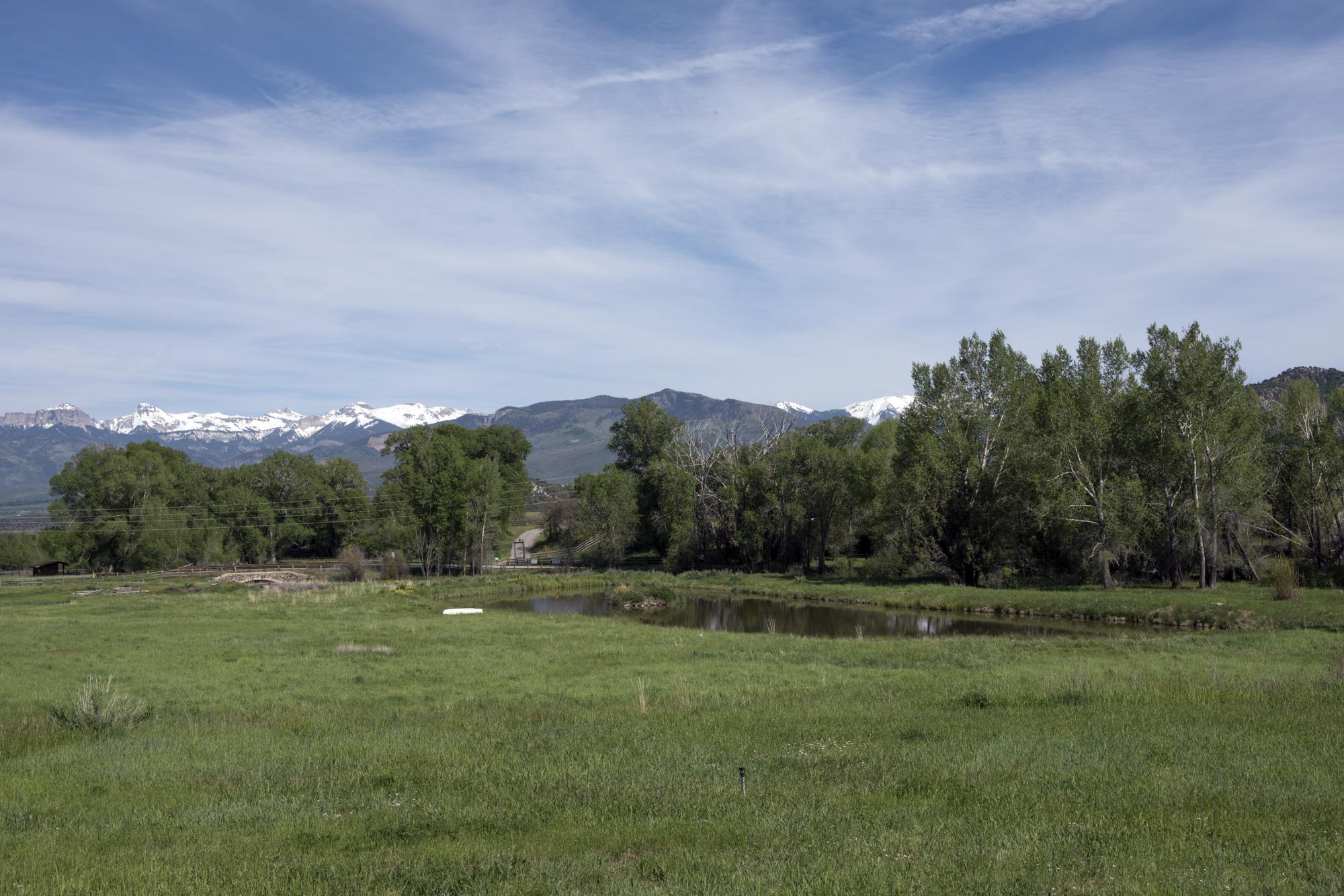
Ridgway sits in Ouray County, in the wide green trough of the Uncompahgre valley, with the San Juans stacked up to the south in the most theatrically vertical arrangement the Rockies manage anywhere in Colorado. It is a place that photographs well and works hard, and in 1982 it was not yet the buffer zone of a resort economy in the way parts of the region have since become.
The barn — the Vance, as the old cabin-and-barn complex on the property is known — was the hook. RL Mag presents Lauren’s recollection plainly enough: the age of the structure was what got mentioned to him, the barn was what he went to see, and the affection for the property followed from standing in front of it. Ricky Lauren’s recollection, as relayed in the same account, adds the light: her husband driving up and encountering the mountains at sunrise, and the sheer scale of it stopping him.
That sequence matters, because it inverts the usual order of a big Western land purchase. The land was not first assembled and then furnished with a set piece. A century-old working structure was already standing, and everything else — the decades of acquisition, the cattle programme, the conservation posture — accreted around it.
RL Mag also records a scruple that reads as unusual for a man whose profession is the construction of image: Lauren has said that having to build on the property at all caused him a kind of pain, and that he chose low, inconspicuous sites for what did get built. Whether or not one grants a designer that particular anxiety, the resulting rule of thumb — build low, build out of the sightline — is a defensible way to treat a valley floor with a mountain wall behind it.
Cattle first, and the animals that came with the deal
The most durable fact about the Double RL is that it kept doing the job it was already doing. Lauren told Bon Appétit that part of the appeal was that it was a real working cattle ranch, and that not raising cattle was never seriously on the table. That is a low bar in principle and a high one in practice; plenty of large Western holdings have quietly become lawns with fences.
Bon Appétit’s reporting puts the herd at roughly 800 head, Angus and South Devon — a figure worth holding loosely, since herd numbers on any ranch are a moving quantity that shifts with season, market and rainfall. The same account describes cattle being moved pasture to pasture by cowboys on horseback rather than in four-wheel drives, which is less a nostalgia flourish than a management choice: horses handle broken ground and stock pressure differently to vehicles, and the difference shows up in how cattle behave afterwards. Some of the beef, both Bon Appétit and RL Mag indicate, goes to Lauren’s restaurants in Chicago and New York — a short, legible supply chain from Colorado grass to a dining room table.
Around that operation sits the preserve function. The RL Mag portrait of eagles, elk and deer moving undisturbed through piñon and wild sunflowers is a description of habitat left largely alone across a very large contiguous block. At roughly 17,000 acres — about 69 square kilometres — the arithmetic of unfragmented land does real ecological work regardless of intent. Elk in particular need seasonal room to move, and big private holdings that stay unsubdivided end up functioning as connective tissue whether or not anyone frames them that way.
The Vance, and the people who kept coming back
Of everything on the property, the Vance is the piece with the strongest gravitational pull. Bon Appétit reports it as Lauren’s favourite place on the ranch — the old cabin and its soaring barn — and describes the family camping there when the children were young. In 2011, David Lauren married Lauren Bush at the Vance.
That is a fairly narrow set of facts, and it does not need embroidering. A structure that was already close to a century old when the Laurens first saw it has since absorbed several decades of one family’s ordinary use: sleeping out, coming back, marking a wedding. Buildings acquire meaning through repetition more than through renovation, and the Vance’s role in this story is essentially that of an anchor point — the reason the first purchase happened, and the place the family kept returning to once everything around it had grown.
There is a tidy irony in the arrangement, and it holds up under inspection. The founder of one of the most deliberately constructed visual worlds in American commerce bought into a Colorado valley because of a barn, then spent decades expanding around it while insisting the place go on running cattle. The Double RL is a brand adjacent to a real ranch, not the other way round. The eagles, the elk, the piñon, the roughly 17,000 acres and the 800-odd head of Angus and South Devon are the working ledger; the barn is the reason any of it exists.