
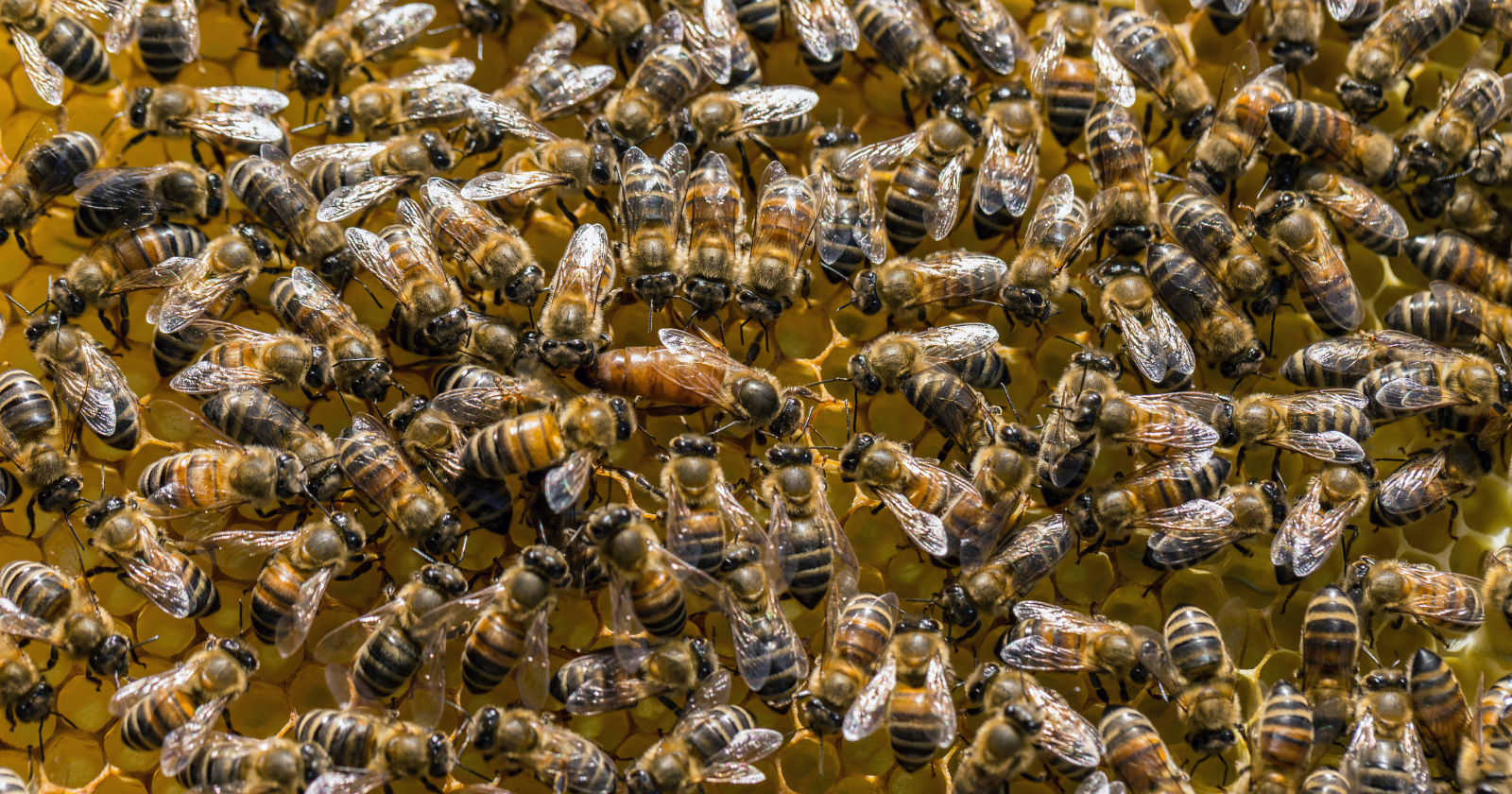
A woman took a shortcut through a graveyard to dodge a parking fee and ended up on a scientific paper.
Rachel Fordyce worked as a technician in a Cornell University entomology lab. To avoid paying for a campus parking spot, she used to park at a nearby plaza and walk the last stretch to work through East Lawn Cemetery in Ithaca, New York. One spring morning in 2022, as Phys.org reported, she noticed bees pouring out of the turf between the headstones, scooped a handful into a jar and carried them into the lab.
They turned out to be Andrena regularis, the regular mining bee. That cemetery, as it happens, is sitting on roughly 5.5 million of them.
How to count five million bees you cannot see
Nobody dug the place up, for reasons that should be obvious. Instead the team used emergence traps: small mesh tents pegged over the soil with a funnel leading to a glass jar. Smithsonian magazine reported that ten of these traps went out across the nesting area before the 2023 season started, running from the end of March to the middle of May and catching 3,251 individual insects across 16 species of bees, flies and beetles. The mining bee dominated the haul.
Density per square metre, scaled across about 6,000 square metres of grass and gravestones, gave a population somewhere between three million and eight million, with 5.5 million as the midpoint. In a paper published in Apidologie, lead author Steve Hoge, an undergraduate in the lab at the time, and his co-authors argue the find ranks among the largest such aggregations documented in the scientific literature.
One site, one season, one estimate with a wide margin either side. Still, that is an astonishing number of bees under an acre and a half.
Solitary bees that are hopeless at being solitary
“Aggregation” sounds like a hive, but these bees don’t share one. Mining bees have no queen, no workers, no honey and no shared front door. Every female digs her own burrow, stocks a series of underground chambers with pollen and nectar, lays her eggs and seals the entrance behind her. Millions of them simply happen to fancy the same patch of dirt, which is roughly the insect equivalent of a suburb where nobody knows their neighbours.
They also come with freeloaders. Cuckoo bees of the genus Nomada loiter around the burrow entrances waiting for a chance to lay their own eggs in somebody else’s carefully stocked nursery.
Senior author Bryan Danforth told Scientific American that he was floored when the calculations came back, having previously seen published estimates topping out in the hundreds of thousands. Specimens collected at the site date back to 1935, so this lot has been quietly getting on with it for the better part of a century.
Why a graveyard, specifically
Sandy, well-drained soil is easy to dig. This is true whether you are a bee with mandibles or a gravedigger with a shovel, which is why so many nineteenth-century cemeteries ended up sitting on exactly the soil mining bees prefer. East Lawn opened in 1878.
Everything since has favoured them. Speaking to National Geographic, Danforth listed the appeal: not much pesticide compared with farmland or a suburban lawn, decent flower diversity, quiet, and ground that almost nobody disturbs. Per the Cornell Chronicle, Danforth reckons about 75 per cent of bee species live this way, alone and underground, which makes the honeybee a strange choice of mascot for the whole group.
The apples next door
Cornell’s own orchards sit about 500 metres from the cemetery gates. Mining bees overwinter as adults rather than larvae. That’s unusual for the group, and it means they surface earlier than most solitary bees, right around when the apple trees bloom.
This matters more than it sounds.
Earlier Cornell work found native bees to be two to three times better at pollinating apples than honeybees, largely because honeybees go for the nectar at the base of the flower and often miss the reproductive parts, while wild bees are after the pollen and blunder straight through them. New York is the second biggest apple state in the country. A few million unpaid, unmanaged, uncounted pollinators had likely been doing a good deal of that work long before anyone thought to count them.
What happens now
Danforth has started surveying cemeteries across New York State and set up a citizen science project on iNaturalist so people can log ground-nesting bees wherever they find them. He has said, plainly, that he expects bigger aggregations are out there.
He has also been blunt about the risk. Pave one of these sites and five million pollinators vanish in an afternoon, because nothing on the surface hints at what’s underneath.
That is the uncomfortable part of an otherwise charming story. The colony sat under a footpath that cemetery visitors walked past every day, for roughly ninety years, until someone finally looked down.
