
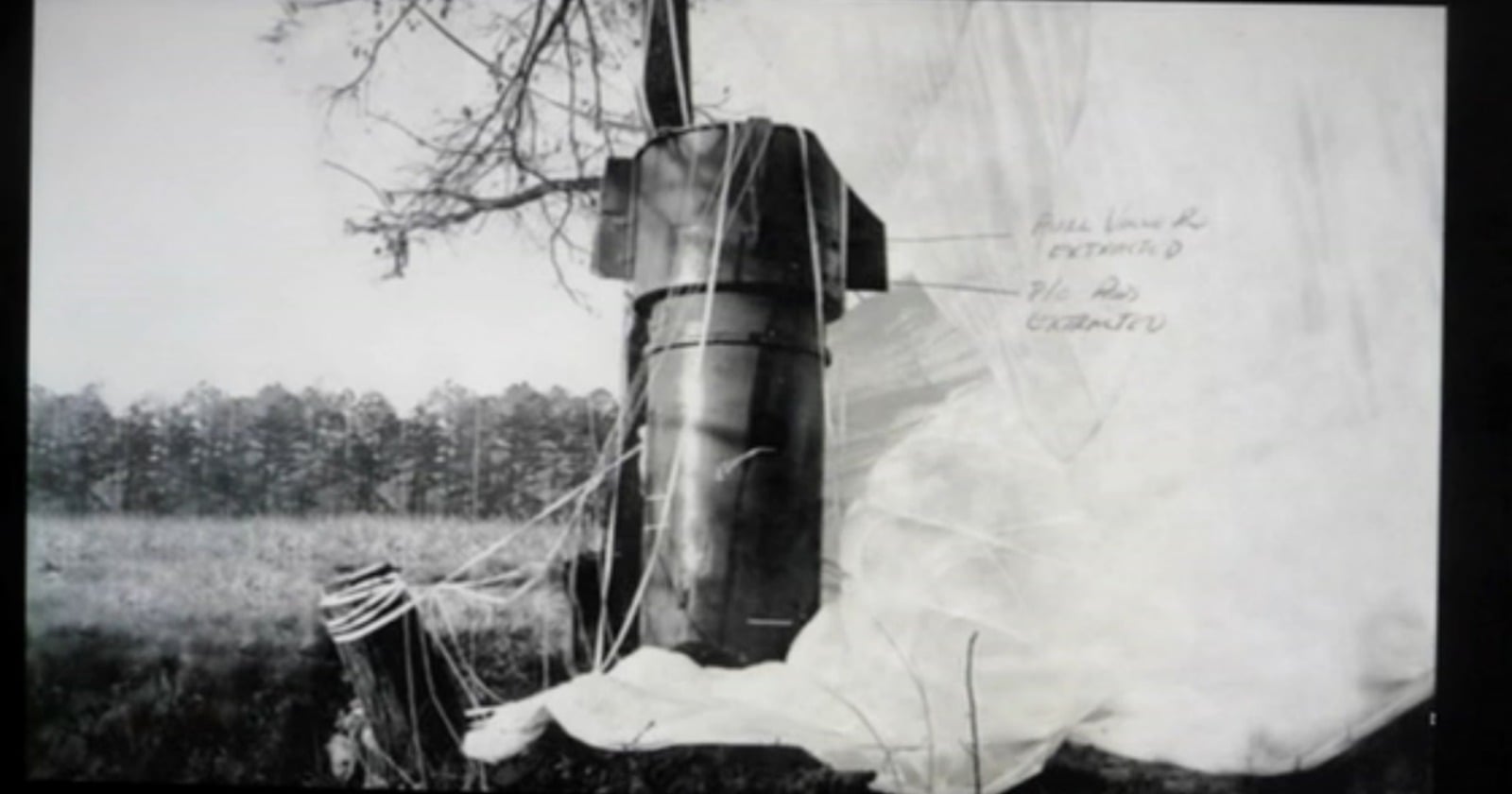
A B-52G on a Strategic Air Command airborne alert mission was refuelling over the Atlantic when the tanker crew told its commander he had a fuel leak in his right wing. The tanker pulled away. The bomber was carrying two Mk 39 Mod 2 thermonuclear weapons, and it came down near Seymour Johnson Air Force Base at about half past midnight on 24 January 1961.
What happened between those two moments is set out in two Sandia Corporation reports written the following month. One of them had been public only in a heavily excised form and the other not at all until 2021, when both were released through a Freedom of Information Act request by Government Attic. The National Security Archive published them the following year. Read together, they are a contemporaneous engineering account of the night, and they are stranger and more specific than the story that grew out of them.
The leak in the right wing
The pilot reported the leak to Seymour Johnson, said he had complete control of the aircraft, and asked for instructions. He was told to stay over the ocean and burn off his excess fuel.
While he was doing that, the hole in the wing apparently became a major rupture. H. D. Bickelman, the Sandia representative who flew out to the crash site, recorded in his accident report that the aircraft was reported to have lost 37,000 pounds of fuel in a two-minute period.
The commander still had the aeroplane. He was brought in over land to fly a stabilisation run, the standard check at approximately 10,000 feet that the commander still has control of the plane. During that run he lost control, and the aircraft apparently lost a wing or a portion of one.
The crew’s account at bail-out
The bail-out order went out. Five of the eight men aboard got out alive and three were killed. The wreckage came down along the flight path over approximately a mile and a half, the tail section a mile from the wing and the crew compartment, which were found inverted, severely burned and completely demolished. Bickelman recorded the assumption that the breakup occurred in the vicinity of 9,000 feet.
The surviving crew told investigators that both weapons were still aboard when they left, and that all switches were in the normal safe position. Under the airborne alert rules of the day the bomb rack lock was to be safety-sealed shut, the aircraft’s T-249 monitor and control units and its T-380 readiness switch were to be sealed in the off position, and safing pins were to be installed in the weapons’ pullout rods.
The T-249 units sat in the navigator’s compartment, which burned. Parts of them were found but no determination of their condition could be made at the time, and Bickelman recorded only that the condition of the weapons made it a logical assumption that they had been safe.
Weapon number one in the sandy clay
The bomb in the aft bomb bay came down under a parachute that deployed in a normal manner. It hit near-vertically in sandy clay, drove its nose approximately eighteen inches into the ground, stayed upright, and was found with its parachute hanging in the trees beside it. It was intact with only minor damage, and its components could be analysed at the scene.
The component list is the part that matters. The safing pins had been pulled from the arming rods and the rods themselves extracted. The low-voltage thermal battery had fired. The timer had completed its cycle. The trajectory-arming barometric switch showed all its contacts closed.
The high-voltage thermal battery, the one that would have charged the firing capacitor, had fired. The crush switch in the nose was deformed, and the report by J. M. de Montmollin and W. R. Hoagland says it can be assumed that it supplied a fire signal at impact.
Two switches had not moved, and they were the two that mattered, in that order. The MC-772 arm-safe switch was in the safe position, which is what kept current from ever reaching the high-voltage safing switch behind it, so that switch stayed safe too and the firing capacitor was never charged. De Montmollin and Hoagland put it in one line: under these conditions, arming of the weapon is prevented by the MC-772 and the MC-788.
Bickelman’s own note on the weapon is hedged. The appearance, he wrote, is that the tearing apart of the aircraft removed the safing pins from the arming rods, and that from that point onward the weapon went through a normal sequence of events in which detonation was prevented by the arm-safe switch being in the safe position.
The reservoir valve had not been fired and the tritium stayed where it was. An explosive ordnance disposal team rendered the bomb safe by pinching and cutting the fill tube between the reservoir and the pit, then taking the weapon apart.
The crater left by weapon number two
The bomb in the forward bomb bay came down without its parachute, which is its own small mystery: Strategic Air Command later told the investigators that the deployment mechanism, the explosive devices and the timers had all operated, and the reason the canopy never opened was unknown. The weapon fell free, went in past the aircraft’s own impact point, and left a hole five feet deep and approximately nine feet across.
The first assumption on site was that the high explosive had undergone what the reports call a one-point detonation and blown the crater. It had not. Digging was slowed by surface water in the hole, and the primary was not recovered until the end of the month, from a depth of about twenty feet.
The recovery of this weapon produced the one alarming-looking piece of evidence in either report. When the arm-safe switch was pulled from the wreckage, its indicator drum read ARM.
It had not armed. Inside the housing, the plastic wafers carrying the fixed contacts had broken off their posts and shifted approximately a quarter of an inch, and there was no continuity through the switch in either position. The engineers concluded that the rotation of the drum was undoubtedly due to impact shock, that the contacts in all probability never closed in the arm position, and that the switch must be taken to have been in safe until the moment of impact.
The Sandia bench post-mortem also found that this weapon’s timer had run about twelve seconds before impact damage stopped it, well short of the forty-two seconds at which its contacts would have closed, so its high-voltage battery was never activated at all.
The famous line was written eight years later
The line most people know about Goldsboro is not from either of these reports. It comes from a 1969 Sandia review by Parker F. Jones, who supervised the laboratory’s nuclear weapons safety department, and which the Guardian published in 2013 after a Freedom of Information Act release to the writer Eric Schlosser. The National Security Archive, pointing readers to that review, says the two 1961 documents confirm a subsequent Sandia evaluation that one main control switch, set to safe, was the only thing standing in the way.
The 1961 documents describe the same mechanism in flatter language. Bickelman’s abstract states flatly that there were no detonations, that no radiological safety hazards resulted, and that the safety features of both bombs behaved in a normal manner. De Montmollin and Hoagland conclude that the arm-safe switch prevented a nuclear detonation in these weapons as it was designed to do. The engineers were describing a system working, not a coin landing the right way up.
Both reports also come with their limits printed on them. Passages are excised. The de Montmollin report’s own title page names the wrong city, putting the crash near Greensboro rather than near Seymour Johnson, which is where the first sentence of its introduction puts it.
The two reports also put the free-falling weapon at different heights when it came away from the aircraft, though the ranges overlap. De Montmollin and Hoagland say it probably separated between 2,000 and 5,000 feet. Bickelman puts it at some 2,000 to 3,000 feet by working back from the twelve seconds the timer ran, and adds that the weapon’s velocity and position at that moment are subject to some speculation. Neither report, as released, prints a yield; the National Security Archive describes the weapons as four megatons each. And the line that carries the most weight in the whole file, the one about the nose supplying a fire signal, is written as an assumption rather than a measurement.
The modification the report asked for
The recommendation at the end of the de Montmollin report is not rhetorical. It asks that a specific modification, ALT 197, approved in January 1960, be incorporated as rapidly as possible in every bomb of the Mk 15/39 family used on airborne alert.
ALT 197 replaces the MC-772 with a different arm-safe switch and puts the new switch’s contacts into the line between the arming generator and the low-voltage thermal battery matches, so that a weapon released in the safe condition cannot start its own power supply. With that change made, the report says, the system was considered adequately safe for alert flying without safing pins installed in the pullout rods.
The handling at the time
Bickelman’s report turns, near its end, to something else. The Air Force released the details immediately, as far as they were then known, and the evening papers in the area carried them that same Tuesday along with a statement that the weapons were safe and that no radiological hazards existed, and after a day of human-interest follow-ups the story was dropped as no longer news.
He thought the handling highly competent, and by the standards of 1961 it was: the weapons were not hidden.
What stayed out of public view was the component list and the order in which the parts fired. The public was told about the crash before that same day was out. It waited sixty years for these reports’ component-level account of how the sequence ran.
