

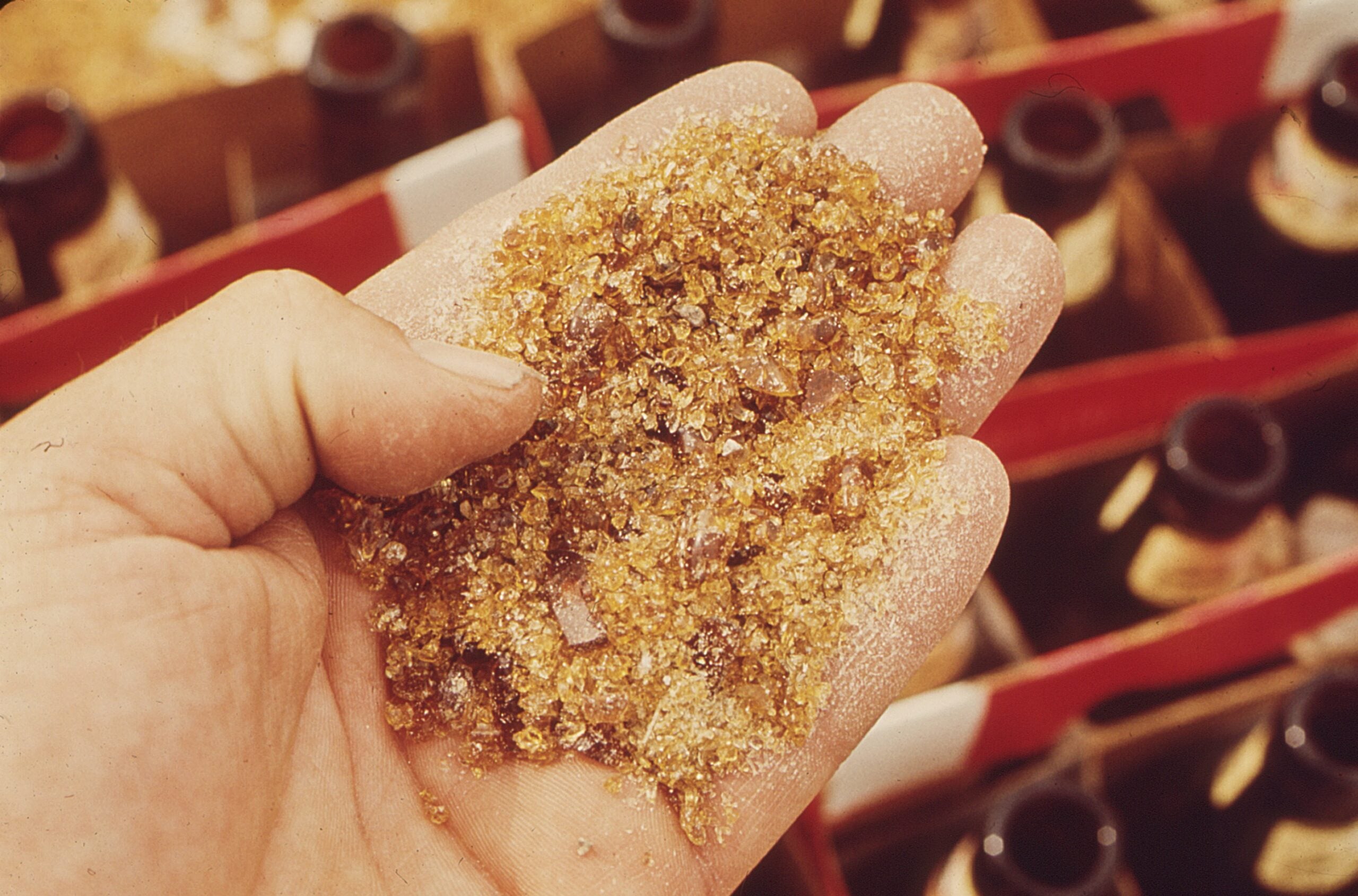
For about 200 feet of an Idaho Highway 75 rebuild in 2002, discarded glass became part of the material beneath the road. Almost 300 tons went into the fill during a $5.6 million project that also replaced a narrow three-span crossing over the Big Wood River with a two-span bridge 178 feet long, designed to accommodate up to four lanes of traffic.
The project was written up by A. Zeyher in Roads & Bridges in May 2002 under the title “Viewing the fill as half glass.” The TRID abstract preserves the central facts: glass from a nearby recycling centre, almost 300 tons used along 200 feet, and a highway reconstruction project that found a use for it. It records the installation, not a long-term assessment of how the material subsequently performed.
What 300 tons of jars looks like when it stops being packaging
The physical fact worth sitting with is the conversion. A recycling centre’s glass pile consists of containers that have finished one job. Crushing and screening can prepare them for another. The relevant properties become particle size, shape, cleanliness and how the material behaves when compacted.
The Federal Highway Administration’s description of waste glass as a construction material explains that properly sized and processed cullet can behave similarly to gravel or sand. Proper crushing can also greatly reduce sharp edges and the handling hazards associated with them. That is a processing requirement, not a promise that any pile of broken bottles is safe to pick up.
A September 4, 2026 account in The Times of India identifies the source as the Ohio Gulch Recycling Center in the Wood River Valley. It places the highway section near Ketchum and describes an eight-to-12-inch layer of cullet beneath the road surface. That measurement describes the thickness of the glass layer, rather than establishing how far below the surface its upper edge lay.
The same account credits the late Idaho state senator Clint Stennett with championing the initiative. Attributing his remarks to Roads & Bridges, it reports that he described the project during an Earth Day visit as “an excellent example of Idahoans, business and government working together to use our resources in the best possible way.” His accompanying point was that “it is critical that not only in highway projects, but in all aspects of our lives and businesses we look to reuse and recycle our critical resources.”
Fill is not pavement, and the difference is the whole engineering story
It is easy to blur crushed glass beneath a road into crushed glass in its wearing surface. They are different engineering applications. In an asphalt mixture, the material has to work with the binder as well as the other aggregate. Glass bonds poorly to asphalt binder, and moisture-related loss of adhesion can contribute to deterioration.
That does not make glass-containing asphalt inherently unsuccessful. FHWA’s guidance on glass in asphalt concrete records satisfactory performance with appropriately processed glass in controlled proportions. It also describes problems associated with high glass contents and oversized particles. The distinction is between a designed mixture and the assumption that glass can replace stone without changing anything else.
Unbound material beneath the pavement avoids that particular binder-adhesion problem. It still has to meet the demands of its layer. FHWA’s granular-base guidance describes processed glass as free-draining and explains that appropriate sizing, cleaning and, where necessary, blending with conventional aggregate matter. The same general equipment used to place and compact conventional aggregate can be used for glass.
Those material properties help explain the appeal of the Idaho experiment. They should not be mistaken for a test report on that particular highway section. The documented achievement was finding a construction use for collected glass; proving decades of performance would require additional evidence.
The arithmetic that keeps most cullet out of most roadbeds
Here is where the honest part lives, and the Roads & Bridges abstract does not dodge it: further processing to meet grade-material requirements would probably have made the glass too costly against the area’s abundant, cheap rock aggregate. Using it as fill on this project did not establish that it could economically replace every other road-building material.
The wider calculation is more complicated than the price of a pile of glass. FHWA’s cost-evaluation guidance includes processing, stockpiling, loading and transport in the delivered price. Installation, testing and maintenance can change the comparison further. Avoided disposal costs can benefit the material’s producer, while a long haul can erase an otherwise attractive saving.
A nearby recycling centre can therefore be an advantage. So can a costly disposal alternative. Neither guarantees that glass wins against local aggregate, and a historical price comparison cannot settle the economics of a different project decades later.
Which is why the Ketchum story works best as a specific example rather than a universal template: almost 300 tons of discarded glass found a use beneath 200 feet of highway. The material did not have to become another bottle to become useful again.