

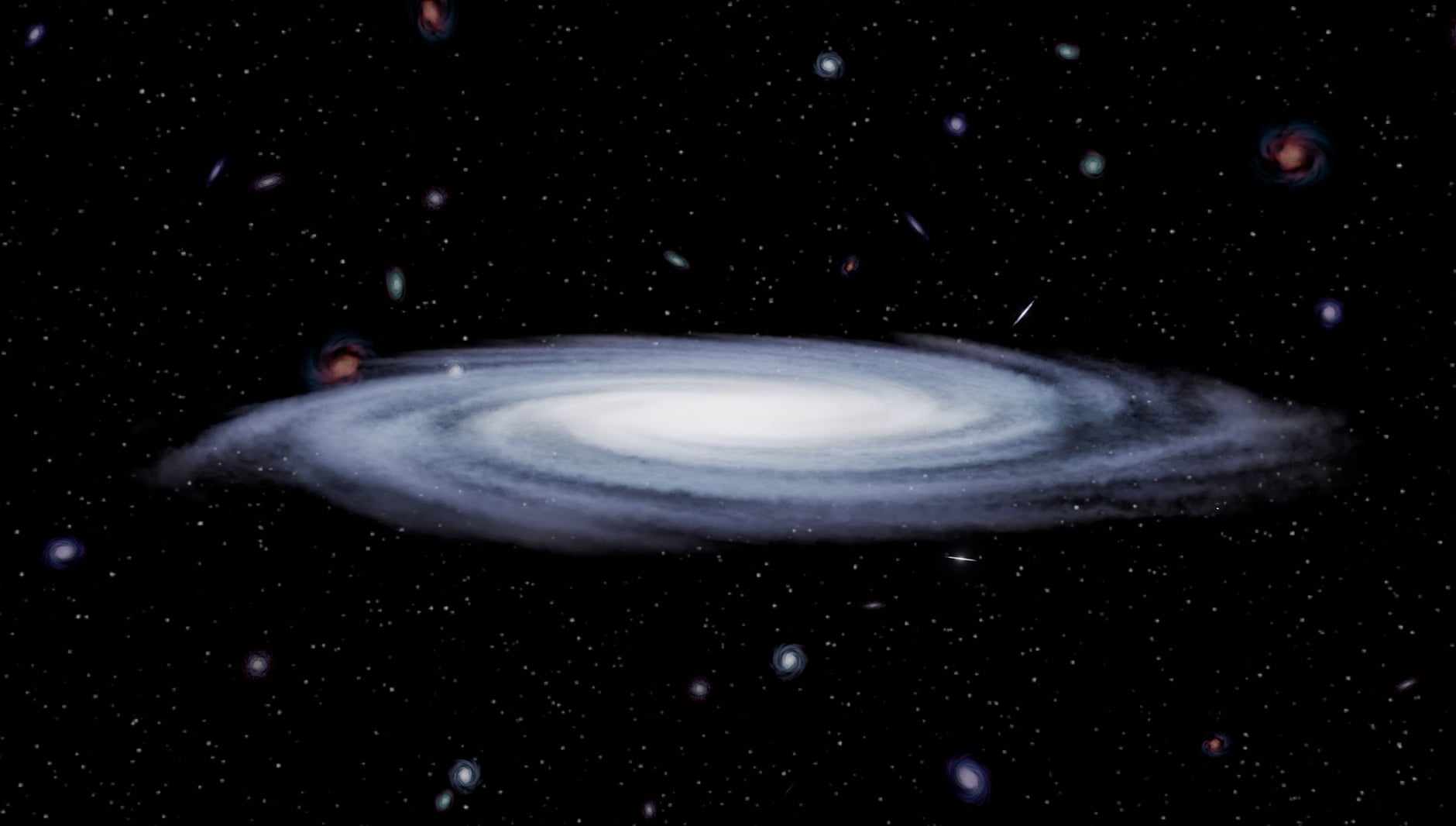
The universe did not simply run out of raw gas as its rate of star formation declined. That is the clearest implication of a new measurement spanning almost 2.5 million galaxies and the past 4.5 billion years.
Over that interval, the cosmic star-formation rate density fell by a factor of 2.46. Put another way, the present universe forms stars at about 41 per cent of the rate it did at the beginning of the period, a decline of roughly 59 per cent.
Neutral atomic hydrogen, written H I by astronomers, followed a very different path. Its cosmic density fell by a raw factor of 1.35, equivalent to about 26 per cent. After the researchers applied conservative corrections for likely systematic effects, the factor became only 1.12, or a decline of roughly 11 per cent.
The mismatch does not identify one new mechanism that shut down star formation. It does rule out a simple version of the fuel-shortage story in which galaxies rapidly exhausted or lost their atomic hydrogen. Much of that reservoir remained. The harder question is why less of it reached the cold molecular phase from which stars form.
Atomic hydrogen is fuel, but not the fuel inside the engine
Most ordinary matter in the universe is hydrogen, yet hydrogen inside a galaxy occupies several physical states. It can be ionised, with electrons separated from protons. It can be neutral and atomic, with one electron bound to each nucleus. In sufficiently cold, shielded regions, two hydrogen atoms can pair to form molecular hydrogen, H2.
Stars form inside dense molecular clouds. Gravity draws parts of those clouds inward until cores become hot and compressed enough for nuclear fusion. A galaxy may therefore possess a large extended envelope of H I without converting much of it into the compact molecular structures that actually make stars.
This distinction has already appeared on smaller scales. SpaceDaily previously reported that the location and concentration of atomic gas within galaxies can matter more than total gas volume. H I close to the stellar disc is more relevant to current star formation than diffuse gas spread far outside it.
The new work asks the corresponding cosmic question. Across an enormous population and several billion years, did the universe’s stock of atomic hydrogen collapse alongside its production of new stars?
FAST listened for hydrogen’s 21-centimetre signal
Neutral hydrogen emits a faint radio signature with a rest wavelength of about 21 centimetres. It is produced when the relative spin configuration of the proton and electron changes. The transition is extraordinarily unlikely for any one atom, but galaxies contain enough hydrogen for the collective signal to become measurable.
The team used observations from China’s Five-hundred-meter Aperture Spherical radio Telescope, or FAST. The relevant data came from the FAST All Sky H I survey, known as FASHI. Earlier SpaceDaily coverage followed FAST’s first published detections of neutral hydrogen from external galaxies; the new analysis extends that capability statistically across a much larger survey volume.
Radio data alone were not enough. To know where each weak hydrogen line should appear after cosmic expansion stretched its wavelength, the researchers needed accurate galaxy distances. They matched the FAST footprint with optical spectroscopy from the Dark Energy Spectroscopic Instrument’s Bright Galaxy Survey.
The result was a sample of 2,473,945 galaxies over roughly 12,000 square degrees of sky. The usable galaxies occupied four redshift intervals with mean redshifts of 0.033, 0.069, 0.281 and 0.358. Radio-frequency interference prevented a simple uninterrupted sequence through the middle of the range.
Most of the galaxies were measured together, not one by one
At the greater distances in the study, the 21-centimetre emission of a typical individual galaxy is too faint for a secure direct detection. The researchers used spectral stacking. They shifted many radio spectra into a common rest frame using DESI redshifts, then combined them so a shared hydrogen signal accumulated while unrelated noise tended to average down.
Stacking is powerful, but its output must be described carefully. The survey did not make 2.5 million separate high-confidence H I detections. It measured average atomic-hydrogen properties for groups of galaxies binned by quantities such as stellar mass and luminosity.
For each stellar-mass range, the team estimated the average ratio between H I mass and stellar mass. That ratio declined strongly as galaxy mass increased: massive galaxies generally carried less atomic hydrogen relative to their stars. Yet at any fixed stellar mass, its evolution over the 4.5-billion-year interval was less than 0.2 dex.
That weak change also appeared when the analysis was restricted to galaxies above a billion solar masses in stars. Those systems account for more than 80 per cent of the cosmic star-formation rate in the comparison model, so the result is not easily explained by a hidden shift confined to low-mass galaxies.
From average galaxies to a cosmic gas density
The Nature Astronomy paper did not obtain the total H I density by simply adding its detected lines. The authors fitted the relationship between atomic-gas fraction and stellar mass, then integrated it across the galaxy stellar-mass function from one million to one trillion solar masses.
A power-law summary of the four redshift measurements gave a raw fall in cosmic H I density by a factor of 1.35, with a quoted uncertainty of 0.10. If the universe began the interval with 1.35 units for every one unit today, the fraction lost was about 26 per cent.
The high-redshift measurements face larger systematics. FAST’s beam can include emission from more than the intended optical galaxy, a problem known as confusion. A magnitude-limited optical sample can also miss faint galaxies in a way that biases the inferred gas fraction.
The team constructed forward-modelled mock catalogues to estimate those effects. After applying what the authors called conservative systematic offsets, the decline became a factor of 1.12 with the same quoted 0.10 uncertainty. That translates to approximately 11 per cent.
The 11-to-26-per-cent range in the headline therefore brackets the corrected and raw interpretations. It should not be read as a precise confidence interval, or as two independent measurements that can be averaged. The essential result is that both are far smaller than 59 per cent.
Where the 59 per cent star-formation fall comes from
The new study measured H I. It did not independently reconstruct every star born during the same period. For comparison, the authors used an established parameterisation of the cosmic star-formation-rate density, which declines by a factor of 2.46 between redshift 0.41 and the present.
A factor of 2.46 means today’s value is 1 divided by 2.46, or about 0.406 of the earlier value. The fractional decline is consequently about 0.594: roughly 59 per cent.
This 4.5-billion-year window covers only the recent part of a longer history. Cosmic star formation peaked near redshift two, roughly ten billion years ago, and has fallen by about an order of magnitude since then. The new survey does not directly measure H I continuously back to that peak; it provides a particularly precise comparison over redshifts below 0.41.
DESI supplied the distance framework for the galaxy stacks rather than the hydrogen measurement itself. A recent SpaceDaily account of DESI’s three-year cosmology map described a different use of its enormous spectroscopic catalogue. Here, millions of those redshifts allowed faint radio spectra to be aligned correctly before stacking.
The missing step is the molecular phase
H I is a reservoir, but molecular gas is the more immediate precursor to stars. The two are not interchangeable. Atomic hydrogen must cool, become sufficiently dense and gain shielding from ultraviolet radiation. Dust grains help hydrogen atoms meet and form molecules, while gravity, pressure, magnetic fields and turbulence influence whether molecular clouds assemble and collapse.
Observations of molecular gas show an evolution that more closely follows cosmic star formation. A separate 2026 Nature Astronomy measurement of cosmic carbon-monoxide emission, for example, inferred a relatively short global molecular-gas depletion time and the need for continuing inflow. Molecular gas is a smaller and faster-cycling store than the broad H I reservoir.
The new H I result therefore moves attention downstream. Galaxies could retain atomic gas while becoming less able to compress, cool or shield it into molecular clouds. Alternatively, molecular clouds may form but be disrupted more rapidly, or may convert their dense gas into stars less efficiently.
The measurements do not choose among those possibilities. Nor do they show that atomic-to-molecular conversion alone caused the entire decline. Gas accretion from the circumgalactic medium, stellar and black-hole feedback, changing galaxy structure and environmental stripping all influence where hydrogen resides and which phase it occupies.
A stable reservoir can conceal a moving cycle
A nearly constant cosmic amount does not imply that the same atoms sat undisturbed for 4.5 billion years. Gas enters galaxies, changes phase, forms stars, is returned by stellar winds and supernovae, becomes ionised, cools again or is expelled into surrounding haloes.
The H I reservoir could remain broadly level if losses to molecular clouds and outflows were balanced by recombination and fresh accretion. Measuring the size of the store alone cannot reveal the rates of every flow into and out of it.
This is why the result constrains models without completing the story. A successful galaxy-evolution simulation must reproduce both curves at once: weak late-time evolution in atomic hydrogen and a much steeper decline in star formation. Matching one while missing the other means the model’s baryon cycle is wrong somewhere.
The authors compared their measurements with IllustrisTNG and SIMBA simulations, but the observational benchmark is broader than a contest between two named models. It links how gas enters a galaxy, how it is distributed by mass, how it changes phase and how feedback regulates the final collapse into stars.
Why the result is strong, and where it remains conditional
The sample’s scale is its obvious strength. Combining FAST with DESI supplied accurate redshifts for almost 2.5 million galaxies across an immense area, reducing statistical uncertainty that limited earlier measurements at intermediate redshift.
The measurement is still indirect in important ways. It depends on stacking, corrections for optical selection and beam confusion, fitted relations outside the most directly sampled mass ranges and a stellar-mass function used to integrate the cosmic total. The gap in redshift coverage also means the four points are not a continuous movie.
The authors made the underlying stacked spectra and figure data available, although the DESI DR2 redshift catalogue used in the analysis was not yet public under the collaboration’s data policy when the paper appeared. Independent surveys and different telescopes will be valuable checks on the small amount of evolution inferred after correction.
Even the uncorrected result, however, leaves the central disparity intact. Atomic hydrogen fell far less than star formation. Reasonable changes to the systematics alter the precise size of the H I decline, not its basic failure to track the star-formation curve.
The universe kept the pantry but used less of it
The familiar fuel analogy needs one refinement. Galaxies did not merely consume a tank until it approached empty. They retained a large stock of neutral atomic hydrogen while the rate at which the universe produced new stars fell by more than half.
That does not make fuel irrelevant. It separates availability from readiness. Gas can exist in a galaxy without occupying the cold, dense molecular structures where star formation becomes possible, just as an ingredient can be present without reaching the part of a process that uses it.
The next advance will require measurements that connect the phases within the same populations: extended H I, dense molecular gas, current star formation, inflow, outflow and galaxy environment. The new survey has narrowed the mystery by showing where the missing explanation is not. The universe’s atomic reservoir did not disappear quickly enough to account for the fading birth rate of stars.