

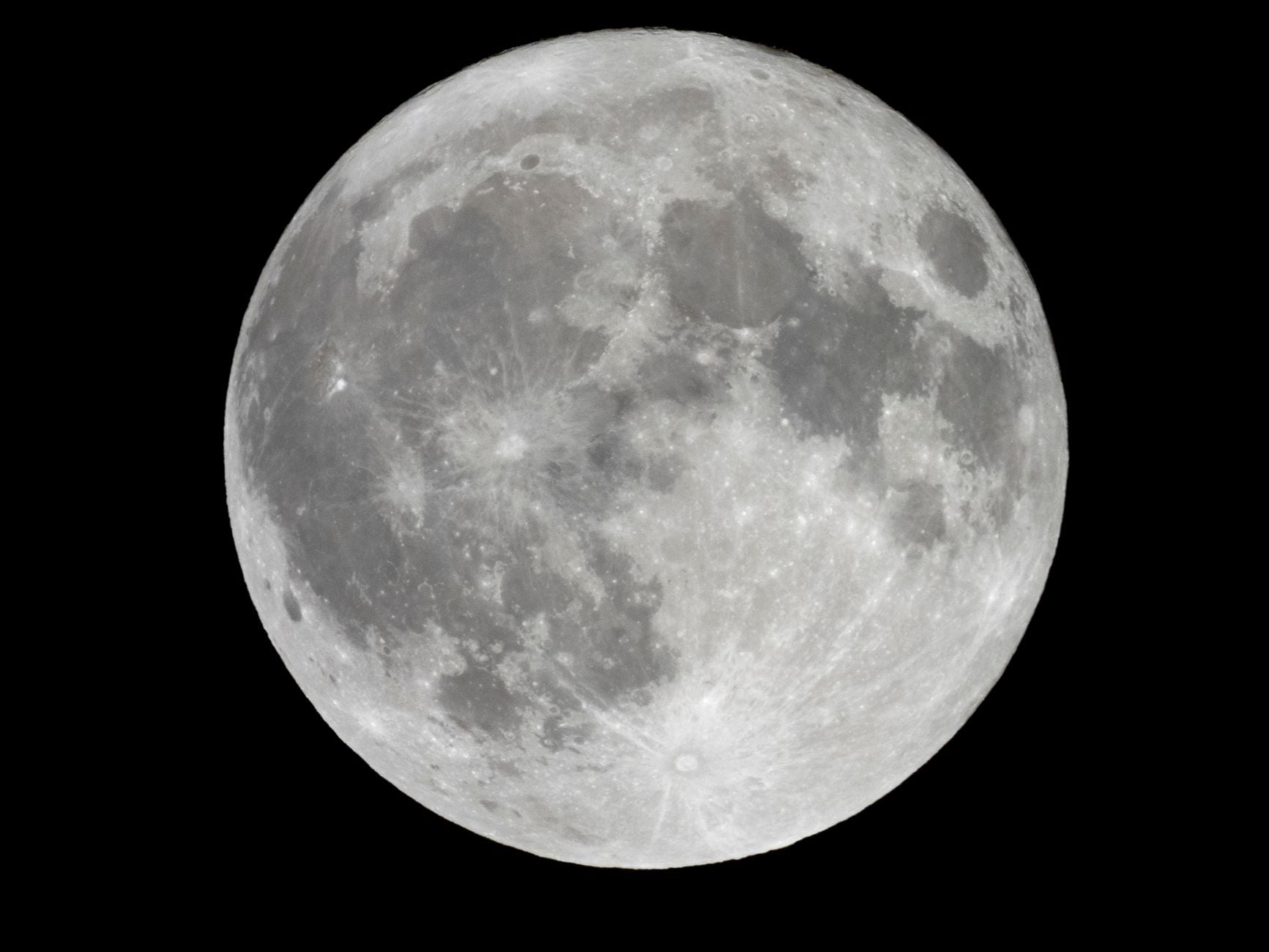
For decades, the standard computer version of the Moon’s birth began with a practical simplification. A Mars-sized body usually called Theia struck the young Earth, and both worlds were treated largely as fluids: gravity, pressure and shock heating mattered, while the ability of solid rock to resist deformation did not.
That approach produced the familiar outcome—a hot ring of iron-poor debris around Earth, from which the Moon assembled later. But a study published in The Astrophysical Journal Letters has now rerun a canonical version of the collision with temperature-dependent rock strength included. In one calculation, a single Moon-sized body emerged in roughly five hours.
The result is not proof that the real Moon formed on that timetable. It is one branch of a numerical experiment, and earlier high-resolution models have also made a large satellite within hours. What is new is the proposed control: whether the colliding rock was hot and weak or colder and stronger could help decide whether the impact left one coherent body or a disk.
What the canonical collision was built to explain
The Moon presents origin theories with an awkward combination of clues. It is unusually large compared with its planet. It contains relatively little iron and has a much smaller core, proportionally, than Earth. The Earth–Moon system also carries a particular amount of angular momentum that any convincing history has to reproduce.
Then there are the rocks. Apollo samples showed that the Moon was once extensively molten, consistent with a global or nearly global magma ocean. Their isotopic chemistry is also extraordinarily similar to Earth’s mantle, even though a collision with another independently formed world might be expected to leave the Moon with a more foreign signature.
The giant-impact hypothesis brought many of those clues into the same story. Near the end of terrestrial planet formation, Theia struck the proto-Earth at an oblique angle. Iron preferentially stayed with or fell back into Earth while silicate-rich material entered orbit. That debris spread into a disk and later accreted into the Moon.
A SpaceDaily report on the canonical simulations described how work by Robin Canup and Erik Asphaug strengthened the idea in 2001. Those calculations found a narrow family of collisions capable of producing the system’s broad mass and angular-momentum constraints. The result became a benchmark that later models have repeatedly revisited.
Why model colliding planets as fluids?
Calling Earth and Theia “strengthless fluids” can sound like an obvious mistake. At giant-impact energies, however, it is often a reasonable first approximation. Pressures in the deep interior dwarf the strength with which ordinary rock resists bending or breaking. The collision also melts and vaporises immense volumes of material. On that scale, gravity, shock pressure and thermodynamics dominate.
The usual tool is smoothed-particle hydrodynamics, or SPH. Instead of representing a planet as a rigid ball, the method divides it into a large set of computational particles. Each carries properties such as mass, temperature, density and velocity. The code follows how those particles compress, heat, mix and move under gravity during the impact.
Useful approximations still have boundaries. The new study, led by C. Adeene Denton of Southwest Research Institute with collaborators at the University of Arizona, focuses on the outer hundreds of kilometres of Theia. Stresses there can be low enough for the mechanical strength of solid rock to influence deformation even while the deeper planet behaves much more like a fluid.
That outer material is not a minor detail. It is the part most exposed to stretching, stripping and transfer into orbit. If strength changes how it responds during the first contact, the same initial masses, impact speed and angle can lead to a different exchange of momentum and a different final shape.
Putting temperature-dependent strength into the impact
The researchers added a realistic strength treatment to SPH simulations of the canonical collision. The temperature dependence matters because rock near its melting point is weak, while cooler solid rock can sustain greater stress before it yields. “Strength” here does not mean Theia stayed rigid like a billiard ball. It means some regions resisted deformation for long enough to redirect how the collision unfolded.
According to the Southwest Research Institute account of the work, one run used the same canonical impact parameters and equal internal temperature structures for the two bodies. With strength included, it produced a large, coherent satellite after around five hours instead of leaving only a disk that had to assemble later.
“Intact Moon” needs careful reading. It does not mean the collision instantly delivered the cool, tidally locked, cratered world seen today. Nor does it mean every atom of a pre-existing body survived undisturbed. It means the calculation ended with one substantial connected satellite rather than only a dispersed protolunar disk. That object was born from a violent, deforming collision and would still have faced cooling, differentiation, bombardment and long-term orbital evolution.
The simulation time is equally specific. Roughly five hours describes the early dynamical outcome in that run, not the time required to finish every stage of lunar evolution. The Moon’s crust, internal layers and present orbit took vastly longer to develop.
The colder case did not give the obvious answer
It would be tempting to reduce the result to a neat rule: stronger rock stays together, while weaker rock makes a disk. The study reports something more complicated. For one set of otherwise identical canonical parameters, a hot but still solid Theia produced an intact Moon, whereas a colder, stronger Theia produced a classic protolunar disk.
That reversal is a useful warning about planetary impacts. Material strength does not merely act as glue. It changes where a body deforms, how momentum is transmitted and which portions are stretched, detached, captured or returned to Earth. A stronger outer layer can therefore alter the geometry in ways that do not map monotonically onto “more intact.”
Temperature becomes a historical variable rather than a cosmetic input. A Theia struck soon after forming or after being heated by earlier collisions may have had a weaker outer region than the same world after a long interval of cooling. In principle, the age and thermal state of the bodies at impact could decide which route was available.
The paper does not establish the exact temperature of the real Theia, and a model outcome cannot date the impact by itself. What it does show is that two collisions described with the same broad mass, speed and angle need not be physically equivalent if their rocks have different mechanical states.
A Moon formed in hours is not the new part
Rapid direct formation has appeared before. In 2022, high-resolution simulations led by Durham University researchers showed a Moon-like satellite forming immediately after impact, on a timescale of hours. SpaceDaily covered those calculations, which demonstrated that increasing numerical resolution could reveal structures that coarser runs missed.
The present work should therefore not be read as the first computer model ever to make a Moon in one piece, or as evidence that all earlier disk models were wrong. Its contribution is to identify temperature-dependent material strength as another control capable of switching the result, including in a deliberately canonical setup.
Resolution and strength address related but distinct weaknesses. More particles can reveal smaller-scale flows and instabilities. A material-strength law changes the physics assigned to those particles. A detailed simulation can still omit an important process, while a more complete physical model may still need higher resolution. Both questions have to be tested.
The chemistry remains a demanding test
A dynamically plausible Moon is only part of the problem. Any scenario also has to confront the close isotopic resemblance between lunar samples and Earth’s mantle. In many versions of the canonical collision, much of the orbiting material comes from Theia. If Theia formed from a distinctly different reservoir, the resulting Moon ought to preserve more of that difference.
One possible answer is that the two bodies were never very different. Isotopic work discussed in a SpaceDaily report on Theia’s likely birthplace points towards an origin in the inner Solar System, perhaps close enough to Earth’s formation zone for their starting compositions to resemble one another. Other scenarios rely on vigorous mixing, equilibration or a different balance of material from Earth and Theia.
An intact-satellite outcome does not automatically solve this compositional puzzle. If the coherent body contains a large, relatively unmixed piece of Theia, it might make the problem harder unless Theia already resembled Earth. If the collision mixes the right reservoirs before capture, it may help. The detailed particle histories and predicted isotope distributions matter more than the visual fact that one large object survives.
The new thermal connection could nevertheless be valuable. The timing of the impact affects how much the bodies had cooled, while the Moon’s volatile inventory and internal chemistry retain clues about heating and material loss. Linking those records to a mechanical outcome gives future studies a more specific set of relationships to test.
What a successful model must do next
The giant-impact hypothesis remains the leading framework, as NASA’s overview of lunar formation explains. But there is no surviving video of the event, and simulations are conditional experiments rather than replays. Their conclusions depend on the equation of state for compressed rock, treatments of fracture and friction, starting temperature profiles, numerical resolution and impact geometry.
A compelling strength-aware scenario would need to work across more than one carefully chosen run. Researchers can explore broad grids of impact angle, velocity, mass ratio, spin and temperature, then test whether intact satellites are common or rare. They can also compare how different strength prescriptions behave at the extreme pressure and temperature limits that laboratory experiments cannot fully reproduce.
The early outcome must then connect to later observations. Does the satellite have the right mass and iron fraction? Does it begin in an orbit that can evolve into the present Earth–Moon system? Can it develop a magma ocean consistent with lunar rocks? Does it retain or lose the expected volatile elements? And does its mixture of proto-Earth and Theia material resemble the samples brought home by Apollo?
Future lunar samples could sharpen those comparisons. Material from new locations, particularly old terrain far from the Apollo landing sites, may reveal heterogeneity hidden by the existing collection. Better geophysical measurements of the Moon’s interior would also constrain how thoroughly the young body melted and differentiated.
A five-hour result, and a much longer investigation
The most interesting lesson is not that a computer made a Moon before lunch. It is that an approximation that works well in a planet’s deep interior may fail near its surface, precisely where material is being stripped away, transferred or retained.
Classic fluid simulations were productive, not foolish. They established much of the modern case for a giant impact and gave researchers a common benchmark. Newer direct-formation models added resolution. This study adds another physical lever and suggests that the early temperature of Theia may have mattered alongside its mass, speed and angle of approach.
For now, the intact Moon is a credible outcome in one reported branch, not a settled reconstruction of what happened about 4.5 billion years ago. The collision itself is gone. Progress comes from making the models less idealised, then asking which version leaves traces that real lunar rocks, orbits and interiors can still reveal.