
When Georgia Tech researchers finished tumbling grains meant to approximate some of Titan’s organic material, they tipped the container and let the contents fall. Most of the grains came out. Between 2 and 5 percent did not. They remained attached to the walls, held there by electrical charge.
The physical contrast was hard to miss. In comparable tumbler experiments with terrestrial quartz-rich sand and volcanic ash, all the material fell out. The organic grains behaved more like the irritatingly persistent packing pieces that cling to a cardboard box than like ordinary beach sand.
That result was reported in a 2017 Nature Geoscience paper led by Joshua Méndez Harper. It offered a possible explanation for a much larger problem: why Titan’s enormous dunes appear to record winds that do not neatly match the moon’s usual near-surface circulation.
The finding is worth taking seriously, but it should not be read as the final word. The grains were laboratory analogues, not material collected on Titan, and a later experiment with a more complex Titan haze analogue found much weaker charging. The useful question is not simply whether the grains stuck. It is how closely those grains resembled the substance that actually covers Saturn’s largest moon.
A stripped-down version of Titan in a tumbler
Titan’s thick atmosphere is about 98 percent nitrogen. Sunlight and energetic particles drive chemical reactions in its upper atmosphere, building carbon-rich molecules that combine into a persistent orange haze. Some of that material settles towards the surface and is thought to contribute to the dark sand collected into equatorial dune fields.
The Georgia Tech team did not attempt to reproduce this whole chemical chain. Instead, it chose relatively simple organic solids that have been discussed as possible constituents or analogues: naphthalene and biphenyl, both aromatic hydrocarbons, and polystyrene. The researchers put the grains in a small cylinder, filled it with dry nitrogen and rotated it for roughly 20 minutes.
As grains collided with the container and one another, they exchanged electrical charge through contact. When the material left the tumbler, it passed through a Faraday cup so that the team could measure the charge grain by grain. All three organic materials acquired charge, while a visible fraction remained inside the cylinder.
The team’s Georgia Tech summary reported the striking retention figure of 2 to 5 percent. It also argued that, in Titan’s very dry environment, charge on insulating organic grains might survive far longer than comparable charge on many terrestrial materials.
Static can alter when sand begins to move
A sand grain moves when the forces exerted by wind overcome gravity, friction and cohesion with neighbouring grains. Electrical attraction adds another restraining force. The effect does not need to glue an entire dune into one solid mass. It only needs to make the resting bed harder to disturb.
The 2017 study calculated that electrostatic cohesion could increase Titan’s threshold wind speed for initiating grain motion by up to an order of magnitude. Once grains were moving, repeated collisions could also encourage them to clump. In the laboratory, charged organic particles formed aggregates much larger than the original grains.
Titan’s low gravity helps grains become airborne, but the moon’s dense atmosphere also makes its sediment transport unlike the familiar version on Earth. Add long-lived electrical charge and the threshold becomes still more complicated. A wind that looks sufficient in a model of neutral grains may accomplish very little if the real grains are mutually attracted.
The result speaks to Titan’s wind-direction puzzle
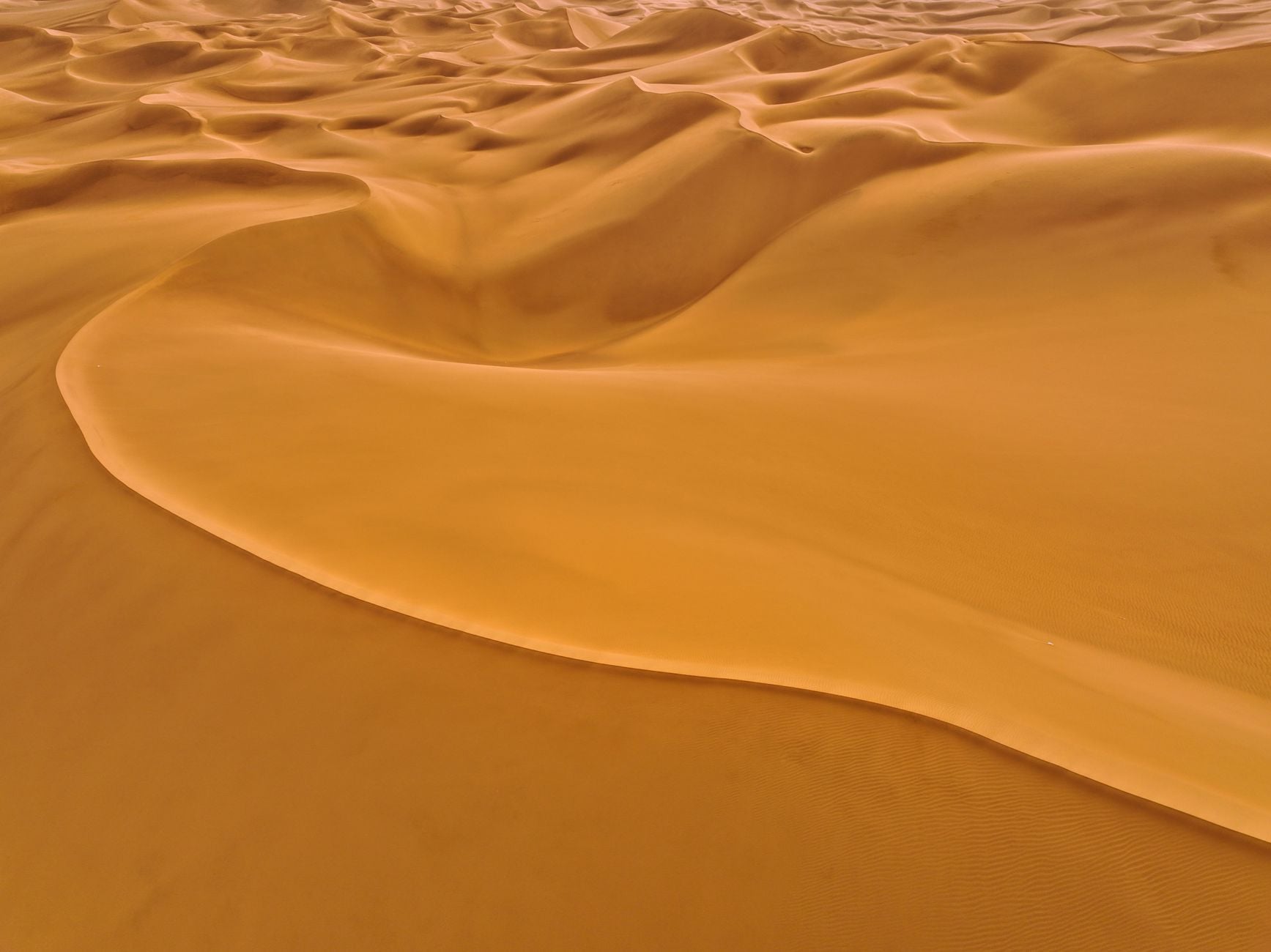
Titan’s dunes are immense. NASA’s Cassini science overview describes ridges commonly one to two kilometres wide, hundreds of kilometres long and around 100 metres high. Together they occupy broad belts around the equator.
Their orientation has been difficult to reconcile with the weaker winds expected near the surface. One proposed resolution is that the dunes are shaped mainly during relatively rare, strong wind events, including storms associated with Titan’s changing seasons, rather than being steadily reorganised by the prevailing breeze.
Electrically cohesive grains make that explanation more plausible. Weak winds could pass over a charged bed without shifting much sediment. A stronger wind from another direction could finally break grains free and dominate the long-term shape of the dunes. The landscape would then record the winds capable of moving sand, not necessarily the winds that blow most often.
This is not the only possible solution, and the tumbler did not reproduce a Titan storm. It supplied a mechanism that wind models might otherwise omit.
“Nothing stuck” is precise, but easy to overread
The comparison with Earth materials needs careful wording. Terrestrial sand and volcanic ash can certainly become electrically charged. Lightning in volcanic plumes and electrical fields in dust storms are conspicuous evidence of that. The experiment did not overturn those observations.
What it found was narrower. Under the test conditions used for the controls, all the terrestrial sand and ash poured out of the tumbler. Under the dry nitrogen conditions used for the organic analogues, 2 to 5 percent of those grains remained attached. The charge measured on the organics was also more persistent than that usually expected for common silicate sand in humid air.
Those conditions were not identical. The organic grains were tumbled at less than 1 percent relative humidity, while the terrestrial comparison materials were tested at roughly 30 to 40 percent humidity. Water adsorbed on a grain’s surface can help electrical charge leak away. The tumbler also combines contact charging with possible effects from particle breakage, surface roughness and repeated collisions.
Room-temperature naphthalene in dry nitrogen is therefore not a miniature piece of Titan. It is a controlled analogue that isolates several plausible behaviours while leaving others out, including Titan’s surface temperature of about 94 kelvin and the unknown internal structure of its sand.
A later particle-scale test found a weaker effect
In 2020, researchers approached the same question with colloidal-probe atomic-force microscopy, measuring the electrical interaction of individual particles rather than allowing thousands of them to tumble together. Naphthalene and polystyrene again charged strongly. The more revealing material was tholin, a complex laboratory product used to represent Titan’s atmospheric haze.
The tholin produced little or no detectable triboelectric force within the instrument’s sensitivity. In their Earth and Planetary Science Letters paper, the authors concluded that electrostatic charging of Titan’s real sand could be substantially weaker than the earlier simple-organic experiments implied.
That study did not prove that Titan’s dunes are electrically neutral. Tholin is itself an analogue, and dune grains may be mixtures, coated particles or material transformed after reaching the surface. The two experiments probed different scales and different charging histories. Together, however, they make a clean distinction: strong charging is demonstrated for some simple organic materials, while its importance for realistic Titan sediment remains unsettled.
Researchers still do not know what a Titan sand grain is
Cassini mapped dune fields with radar but never returned a grain for laboratory analysis. Candidate materials include complex atmospheric organics, fragments of water ice coated with hydrocarbons, and mixtures processed by winds, impacts and methane rain. Particle size can be estimated from the way the surface interacts with radar and from sediment-transport models, but composition and internal structure are much harder to establish remotely.
SpaceDaily has previously examined how Titan’s equatorial dunes may be built from ice and atmospheric hydrocarbons. The static experiment fits naturally into that larger question. Before anyone can model how the dunes migrate, they need to know what the grains are, how easily they fracture, how strongly they attract one another and what happens when they collide.
Other cohesive forces may also matter. Van der Waals attraction between fine particles can be substantial, and traces of condensed material may alter contact between grains. An electrostatic explanation should therefore be evaluated alongside mechanical and chemical properties, not treated as a complete substitute for them.
Dragonfly will bring the measurements closer to the dunes
NASA’s Dragonfly mission is designed to fly between sites on Titan and examine the chemistry and habitability of its surface environment. It is scheduled to launch no earlier than July 2028 and arrive in late 2034. In a September 2026 mission update, NASA noted that the intended landing dune field has been formally named Ahmakiq Undae.
Dragonfly is not a sample-return mission, and it will not reproduce every process operating across Titan’s dune belts. It should nevertheless place instruments in direct contact with the kind of terrain that Cassini could only view from above. Measurements of composition, meteorology and local surface behaviour can sharply reduce the range of plausible grain models.
Until then, the tumbler remains valuable precisely because it made an invisible force visible. A few percent of the grains refused to obey the simple expectation that loose material should pour out. The terrestrial controls did not do the same.
The boundary around that result matters as much as the result itself. It did not establish that Titan’s dunes are held together by static electricity, and it did not identify their composition. It demonstrated that certain plausible organic materials can become unusually charged in a dry nitrogen environment, strongly enough to cling to walls and to each other. Titan may have electrically sticky sand. Whether its real grains behave that way is now a question for more realistic experiments and, eventually, measurements on the moon itself.