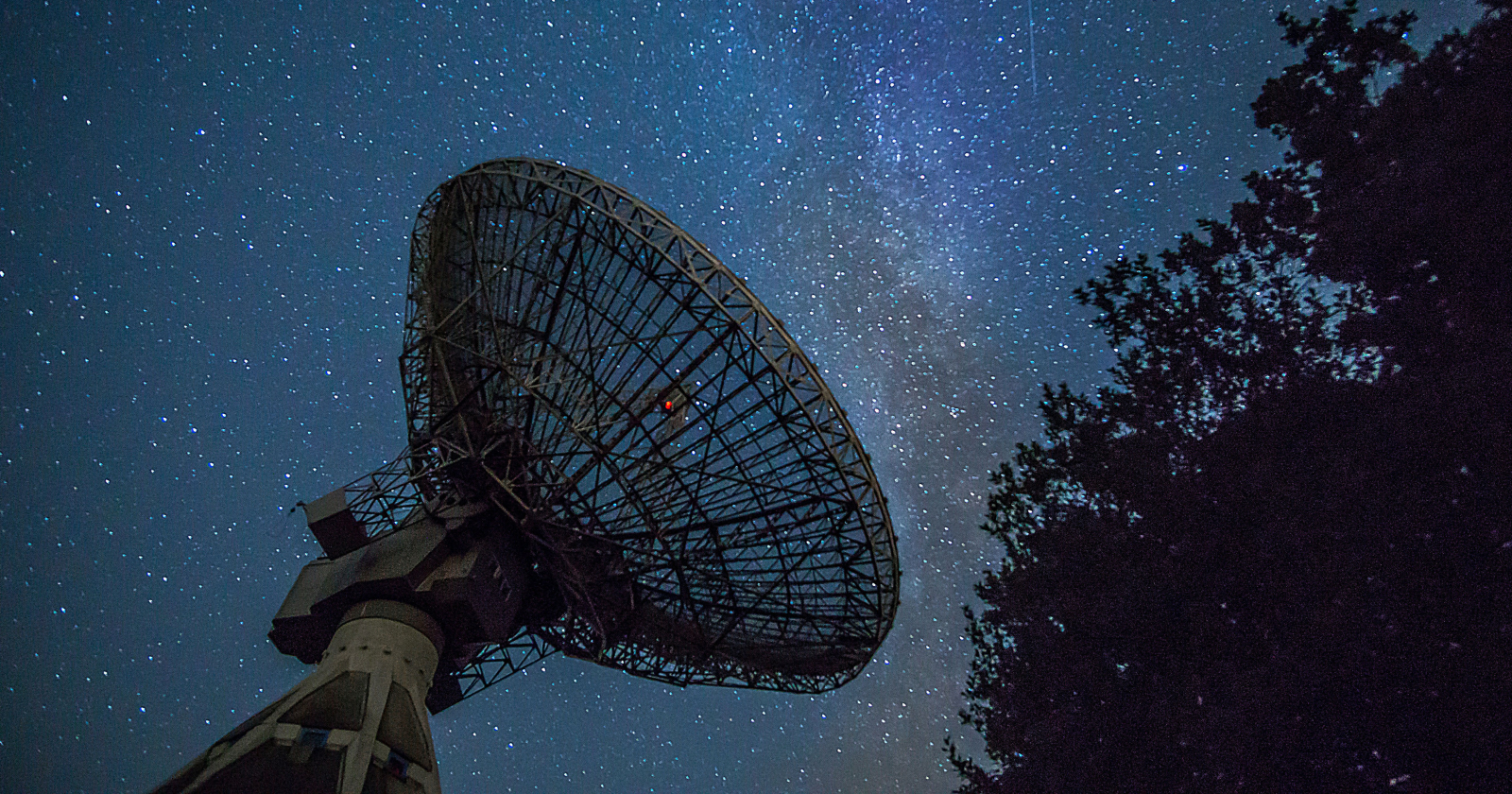
For one night in August 1977, it is genuinely possible that a radio telescope in rural Ohio picked up a signal from another civilization. That sentence is not an exaggeration for effect.
Nearly fifty years later, nobody has proven it, and just as importantly, nobody has disproven it either. Most explanations offered since then have quietly failed under their own weight, which is a strange place for a scientific mystery to sit for half a century.
What actually happened at Big Ear
Ohio State’s Big Ear telescope worked by letting Earth’s rotation slowly sweep a fixed patch of sky across its receivers, which meant any single point in the sky was only observable for 72 seconds at a time. On the morning of August 16, 1977, astronomer Jerry Ehman was reviewing a stack of computer printouts from two nights earlier when he found a signal that filled that entire 72-second window and then some, climbing far above the normal background noise near a frequency radio astronomers already suspected an alien civilization might use to say hello.
He circled the alphanumeric code the signal had printed, 6EQUJ5, and wrote a single word next to it in red ink: Wow!
The frequency mattered as much as the strength did. The signal showed up within about 50 kilohertz of 1420.4058 megahertz, the natural frequency at which hydrogen atoms emit radiation, a number physicists Giuseppe Cocconi and Philip Morrison had proposed back in 1959 as a logical place for any civilization to broadcast, on the theory that hydrogen is the most common element in the universe and any species doing radio astronomy would already know its exact frequency by heart.
It’s one of the reasons the Wow! signal has stayed credible for so long instead of getting dismissed as noise: it landed almost exactly where theory said an intentional signal should.
The telescope was pointed toward the constellation Sagittarius, and the signal’s strength and shape matched what astronomers would expect from a real, distant transmission rather than a stray reflection or a piece of ground equipment. Ehman himself spent the following twenty years being far more careful about the claim than the nickname ever let on. In a technical writeup published on the observatory’s own site, he laid out his reasoning plainly: “I must conclude that an ETI [ExtraTerrestrial Intelligence] might have sent the signal that we received as the Wow! source.”
Big Ear itself didn’t survive long enough to keep looking. The telescope had been running the longest continuous SETI program in history when Ohio State sold the property in 1998, and developers tore the instrument down to expand a nearby golf course. The most tantalizing unexplained signal in the history of the search for alien life was picked up by a telescope that, twenty-one years later, was dismantled for fairway space.
Why “it was aliens” doesn’t actually hold up
Stopping the story there runs into an immediate problem. A real signal from a distant, presumably rotating or orbiting transmitter should, in principle, come back around. Researchers pointed telescopes at the same patch of sky repeatedly in the following weeks, then periodically for years afterward, and picked up nothing. Ehman later argued that this repeated silence was itself the strongest evidence against the exciting version of events, reasoning that if intelligent beings had actually been transmitting, they would very likely have transmitted more than once across so many separate attempts to listen again.
Other explanations have come and gone too. A 2017 hypothesis proposed that hydrogen gas around two comets passing through the area, 266P/Christensen and 335P/Gibbs, could explain the signal, and that idea got real press coverage before other astronomers pointed out the comets weren’t actually in the telescope’s beam at the right time, and comets don’t emit strongly at the frequency in question anyway. Nearly every tidy explanation offered in the last five decades has run into a version of the same wall: something about the details doesn’t quite fit.
The best current guess, and why it isn’t settled either
The most serious recent attempt came in 2024, when planetary scientist Abel Méndez and colleagues proposed that a magnetar, an extremely dense and highly magnetized dead star, could have released a burst of energy that struck a cold cloud of hydrogen gas, causing it to suddenly flare brighter at exactly the frequency Big Ear was listening on. Méndez and his team said they found several similar, fainter signals in archived data from the same patch of sky, which is more supporting evidence than any prior explanation has managed. Of his own hypothesis, he said plainly: “I think we have probably the best explanation so far.”
That’s a genuinely honest way to phrase it, because “best so far” is not the same thing as proven. The hypothesis hadn’t been through peer review as of its announcement, and other scientists in the field pushed back immediately. SETI astronomer Jason Wright’s objection to the magnetar idea was direct: “He’s suggesting a phenomenon that has never been observed.” Both things can be true at once: it may be the most complete natural explanation offered yet, and it may still turn out to be wrong.
What nearly fifty years of not knowing is actually like
I like to win arguments, finish projects, and generally be good at whatever I’m doing, so a scientific mystery that has outlasted fifty years of smart, well-funded people trying to close it out is a genuinely uncomfortable thing for me to sit with. Most questions eventually get an answer if enough competent people keep working on them.
This one hasn’t, not because nobody’s tried, but because the actual data, one printout, one 72-second window, one word scrawled in the margin, was never enough to settle anything on its own. Ohio State graduate researcher Molly Gallagher put it about as honestly as anyone has, noting that the signal sticks around in the scientific mind precisely because it still hasn’t been explained, and it might, genuinely, stay that way.