

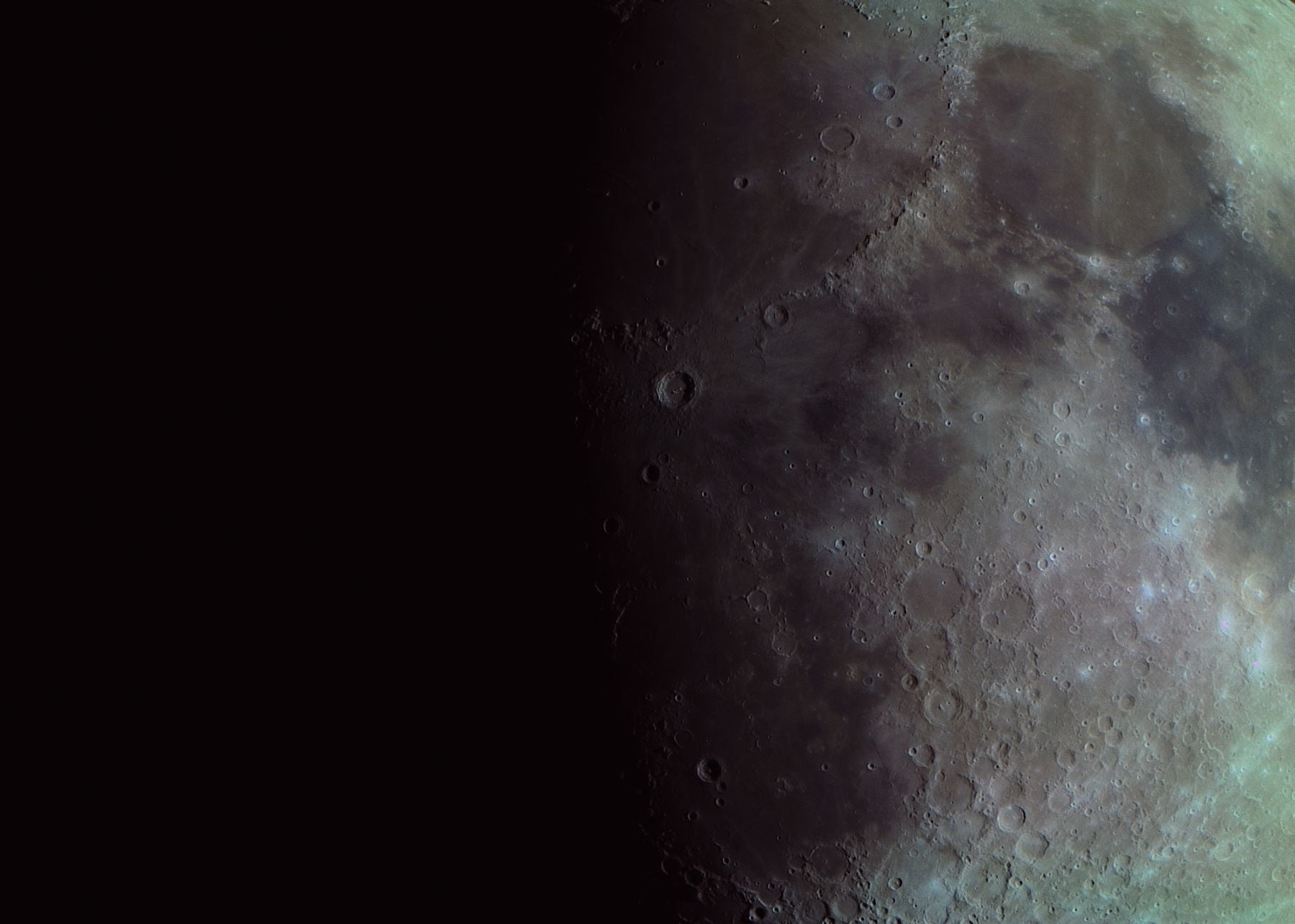
Earth’s oceans have already supplied physical evidence that nearby stellar explosions dusted the Solar System with radioactive atoms. The Moon may carry a much longer version of the same story.
A model published in Physical Review Letters suggests that lunar soil roughly a metre deep could retain distinguishable isotope patterns from 80 to 100 million years of interstellar debris. The deep-ocean record currently used to trace that debris extends only about 10 million years.
This is not the discovery of an intact 100-million-year timeline. It is a prediction about how a long record could survive and how future scientists might read it. The Moon’s surface has been stirred continually by impacts, so the archive is scrambled rather than arranged like pages in a book.
The advance is a mathematical framework for decoding that scrambling. Its authors tested the framework against several kinds of Apollo evidence before using it to forecast what deeper lunar cores may contain.
A few atoms can identify a vanished star
When a massive star explodes, it releases elements forged during its life and death. Some arrive as radioactive isotopes that are exceptionally rare in material formed with the Solar System.
Iron-60 is one of the most useful. It can be created by cosmic rays striking material in place, but excess iron-60 has been found in deep-sea deposits and lunar samples at levels that point to an interstellar source.
Earth’s deposits record a strong pulse arriving about 2.3 million years ago and a smaller, earlier pulse around 7.3 million years ago. The dust may have come directly from nearby supernova shock fronts, or from enriched structures within the Local Bubble through which the Solar System is travelling.
Iron-60 has a half-life of roughly 2.6 million years. After one half-life, half the original atoms remain; after several, the signal becomes progressively harder to detect. That makes iron-60 a powerful witness to recent stellar events but a poor keeper of a 100-million-year history.
Plutonium-244 is different. Its half-life is about 81 million years. It is associated with the rapid neutron-capture process, or r-process, which creates many of the heaviest elements. The relevant source could be an unusual kind of supernova, a collision between neutron stars known as a kilonova, or more than one class of event.
The question is not merely whether plutonium-244 reached the Earth-Moon system. Scientists want to know whether it arrived with the same supernova debris as iron-60, whether it accumulated as a continuing background, and what that implies about the cosmic factories that make heavy elements.
The Moon is quiet, but its soil is not
The Moon looks like an ideal archive because it has no rain, rivers or oceans, no wind-driven erosion and no plate tectonics continually recycling its crust. Material that lands there can remain for immense spans of time.
Yet the lunar surface is not a tidy stack of undisturbed layers. Meteoroids and their fragments have struck it throughout its history. Each crater excavates some soil, compacts material beneath it and buries surrounding ground under a spray of ejecta.
Large primary impacts also create vast numbers of smaller secondary impacts. Across time, this bombardment churns the upper regolith in a process called impact gardening. A grain deposited at the surface may move downward, return upward or mingle with material that arrived much earlier.
Earlier models often approximated gardening as diffusion, rather like particles wandering randomly up and down. Apollo cores complicate that picture. Some measured maturity and isotope profiles have gradients too sharp, or centres too displaced, to be explained by random smearing alone.
Emily Costello of the University of Hawai‘i at Mānoa and colleagues instead treated gardening as an advection-diffusion problem. Advection represents net directed transport; diffusion represents local random mixing.
In their framework, burial beneath ejecta and impact compaction compete with excavation. For the secondary impacts dominating the upper few metres, the balance produces net downward transport. Smaller stochastic displacements spread material around that advancing front.
The equation also includes a source term, which can represent steady space weathering or a sudden delivery of supernova dust, and a decay term for radioactive atoms. It therefore links the physics of cratering with both the timing of deposition and the lifetime of the isotope.
Apollo gave the model two demanding tests
A model can produce a plausible-looking lunar profile without describing the real Moon. Costello’s team therefore began with observations it was not free to invent.
The first test involved soil maturity in Apollo 15, 16 and 17 cores. Exposure to solar wind and radiation creates nanometre-scale metallic iron in lunar grains. The ratio of that material to the soil’s iron oxide provides a measure that changes with exposure and depth.
The model reproduced the measured maturity profiles of cores whose exposure ages were independently constrained using cosmic-ray tracks and cosmogenic radionuclides. Those ages ranged from about 14 million to 450 million years, spanning more than two orders of magnitude.
The second test was more directly astrophysical. The team used the timing and estimated intensity of the iron-60 pulses found in Earth’s deep-ocean record. It calculated how those surface deposits should have decayed and moved through lunar soil under impact gardening.
The resulting depth curves agreed with excess iron-60 measured in Apollo 11, 12, 15 and 16 samples. Apollo 15 and 16 soils have different native iron contents but similar inferred iron-60 inventories after normalisation, which is consistent with an incoming flux not controlled by local mineralogy.
The agreement is encouraging, not absolute proof. Every core experienced its own random impact history, and some fine, mature surface fractions contain more iron-60 than the combined production, delivery and gardening models predict. The team built an empirical uncertainty envelope from the Apollo residuals rather than pretending local variability had disappeared.
Why an 80-million-year signal moves towards a metre
After validation, the researchers tested three illustrative histories for plutonium-244. In the first, it arrived with the iron-60 pulses 2.3 and 7.3 million years ago. In the second, it fell at a constant rate for 10 million years. In the third, that continuous delivery lasted 80 million years.
Recent pulsed material remained concentrated mainly in the upper 10 centimetres. The 10-million-year continuous case also resembled a relatively shallow, steadily accumulated signal.
In the 80-million-year case, impact-driven downward transport and diffusion carried the isotope much farther through the column. The longer accumulation also produced a larger total inventory. A deep tail below about 20 centimetres separated that scenario from recent delivery in the simulations.
The published calculation used a grid extending to 80 centimetres. In its discussion, the team concludes that deposition continuing for 80 million years or more could create a plutonium-244 profile extending to the order of 100 centimetres. The University of Hawai‘i summary describes the potential archive as spanning 80 to 100 million years or longer.
That does not mean the one-centimetre layer corresponds to one million years. Gardening destroys such a simple relationship. The information resides in the overall shape of the concentration profile, especially when several isotopes are measured together.
Four radioactive clocks are better than one
A long plutonium-244 tail would support sustained interstellar delivery. A signal confined to the shallow reworked zone would be more consistent with recent discrete events. On its own, however, plutonium may not identify the precise kind of stellar source.
The model therefore extends to iodine-129, hafnium-182 and curium-247. Their half-lives are roughly 16.1 million, 8.9 million and 15.6 million years respectively. Comparing their abundances with plutonium-244 and iron-60 would place several clocks with different decay rates against the same gardening history.
Those ratios might help separate a recent supernova-linked origin from an older r-process event whose ejecta was later swept towards the Solar System. They could also test whether plutonium-244 and iron-60 share a source or merely overlap in today’s samples.
The method cannot reconstruct every ancient explosion automatically. Old signals weaken through radioactive decay, predicted production ratios depend on astrophysical models, and the number of surviving atoms may be extraordinarily small. Detecting them requires sensitive laboratory measurements and cores whose depth sequence has been preserved.
The 10-million-year ocean comparison has a boundary
Earth’s geological record is vastly older than 10 million years. Ocean sediments and rocks reveal events stretching back billions of years. The narrower comparison here concerns measured deposits of live interstellar radioisotopes used to trace recent nearby stellar activity.
Those deep-ocean detections currently cover about the past 10 million years. Beyond that interval, the short half-life of iron-60 removes much of its signal, while sediment recycling, erosion, dilution and Earth’s active geology complicate preservation.
The Moon avoids oceans and tectonic recycling, but substitutes impact gardening. The new result is not that lunar soil remains untouched. It is that disturbed soil may retain enough structure to remain decipherable.
That distinction also explains why validation against Apollo matters. Without a transport model grounded in real cores, a buried isotope could not be assigned confidently to an ancient influx rather than local mixing, native chemistry or cosmic-ray production.
Artemis could add both depth and latitude
The American Physical Society’s account of the work highlights the practical consequence: future missions should obtain cores approaching or exceeding a metre, rather than relying only on scooped surface material.
Location matters too. Apollo samples come from nearside sites at relatively modest latitudes. Samples from near the lunar south pole would create a much larger geographic separation.
If interstellar dust preserved its incoming direction, the isotope inventory could vary with latitude and offer a clue to the source’s position. Charged dust grains may instead have been deflected and scattered by interstellar magnetic fields, erasing that directional memory. Similar profiles at the pole and Apollo sites would support the latter possibility.
The researchers frame Artemis cores as a future opportunity, not as samples already guaranteed on a particular flight. Mission plans, drilling depths, sample allocation and laboratory access will determine whether the proposed test becomes possible.
A cosmic archive still waiting to be opened
The achievement is therefore more modest and more useful than claiming that scientists have already read 100 million years of supernova history in Moon dust.
The team built a physical model of excavation, compaction, burial, random mixing and radioactive decay. It reproduced Apollo soil-maturity profiles covering tens to hundreds of millions of years, then reproduced the depth distribution of recent interstellar iron-60.
With that foundation, the model predicts that long-lived plutonium-244 deposited over 80 million years or more could leave a measurably deeper signature, reaching towards a metre. Other isotopes could help untangle the source and timing.
The next step is physical rather than mathematical: return deep cores, preserve their vertical order and count the rare atoms. If the predicted profiles are present, lunar soil could extend the record of nearby supernovae, neutron-star mergers and the Solar System’s journey through galactic debris far beyond the ocean window available today.
Apollo showed that the recent pages survived the mixing. Future samples will determine how much of the older volume remains readable.