
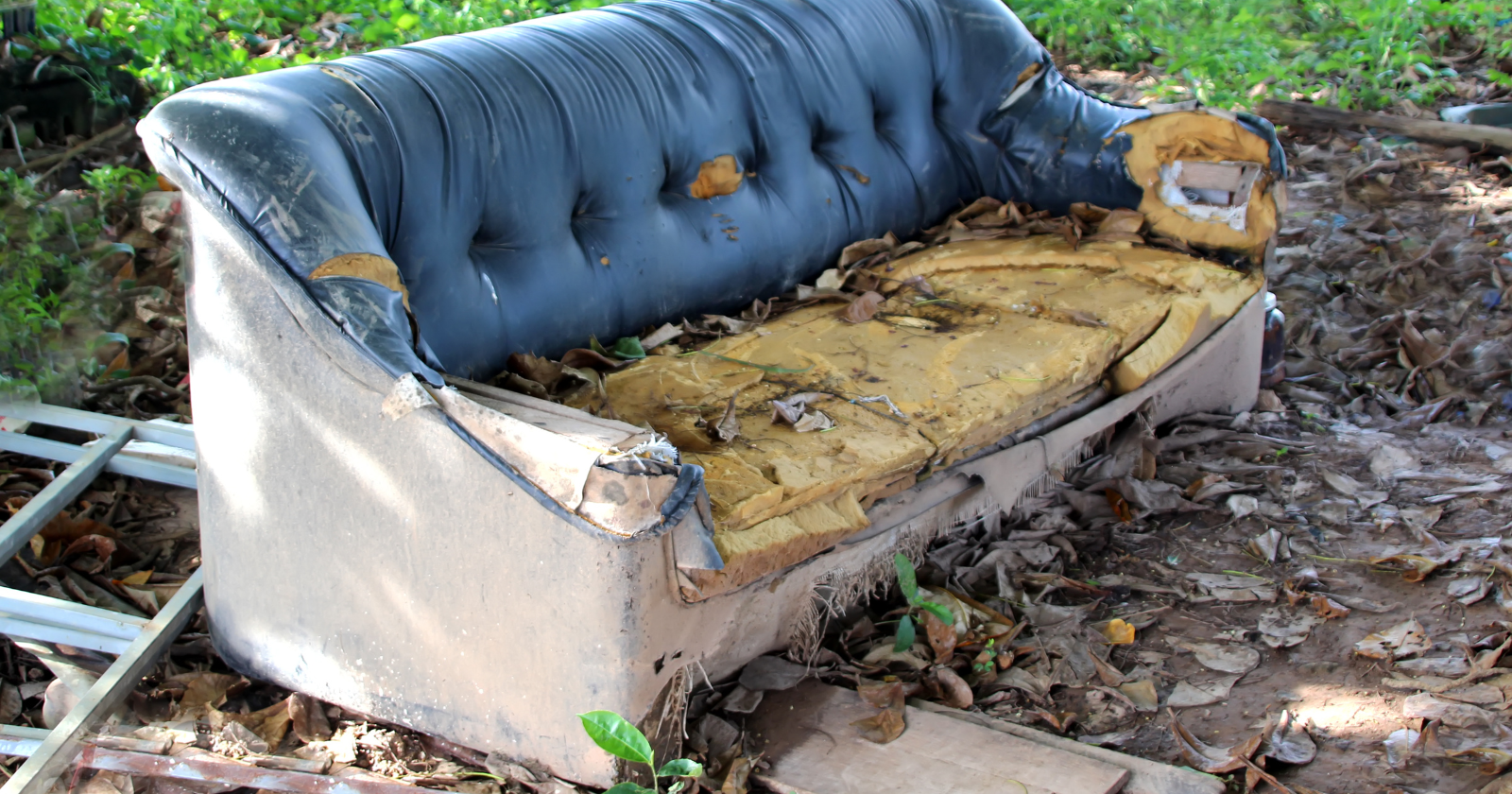
A sofa takes about ninety seconds to shove onto the kerb and roughly forever to get rid of.
In 2018, the most recent year with complete figures, Americans threw out 12.1 million tons of furniture and furnishings. Data from the US Environmental Protection Agency puts the landfilled share at 80.1 per cent, with another 19.5 per cent burned for energy recovery. Recycling accounted for 40,000 tons. Out of twelve million.
That is three tenths of one per cent, and the agency is unusually frank about why the figure is so thin. Apart from mattresses, it could not locate a measurable data source for recovered wood, textiles or metal from furniture at all.
The trend line is not subtle either. That 12.1 million tons was 2.2 million tons in 1960, meaning the category has grown roughly five and a half times over while the population grew by about 80 per cent.
Why a sofa beats a shredder
Pull apart a 1940s armchair and the job is tedious but perfectly possible. Timber frame, tacks, cotton or horsehair wadding, a cover that comes off with a knife. Everything separates because everything was joined by something reversible.
Modern seating is assembled differently. One piece might combine an engineered timber frame, steel springs or a metal base, polyurethane foam, polyester wadding and a synthetic cover, with adhesive doing quiet work throughout. Wood remains the largest material by weight in the category, with ferrous metals second, per the same EPA data. Those materials are not stacked in tidy layers waiting to be sorted. Reversibility was never a design goal here. Low cost and comfort were the goals instead, and adhesive delivers both.
Foam is the genuine obstacle. Flexible polyurethane is a thermoset. The Polyurethane Foam Association explains that its molecules are locked together by strong chemical bonds formed during manufacture. Melting it down and pouring it into a new shape, the way you would with a milk bottle, is chemically off the table. Shredding it and gluing the crumbs into carpet underlay is the usual fallback. That works, though it is a one-way trip down the value ladder.
No automated line can sort that combination. It has to be unpicked by hand, or not at all.
Which is where the economics fold. Scrap timber, mixed textile and shredded foam are cheap commodities. Hauling a hundred-kilo sectional, cutting it open, sorting five material streams and paying to move each one somewhere that wants it is not cheap at all. Burial costs less than the sum of those steps, so burial wins.
The mattress exception
One product in this category does get properly recycled, and its story is the whole argument in miniature.
Mattresses have a dismantling industry because four states legislated one into existence. The Mattress Recycling Council, a non-profit founded by the bedding industry, runs collection and disassembly programs in California, Connecticut, Oregon and Rhode Island, each funded by a flat fee charged on every mattress and foundation sold in the state. In California alone, the council reported 1.56 million mattresses recycled in 2024, diverting 65 million pounds of material from landfill.
The fee itself is the interesting part, because it functions as a published price on labour nobody would otherwise fund. When the council lifted the California and Connecticut charge to $16 a unit at the start of 2025, it named the cause plainly: rising minimum wages and inflation working through the cost of collecting, transporting and disassembling the things. California’s fee went to $18 in April 2026.
Eighteen dollars, then, is roughly what it costs to collect a mattress and take it apart, not what the reclaimed steel and foam are worth once it is done. That gap between disassembly cost and material value is why almost no other piece of furniture gets this treatment, and eighteen dollars is about eighteen dollars more than anyone was ever going to spend voluntarily on their own.
France ran the experiment
What happens if the fee covers the whole living room rather than just the bed?
France has been finding out since 2011. Ecomaison, the state-approved organisation originally trading as Eco-mobilier, collects an eco-fee on furniture sold in France and spends it on collection points, sorting and dismantling. By 2023 the body was handling around 1.5 million tonnes of furnishings, with 97 per cent recovered through reuse, recycling or energy recovery. Ecomaison notes that more than half of France’s used furniture was going to landfill when the scheme began.
That 97 per cent deserves a caveat, since it bundles real material recycling in with burning for energy. In the organisation’s 2017 and 2018 reporting, the earliest detailed breakdown available, material recycling alone accounted for 57 per cent, with the rest recovered as energy. Split either way, it is a different planet from 0.3 per cent.
Better recycling chemistry may eventually loosen the constraint. It has not yet. Taking a sofa apart costs an hour of somebody’s time, and the handful of places that decided to pay for that hour are the only places where it reliably happens.
