

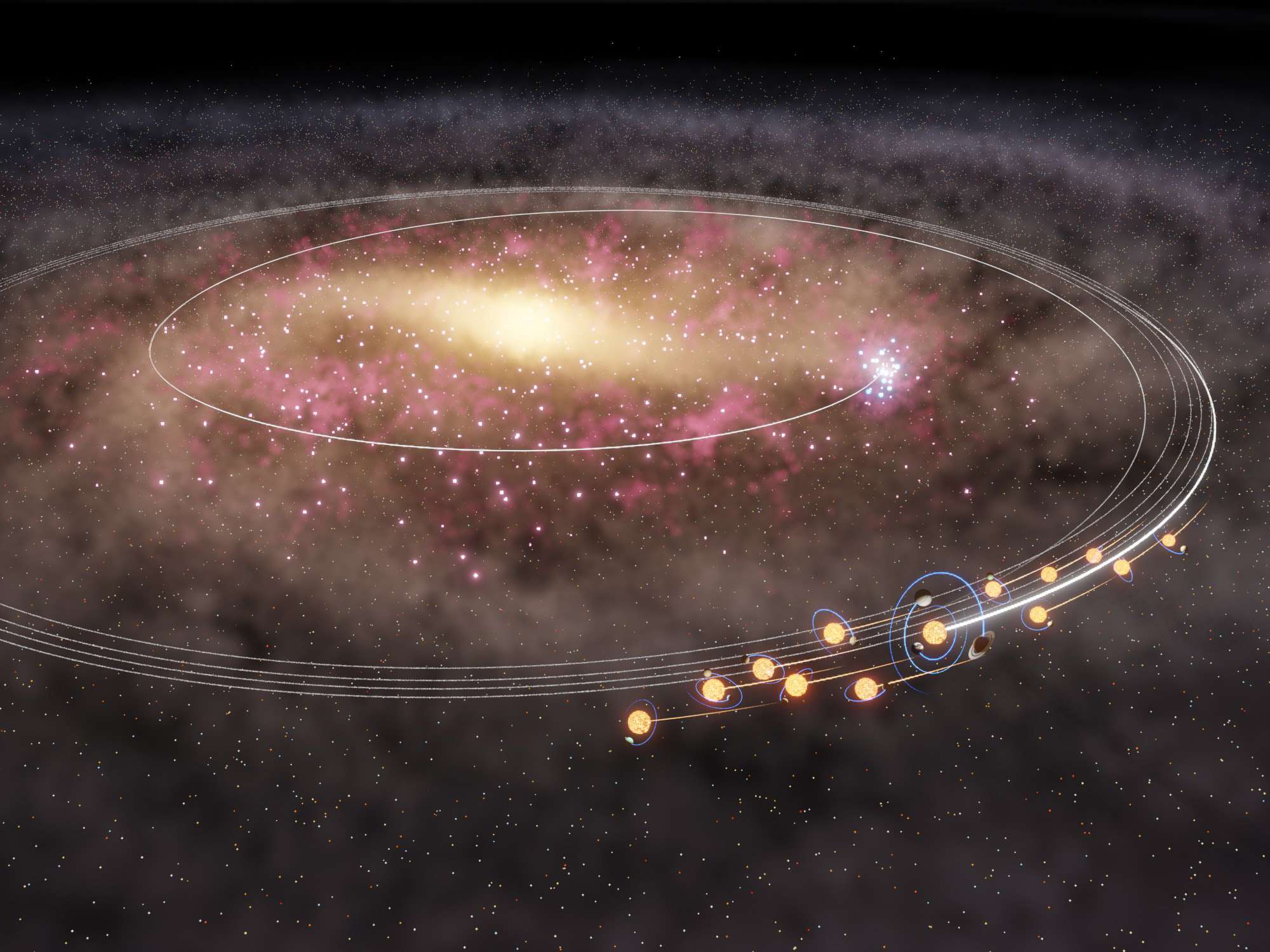
The Sun has completed roughly 20 circuits of the Milky Way since it formed, but those circuits may not all have followed the same track. A new reading of Gaia’s stellar census suggests that our Solar System began much closer to the Galactic centre and moved outward by more than 10,000 light-years, perhaps alongside a large population of stars born during the same unsettled era.
The evidence is not a trail that Gaia watched the Sun leave behind. The spacecraft observed for years, while the proposed journey unfolded over billions of years. Instead, astronomers have used the ages and chemistry of 6,594 nearby stars that resemble the Sun as a kind of Galactic archaeological layer.
Among those stars, 1,551 have estimated ages between four and six billion years. That is a deliberately broad bracket, but it contains the 4.6-billion-year-old Sun. Once the researchers corrected for the ways Gaia’s spectroscopic sample favours some stars over others, the group appeared as a bump in the population’s age distribution.
The interpretation offered in two companion papers in Astronomy & Astrophysics is arresting: many of these stars may have formed in the Milky Way’s inner disk and migrated outward while the Galaxy’s central bar was taking shape. The idea could help explain how the Sun crossed a region that, in today’s Galaxy, ought to be a formidable dynamical barrier.
A solar twin is not a lost solar sibling
The word “twin” needs some care. In this work, it does not mean a star born beside the Sun from the same molecular cloud. It does not mean the star has planets, still less that it has an Earth.
A solar twin is a star whose observable atmospheric properties sit close to solar values. The team behind the first of the two studies selected candidates within 200 kelvin of the Sun’s effective temperature, within 0.2 dex of its surface gravity and within 0.1 dex of its metallicity. Gaia quality flags and colour and brightness tests then removed candidates likely to be poor matches.
That produced a high-confidence catalogue of 6,594 stars, all within about 300 parsecs, or just under 1,000 light-years, of the Solar System. It is about 30 times larger than the biggest previous high-confidence solar-twin samples.
The scale matters. A handful of exceptionally well-studied twins can reveal exquisite chemical detail, but it cannot reliably describe a population. Thousands of less individually precise stars can expose features in a distribution that no single star can establish.
Gaia supplied the raw material through the spectroscopic component of its third data release. The GSP-Spec catalogue contains parameters derived from spectra for about 5.6 million stars. From that much larger pool, the authors built their tightly screened Sun-like sample and estimated each star’s age by comparing its temperature, composition and brightness with stellar-evolution models.
These are model-derived ages rather than engraved dates. Main-sequence stars change slowly, which makes them difficult clocks. The uncertainty is one reason “born around the same time as the Sun” means membership in a four-to-six-billion-year interval, not simultaneous formation.
Why 1,551 stars do not speak for themselves
The raw catalogue contains 1,551 stars in that age interval, nearly a quarter of the sample. Yet a count alone cannot reveal the Milky Way’s history. Gaia did not observe every solar twin with equal probability, and age errors can move stars between bins.
To confront that problem, the researchers constructed a mock population of 75,588 artificial solar twins. They passed those synthetic stars through a model of the catalogue’s selection effects, then compared the mock and observed age histograms. In a second paper devoted to the age distribution, they used a simple observed-to-mock ratio and two separate mathematical deconvolution methods.
The corrected distribution showed two principal features. One is a relatively narrow rise near two billion years, which the authors connect to a comparatively recent episode of star formation in the disk. The other is the broad four-to-six-billion-year bump overlapping the Sun’s formation epoch.
This is also where the limits should be stated plainly. The older bump appeared in the ratio method and in the Richardson-Lucy reconstruction, but not in the team’s regularised least-squares result. The authors discuss the feature seriously, and its presence in more than one treatment makes it interesting, but the exact shape of a deconvolved age distribution is not independent of method.
Nor does an age bump prove that all 1,551 stars travelled together. The proposed migration is a population-level explanation for why so many solar-metallicity stars of that age are now nearby. It is not a backwards integration of 1,551 precise orbits to one common birthplace.
The Sun’s chemistry points inward
Today the Solar System lies about 27,000 light-years from the Milky Way’s centre. As an earlier Deep Field look at our Galactic orbit described, the Sun is not parked at that distance. It travels around the Galaxy at hundreds of thousands of kilometres per hour.
The new question is whether the average radius of that orbit changed. The clue comes from metallicity, the astronomer’s term for elements heavier than hydrogen and helium. Successive generations of stars enrich their surroundings, and the Milky Way’s denser inner disk reached solar metallicity earlier than the outer disk did.
Placing a 4.6-billion-year-old star with the Sun’s chemical composition into models of Galactic enrichment generally points to a birthplace closer to the centre. The authors cite estimates below roughly 20,000 light-years, while some previous work places the Sun near five kiloparsecs from the centre at birth. Compared with its present radius, that implies an outward shift of at least three kiloparsecs, close to 10,000 light-years and perhaps more.
That number is an inference from stellar chemistry and Galactic modelling. There is no surviving signpost saying where the Sun was born, and the uncertainties among birth-radius estimates remain substantial. What Gaia adds is a large nearby comparison population that may share the same chemical and chronological story.
Migration does not mean a straight flight across the Galaxy
A star moving outward through a disk is easy to picture as a traveller crossing concentric lanes. The dynamics are subtler. Every disk star follows an orbit around the Galactic centre, with smaller inward and outward excursions superimposed on that path.
Spiral arms and the central bar can trade angular momentum with a star. In a process astronomers call churning, the star’s guiding radius changes while its orbit can remain fairly circular. That differs from blurring, in which an orbit becomes more eccentric and merely visits a wider range of radii.
The older solar twins in the new study do not show the strongly shifted, highly heated orbital distribution that blurring would predict. Their guiding radii are only somewhat more broadly distributed than those of younger twins. The authors therefore argue that relatively gentle changes in angular momentum provide the better description.
Nothing about that requires the stars to have remained a visible cluster. “Mass migration” is useful shorthand for many stars responding to the same evolving Galactic structures. It should not be mistaken for thousands of suns flying outward as a bound flock.
The Galactic bar presents a genuine puzzle
The Milky Way is a barred spiral galaxy. A dense, elongated structure of stars rotates through its central region, and its gravity shapes motions far beyond the bar itself.
Near the bar’s corotation radius, the bar’s pattern turns around the Galaxy at about the same angular rate as orbiting stars. Dynamical models suggest this region can behave like a barrier, making it difficult for a star born inside to migrate into the outer disk. Previous simulations cited by the team found that perhaps one percent or fewer of stars from the Sun’s proposed birth radius should reach the solar neighbourhood within 4.6 billion years.
If that barrier was already settled when the Sun formed, the Sun’s apparent journey looks improbable. The abundance of comparably old solar twins makes a one-off stroke of luck less satisfying, at least under the authors’ interpretation.
Their proposed solution is timing. A bar under construction is not the same dynamical machine as a mature bar. During its formation, and through its interaction with spiral arms, it may have both compressed gas into a period of vigorous star formation and temporarily increased the efficiency with which stars changed their orbital radii.
On this reading, the four-to-six-billion-year bump records an active phase in the bar’s development. Stars formed or present in the inner disk during that interval gained an unusual opportunity to cross what later became a more effective corotation barrier. The Sun would have been one participant among many.
It is an economical explanation because one changing Galactic structure accounts for both an excess of stars from the right era and their arrival on the far side of a normally restrictive boundary. It remains a proposal. The Milky Way bar’s age, length, rotation rate and slowing history are all active research questions, and other combinations of star formation and migration could alter the observed age distribution.
Did moving outward help life on Earth?
The National Astronomical Observatory of Japan’s account of the research takes the argument one step further. It suggests that migration could have carried the young Solar System from an energetically hostile inner region into a safer outer disk, helping Earth retain stable conditions for billions of years.
There is a reasonable physical idea underneath that suggestion. Closer to the Galactic centre, stars are more crowded, massive-star formation is more intense and destructive events such as supernovae are more common. A planetary system’s path through the Galaxy could change its exposure to radiation and its rate of close gravitational disturbances.
Earlier simulations by some of the same researchers framed this as a “Galactic habitable orbit”. In that picture, habitability is not defined by one fixed annulus around the Milky Way. It depends on a star’s route through an evolving Galaxy.
But neither of the two new solar-twin papers measures life, complex or otherwise. They do not reconstruct Earth’s radiation dose, count nearby supernovae along the inferred route or show that biology would have failed had the Solar System stayed farther inward. The habitability connection is a hypothesis layered onto the migration interpretation.
The trade-offs are not one-sided, either. The metal-rich inner disk may have offered abundant raw material for rocky planets. Moving outward might reduce some hazards while changing comet fluxes or other environmental conditions in ways that are still uncertain. We have only one inhabited Solar System, so a claim about why complex life appeared cannot yet be tested against a large comparison sample.
There is something quietly appropriate about that restraint. As another recent Deep Field article noted, artificial skyglow now hides the Milky Way from more than a third of humanity. Even when the Galaxy is visible, its influence on Earth’s history is mostly indirect, read through chemistry, motion and statistical patterns rather than anything the eye can see.
What would make the case stronger
The solar-twin catalogue is valuable even if the mass-migration explanation changes. Its 6,594 entries, age estimates and quantified selection function give other teams a defined population with which to test chemical clocks, disk evolution and stellar-migration models.
Stronger evidence would come from independent age methods, more precise elemental abundances and comparable samples that reach beyond Gaia’s bright local spectroscopic selection. Models of a forming and slowing bar must also reproduce not only the age bump but the stars’ present orbital properties and chemical patterns.
The inner Galaxy is especially important and especially hard to observe because dust blocks visible light. Japan’s planned JASMINE mission is designed to use infrared astrometry toward the Galactic centre. Such measurements could help map the motions and history of the region from which the Sun is proposed to have emerged.
Gaia turned one solar history into a population question
For years, the Sun’s apparently inner-disk chemistry and its current outer address created a story about a single unusual star. The Gaia catalogue changes the scale of the question. There are now thousands of nearby solar twins to compare, including more than 1,500 assigned to the broad era in which the Solar System formed.
The most defensible conclusion is not that Gaia has proved migration made life possible. It is that a large, carefully characterised stellar population contains a pattern consistent with widespread outward migration during a consequential period in the Milky Way’s development.
If later observations confirm that history, Earth did not simply form at its present Galactic address. The Solar System arrived here through the changing architecture of the Milky Way. Whether that journey was merely part of our astronomical history or one condition that helped complex life endure remains the harder, and more interesting, question.