

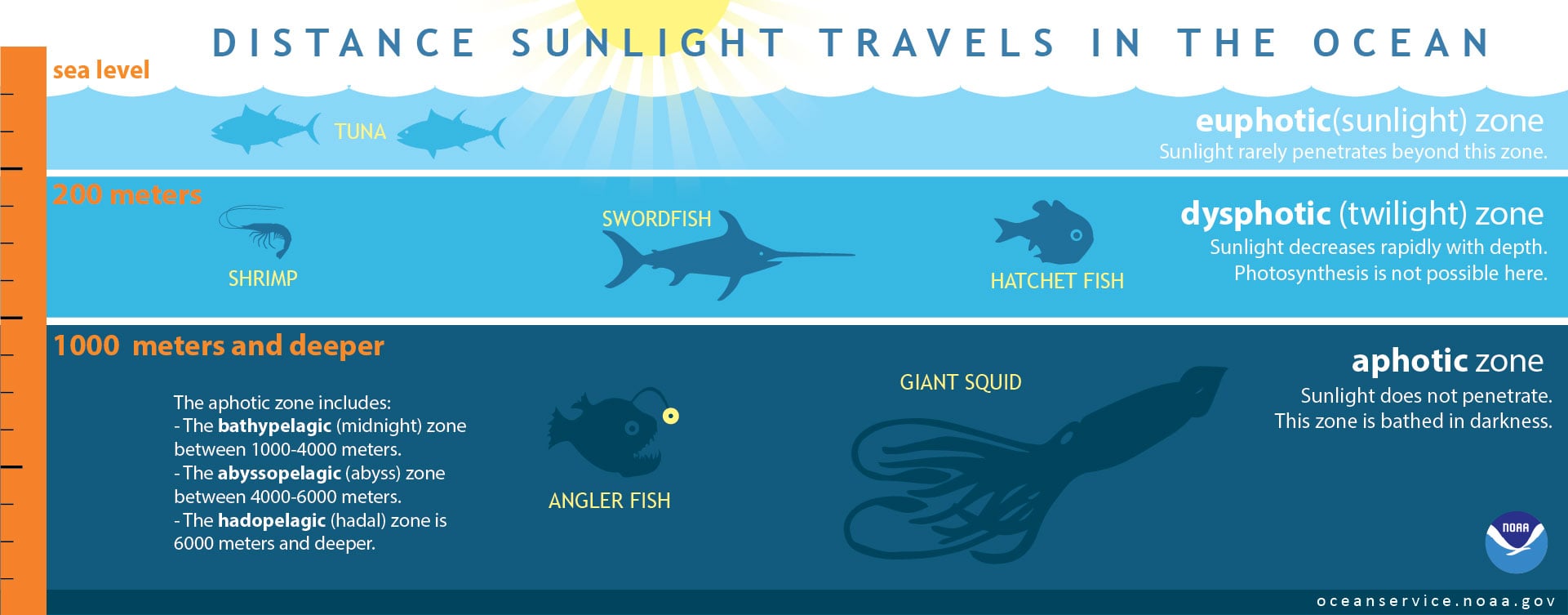
Seen from orbit, Earth looks like a blue world wrapped in one connected, sunlit ocean. That horizontal view hides a much sharper vertical division. Light is plentiful near the surface, too weak to power photosynthesis farther down, and eventually absent altogether.
The standard boundaries are close to the rounded figures in the headline. The euphotic, or sunlit, zone extends from the surface to roughly 200 metres (656 feet). The dysphotic, or twilight, zone runs from about 200 to 1,000 metres (656 to 3,280 feet). Below about 1,000 metres begins the aphotic zone, where sunlight does not penetrate. These are conventional zone boundaries, not fixed global walls. Water clarity, suspended particles, season, latitude and the Sun’s angle all affect how far light travels at a particular place and time.
The key distinction is that photosynthesis fails before sunlight reaches zero. An organism needs enough light energy arriving quickly enough to manufacture more organic material than it consumes. A residual glow can therefore remain visible to an adapted animal long after the energy budget for photosynthesis has become impossible.
Two thresholds, not one
The upper boundary near 200 metres marks the lower edge of useful photosynthetic light, not the instant at which every photon disappears. The US National Ocean Service divides the water column into a sunlit zone, a twilight zone where light is insufficient for photosynthesis, and a dark zone below 1,000 metres. In unusually clear water, instruments may detect traces deeper than the nominal boundary, but detected is not the same as biologically productive.
That creates two separate thresholds. The first is an energy threshold for primary producers. The second, hundreds of metres lower, is an optical threshold at which direct sunlight effectively no longer penetrates. Combining both under the single word “dark” erases the enormous habitat between them.
Oceanographers use several overlapping names. Epipelagic usually describes the upper 200 metres, mesopelagic the 200-to-1,000-metre interval, and bathypelagic the water from 1,000 to 4,000 metres. Euphotic, dysphotic and aphotic describe light conditions, while the pelagic terms describe depth zones. The boundaries often coincide for convenience, but the vocabularies answer different questions.
Water filters colour before it removes light
Seawater does not dim every wavelength equally. Reds, oranges and yellows are absorbed relatively quickly. Blue wavelengths travel farther, which helps explain the colour of clear ocean water and the blue cast of the last natural light at depth. A red animal can look black in the twilight zone because there is almost no red light left to reflect.
Water itself is only part of the filter. Dissolved organic material, sediment, plankton and other particles absorb or scatter additional light. A productive coastal sea can darken far sooner than exceptionally clear water in the open subtropics. Storms, blooms and runoff can alter that optical environment without changing the physical depth of the seafloor.
Even the word “visible” needs a viewer. Human eyes, digital sensors and the visual systems of deep-sea animals have different sensitivities. Woods Hole Oceanographic Institution notes that the human eye may register total darkness near 850 metres while highly sensitive animals can still detect downwelling sunlight closer to 1,000 metres. The 1,000-metre line is a useful global convention, not a claim that every last solar photon stops at precisely the same depth.
The sunlit zone is a thin roof
Almost all oceanic photosynthesis is concentrated in the upper layer. Microscopic phytoplankton use sunlight, carbon dioxide and nutrients to build organic matter. That primary production supports marine food webs, releases oxygen and helps drive the exchange of carbon between atmosphere and ocean.
Yet 200 metres is shallow beside an average ocean depth of 3,682 metres. NOAA Ocean Exploration describes more than 90 per cent of the ocean as deep ocean below 200 metres. It also puts the ocean’s surface area at about 360 million square kilometres, covering roughly 70 per cent of Earth. The productive layer is better pictured as a thin illuminated roof over a much larger dim and dark volume.
This geometry helps explain why surface events can matter far below. Changes in plankton growth, ocean mixing and the composition of sinking particles influence how much food reaches animals that never encounter the Sun. The source of energy and the place where that energy is consumed can be separated by kilometres and by weeks of sinking.
The twilight zone still follows day and night
The mesopelagic twilight zone is not an inactive buffer. Fish, squid, crustaceans and gelatinous animals live in its faint blue light. Large numbers rise towards surface waters after sunset to feed, then descend before dawn, using darkness near the surface and depth during the day to reduce their exposure to visual predators.
This diel vertical migration is often described as the largest animal migration on Earth, although it is measured in vertical distance rather than a journey across continents. It transfers carbon downwards when animals feed near the surface, respire or excrete at depth, or become prey there. That biological transport is one part of the ocean’s carbon pump.
Day and night therefore remain meaningful well below the photosynthetic limit. Faint sunlight can guide an animal even when it cannot fuel a plant. Some species track the changing brightness above and remain at a preferred light level, moving deeper as noon approaches and shallower as evening arrives. The twilight zone is defined by too little sunlight for photosynthesis, not by an absence of solar information.
Below 1,000 metres, sunlight is gone
The bathypelagic zone begins near 1,000 metres and continues to roughly 4,000 metres. Beneath it lie the abyssopelagic zone, commonly placed between 4,000 and 6,000 metres, and the hadal trenches below about 6,000 metres. The deepest measured point is nearly 11 kilometres beneath sea level.
At those depths there is no sunrise, sunset or seasonal change in solar illumination. Water is generally cold, pressure rises by about one atmosphere for every ten metres of depth, and food is sparse compared with the surface. Animals must spend energy carefully, find mates across large distances and detect prey without an illuminated background.
“Permanent darkness” accurately describes the solar environment below the aphotic boundary. It does not mean every part of the deep sea has the same temperature, chemistry or ecology. An oxygen-rich abyssal plain, a low-oxygen basin, a whale fall and a hydrothermal vent can all be dark while supporting very different communities.
Dark does not mean lightless
Sunlight can be absent while locally produced light remains common. Many deep-sea animals manufacture light through bioluminescent chemistry. A NOAA fact sheet estimates that more than 75 per cent of animals in the open-ocean water column can produce light. The flashes, glowing organs and luminous clouds serve as lures, warnings, mating signals, searchlights and decoys.
In the twilight zone, some animals use counterillumination. Light organs on their undersides imitate the faint downwelling light, softening the silhouette seen by a predator looking upward. Below the reach of the Sun, bioluminescence can no longer match daylight, but it remains useful for signalling, deception and attack.
Most deep-sea bioluminescence is blue or blue-green, wavelengths that travel efficiently through seawater and are detected by many marine eyes. Red bioluminescence is rarer and can act like a private torch for an animal whose prey cannot see it. The aphotic ocean is thus better described as having no solar illumination than as containing no photons.
Most deep life still runs on surface sunlight
Even in permanent darkness, most deep food webs ultimately depend on photosynthesis above. Dead plankton, faecal pellets, mucus, moults and other organic particles sink as marine snow. Larger carcasses make rarer but concentrated deliveries. Migrating animals carry additional carbon into deeper water every day.
Only a fraction of surface production reaches the bottom. Particles are eaten, broken apart and decomposed as they fall, so the food supply generally diminishes with depth. Deep-sea organisms compensate through slow metabolisms, opportunistic feeding, large mouths, expandable stomachs or partnerships with microbes.
Chemosynthesis provides an important exception. Microbes at hydrothermal vents and cold seeps use energy from chemical reactions rather than sunlight to build organic matter. NOAA’s comparison of photosynthesis and chemosynthesis explains how the two processes support primary production from different energy sources. A previous SpaceDaily account of the 1977 discovery of hydrothermal-vent communities describes why animals thriving in total darkness changed biological expectations. Such ecosystems are striking local exceptions, not evidence that the entire deep ocean is independent of surface sunlight.
A hidden majority of the planet
The ocean covers about 70 per cent of Earth, and its average depth lies far below the 1,000-metre aphotic boundary. Those two facts explain the headline’s reversal. The familiar blue surface is the entrance to a planetary environment dominated not by sunshine but by cold, high pressure and darkness.
The exact depth at which photosynthesis ends or the last sunlight disappears changes from place to place. The rounded thresholds of about 600 feet and 3,300 feet should not be treated as razor-sharp, universal floors. They are practical boundaries that describe a robust pattern: a thin productive zone, a broad twilight transition, then a far larger realm beyond the Sun.
That realm is not empty. It moves carbon, recycles nutrients, supports animals that migrate on a daily clock and contains ecosystems powered by both falling organic matter and local chemistry. Permanent darkness describes the absence of sunlight, not the absence of life. Much of Earth’s surface lies beneath water that never sees the Sun.