
Asteroid 2024 YR4 did not hit Earth, and it will not do so in 2032. Its importance lies in what happened while astronomers were still uncertain. On 27 January 2025, three independent orbit-computation centres agreed that the chance of an Earth impact had crossed 1 per cent. On 29 January, the International Asteroid Warning Network sent a formal notice to the United Nations Office for Outer Space Affairs and the Space Mission Planning Advisory Group.
It was the first formal asteroid notification issued through an international planetary-defence system created more than a decade earlier. The warning did not predict that impact was the likely outcome. Its 1.3 per cent estimate meant there was still a 98.7 per cent chance of a miss. What changed was that the risk had become large enough, for an object of this size, to activate an agreed process for observations, government notification and possible mission planning.
The asteroid was later cleared as an Earth threat, and a lingering lunar-impact possibility was also eliminated in 2026. That outcome does not make the warning a false alarm. It shows what a warning system is supposed to do when the first calculation is incomplete.
A short observation arc left a long uncertainty corridor
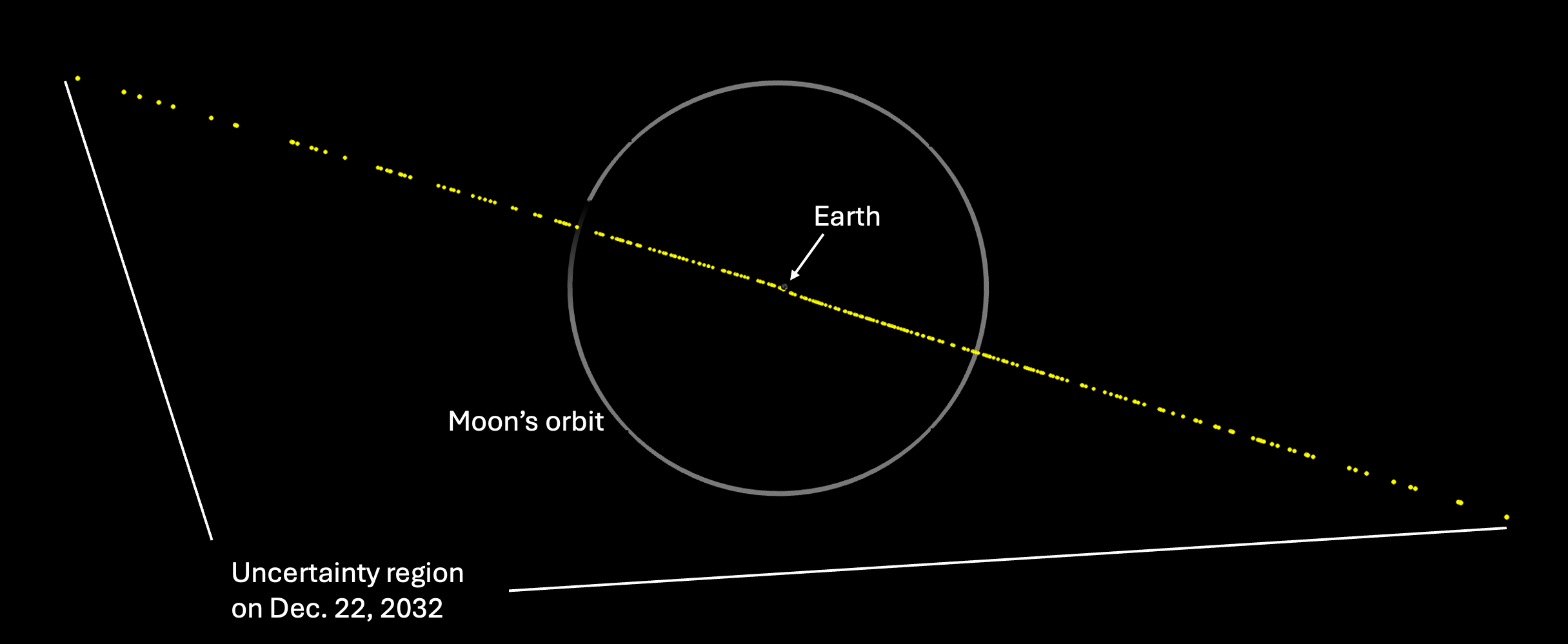
The NASA-funded Asteroid Terrestrial-impact Last Alert System discovered 2024 YR4 from its station at Río Hurtado, Chile, on 27 December 2024, two days after the asteroid had passed relatively close to Earth. Pre-discovery images extended the record back only to 25 December. Astronomers therefore began with a very short observed segment of an orbit that had to be projected eight years forward to 22 December 2032.
An early orbit prediction is not a single line through space. It is a range of statistically possible trajectories, often shown as a long uncertainty region. At first, only a tiny fraction of that region intersected Earth. New measurements reduced the range of possible positions, but Earth remained inside it. As the denominator shrank around the planet, the calculated impact probability rose even though the asteroid had not changed course.
NASA’s Center for Near-Earth Object Studies chronology says the estimate passed 1 per cent on 27 January. The object also reached level 3 on the Torino Scale, a rating that calls for attention from astronomers and, for an encounter less than a decade away, from public officials. It was unusual, but it was still much more likely to miss than hit.
One per cent was a trigger, not a prediction
IAWN’s notification threshold applies when an object larger than roughly 10 metres has a greater than 1 per cent chance of impact. The threshold is deliberately much lower than 50 per cent because waiting until a collision becomes the most likely outcome could waste years needed for tracking, physical characterisation, disaster planning or deflection.
The rule also creates a communication discipline. Once the numerical and size criteria are met, the decision to notify does not depend on whether one agency considers the story alarming enough. Observatories submit positions to the Minor Planet Center, specialised centres calculate the orbit independently, and IAWN coordinates the result.
For 2024 YR4, NASA CNEOS, ESA’s Near-Earth Object Coordination Centre and the NEO Dynamic Site in Italy independently reached the same conclusion on 27 January. That agreement mattered because impact probabilities can fluctuate when each additional observation shifts a very narrow uncertainty region.
The January 29 notice set the machinery in motion
The formal IAWN notice dated 29 January put the probability at 1.3 per cent and the asteroid’s likely diameter at 40 to 90 metres. It identified a possible impact on 22 December 2032 and a corridor extending across parts of the eastern Pacific, South America, the Atlantic, Africa, the Arabian Sea and South Asia. An object in that range would not threaten civilisation, but an impact or airburst could cause severe damage across a city or region.
The notice went to the chair of the ESA-led Space Mission Planning Advisory Group, known as SMPAG, and to the planetary-defence programme officer at the United Nations Office for Outer Space Affairs, or UNOOSA. A United Nations status report records that UNOOSA distributed the information to member states on 30 January.
That was notification, not an instruction to evacuate a corridor defined nearly eight years in advance. It also did not automatically authorise a spacecraft mission. The immediate response was to prioritise observations, refine the orbit and prepare the advisory groups to reassess if the probability rose, fell or remained unresolved.
The protocol had waited more than a decade for this case
The response structure was not improvised in January 2025. After years of work on an international approach to near-Earth objects, United Nations bodies endorsed recommendations for IAWN and SMPAG in 2013. The two groups were established in 2014, according to UNOOSA’s history of the programme.
IAWN links the observatories, catalogues and orbit specialists needed to discover and characterise a threat. SMPAG brings together national space agencies to examine reconnaissance, deflection and other mission options. UNOOSA provides a channel for credible impact information to reach governments rather than circulating only within the astronomy community.
For years the architecture existed alongside exercises, procedures and threshold discussions, but no asteroid had required the formal notification step. At its February 2025 meeting, IAWN described 2024 YR4 as the first such case. That is the precise first in this story: earlier asteroids had appeared on risk lists and earlier warnings had been discussed, but this was the first formal IAWN notice after an asteroid exceeded the network’s 1 per cent threshold.
The all-clear was part of the same protocol
The probability continued to move as telescopes accumulated data. NASA’s estimate reached a maximum of 3.1 per cent on 18 February, the highest then recorded for an asteroid of this size or larger. Fresh observations the following night brought it down to 1.5 per cent. SpaceDaily’s report from that stage described how darker skies after the full Moon helped astronomers recover the faint object.
By 23 February, NASA’s estimate had fallen to 0.004 per cent, or about one chance in 26,000. IAWN issued a final notification on 24 February stating that there was no significant Earth-impact potential for the next century.
This familiar rise and fall is not a flaw in impact monitoring. When Earth happens to sit inside a narrowing uncertainty region, its share of the remaining possible trajectories can initially grow. Further observations then shrink and move that region until Earth falls outside it. The system’s job is to communicate both stages: the point at which the risk becomes operationally relevant and the point at which it can be cleared.
Webb eventually closed the lunar footnote
Clearing Earth did not end the scientific campaign. Infrared measurements by the James Webb Space Telescope refined the asteroid’s diameter to roughly 60 metres. Other observations found a fast, retrograde rotation and a stony composition, while researchers traced an unusual route from the central main belt into an Earth-crossing orbit. SpaceDaily covered that physical and dynamical portrait after the terrestrial threat had receded.
A separate uncertainty remained. The 2032 trajectory still carried a roughly 4 per cent chance of hitting the Moon after an Earth impact had been excluded. Webb recovered the exceptionally faint asteroid in February 2026, allowing CNEOS to tighten the orbit again. NASA’s March 2026 update ruled out a lunar impact and placed the expected pass about 21,200 kilometres above the Moon’s surface.
Neither change represented a physical turn by the asteroid. Both reflected improved knowledge of where the same orbit will carry it.
What was tested, and what was not
No deflection mission was launched, and none was needed. SMPAG met, shared information and remained ready to consider options, but the observational campaign resolved the threat while there was still ample time. The test was therefore institutional: could independent calculation centres agree, could observers respond worldwide, could agencies speak consistently while the probability changed, and could the United Nations relay the result to governments?
Humanity has separately tested one physical defence. NASA’s DART spacecraft struck Dimorphos in 2022 and shortened the asteroid moonlet’s orbit by about 33 minutes. That demonstrated a kinetic impact on one type of target. It did not remove the need to find a dangerous object early, measure its orbit and decide when an international response should begin.
2024 YR4 tested that earlier half of planetary defence under real uncertainty. The protocol activated, the warning reached the United Nations, more observations arrived and the same channel carried the all-clear. The asteroid missed. The system still had something important to prove.