
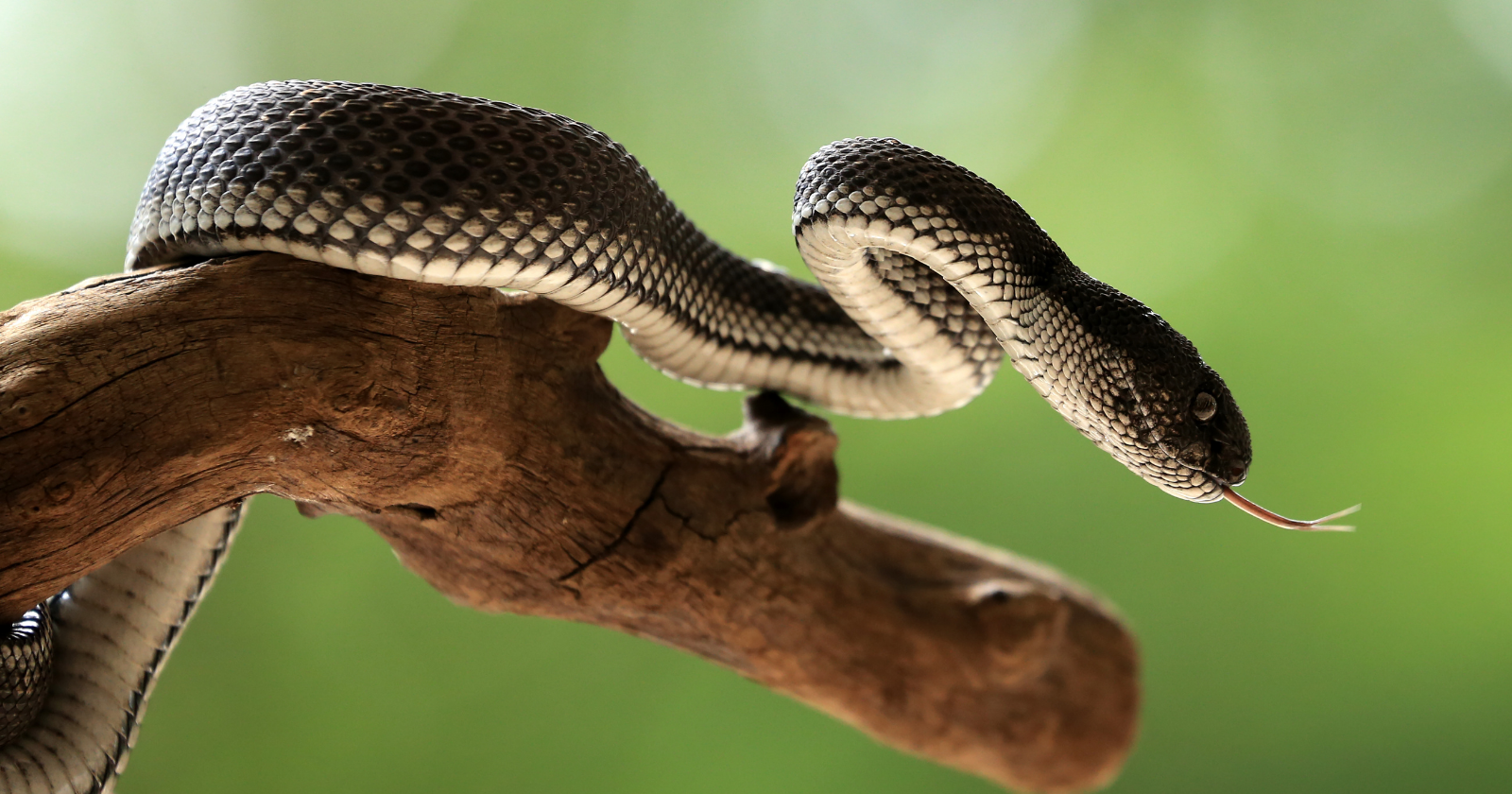
On the island of Guam, when the lights go out, the line crews of the Guam Power Authority often know what they will find before the truck arrives: a dead snake, draped between two conductors or curled at the base of a transformer, its body still completing the connection that killed it and blacked out the neighborhood.
Since 2021, those crews have had an extra task on the work order. Instead of clearing the carcass and moving on, they bag the snake for science. U.S. Geological Survey biologists collect the electrocuted animals and record their length, sex and stomach contents, building, outage by outage, a forensic profile of the individuals attacking the island’s grid. The power company and the federal government are running a joint autopsy program on their shared enemy, because on Guam the electrical system’s chief adversary is not weather or age. It is a snake.
The perfect conductor
The brown tree snake arrived on Guam as a stowaway in military cargo sometime in the 1940s, from its native range around New Guinea and northern Australia. What it did to the island’s wildlife is one of ecology’s darkest case studies: with no predators and an island of naive prey, it ate ten of Guam’s twelve native forest bird species into local extinction and reached densities unheard of for a snake, at the peak thousands per square mile of jungle.
The grid war is the same invasion measured in volts. The brown tree snake is an arboreal specialist, a climber that ascends anything vertical in search of prey and travel routes, and to a snake evolved for rainforest trees, a power pole is a smooth-barked trunk and the wires are vines. The animals climb the poles nightly, and the trouble comes from the body plan. A brown tree snake is extraordinarily long and thin, routinely one to two meters, and a climbing snake stretching from one conductor toward another does the one thing no bird, rat or lizard on the pole can do: it touches both at once while they are still energized.
Electricity does not care that the bridge is alive. The moment the snake’s body spans two phases, or a live line and a ground, it becomes the missing piece of the circuit, current surges through it, and the result is a dead snake, a tripped breaker or a blown transformer, and some fraction of Guam in the dark. As the USGS puts it with federal restraint, the snakes’ long bodies are well-suited for bridging live wires, producing surges that damage equipment across the system.
An outage every few days, for decades
The scale is what separates Guam from anywhere else on Earth. A landmark economic study documented more than 1,600 snake-caused outages between 1978 and 1997, averaging one every few days for twenty years, with peak years near 200. A third of them were “at large” events taking down whole circuits or multiple circuits, and a single island-wide blackout was costed at over $3 million in lost productivity. Across decades, the snake’s tax on Guam’s economy through the grid alone has run into the millions per year, on top of everything the island spends fighting the animal itself, and it is why every appliance-owning household on Guam traditionally keeps a supply of candles and a healthy skepticism of the evening’s schedule.
The Power Authority has fought back with the tools of a utility: snake guards on poles, insulated and covered conductors, cleared vegetation, hardened substations. It helps, and outage numbers have come down from the worst years, but the island’s snakes number in the hundreds of thousands at least, they climb every night, and, as the utility has learned, hundreds of thousands of dollars of snake-proofing buys reduction, not immunity.
What the dead are telling the living
That is what makes the 2021 collection program more than housekeeping. Every electrocuted snake is a data point from exactly the population that matters, the individuals that actually reach the wires, and the USGS profiling, run with the Office of Insular Affairs and USDA Wildlife Services, is mapping which substations and line segments attract them, what seasons concentrate the attacks, and what the culprits have in common. If grid-attacking snakes skew large, or male, or hungry, or if outages cluster where forest meets feeder, then defenses and trapping can be aimed instead of sprayed, and the same knowledge feeds the wider campaign, from toxic-bait drops over the jungle to the permanent inspection regime that keeps the snake from stowing away to Hawaii, where biologists regard its arrival as a nightmare scenario.
There is a neat closed loop in the arrangement. For forty years the snake has used Guam’s grid as a hunting trail and paid for it, individual by individual, at the top of the poles. Now each casualty testifies. The animal that turned itself into the missing piece of the island’s circuits has become, in death, the missing piece of the dataset, and the crews who once cursed the carcasses collect them carefully, because the fastest way to defend the wires turned out to be listening to what the snakes on them had to say.
