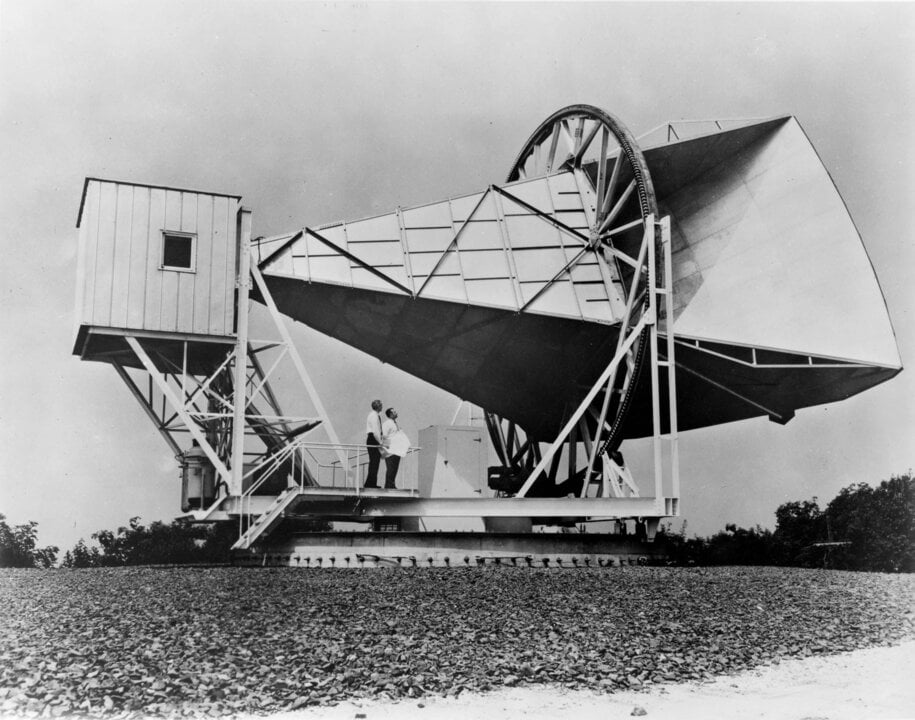
A twenty foot horn antenna built to bounce satellite signals across an ocean, and two grown men standing inside it with a broom, scraping out pigeon droppings by hand.
That was the least dignified setting imaginable for the discovery that ended up confirming how the universe began. The antenna sat in Holmdel, New Jersey, built by Bell Labs in 1960 to work with the Echo and Telstar satellite projects. Within a few years, better equipment made it obsolete for that job, and it was handed over to two radio astronomers, Arno Penzias and Robert Wilson, who wanted to use its extreme sensitivity to study faint radio emission from our own galaxy.
What they got instead was a hiss they could not explain and could not make go away.
A hiss that wouldn’t go away
Penzias, who had trained as a radar engineer before earning his doctorate at Columbia, and Wilson, freshly out of Caltech, pointed the horn at the sky expecting a clean, quiet instrument to work with.
Instead they found a faint, steady noise sitting underneath everything they tried to measure, present no matter which direction they pointed the antenna, present in daylight and at night, present in every season, present at a level well above anything their equipment should have been contributing on its own. They checked the obvious suspects first: loose connections, a stray welded joint they had to re-solder, interference from nearby New York City, even lingering radiation from a high-altitude nuclear test conducted a few years earlier.
None of it explained a signal that refused to change no matter where they aimed. Then they climbed inside the horn’s throat and found pigeons nesting there, along with the white coating their droppings had left across the metal. “And so the pigeons left with a smaller bang, but the noise remained, coming from every direction,” Penzias later said of the cleanup. They live-trapped the birds, scraped the antenna clean by hand, and waited. The droppings were gone. The hiss stayed exactly the same.
What a phone call to Princeton actually solved
The explanation came from less than forty miles away. A Princeton team led by physicist Robert Dicke had been quietly building their own equipment to search for exactly this kind of radiation, a leftover afterglow theorized to fill the entire universe if the Big Bang model was correct. When Penzias called Dicke to describe the mystery noise, Dicke reportedly hung up the phone and turned to his colleagues with four words: “Boys, we’ve been scooped.”
The measurements and the antenna cleanup took place in 1964. The two teams published companion papers in 1965: Penzias and Wilson reported the signal, while Dicke’s team supplied the cosmological interpretation. “This was really the start of modern cosmology,” Wilson later said.
The hiss was the cosmic microwave background, radiation released when the universe became transparent roughly 380,000 years after the Big Bang. It has a temperature of about 2.7 kelvin and arrives from every direction because it fills space rather than coming from a single object in the sky. Penzias and Wilson received the 1978 Nobel Prize in Physics for their part in its discovery.
Two very different silences, sharing one shape
It matters to say plainly that the Bell Labs hiss and the tone Voyager 1 caught decades later are not the same phenomenon, and comparing them too loosely would misrepresent both. The cosmic microwave background is electromagnetic radiation, actual photons, leftover from an event 13.8 billion years old and spread uniformly across the entire universe. The tone in the video is something else entirely, an electrostatic disturbance in the thin, warm plasma immediately surrounding one spacecraft, caused by local physics near Voyager rather than anything universal. One is the oldest light there is. The other is a local hum in gas a spacecraft happened to be sitting in.
What the two stories actually share is the shape of the discovery itself, not the physics behind it. Both involved an instrument built for an entirely different, far more mundane purpose, a satellite relay in one case, a planetary flyby sensor in the other, that ended up being pointed at something nobody had designed it to find. Both produced a signal so persistent and so evenly spread that ruling out every mundane explanation became its own kind of proof. Penzias and Wilson kept the pigeons out and the hiss stayed.
Correction, 31 August 2026: An earlier headline dated the discovery to 1965 and said the researchers spent months scraping pigeon droppings. The measurements and cleanup took place in 1964; the discovery papers were published in 1965.