

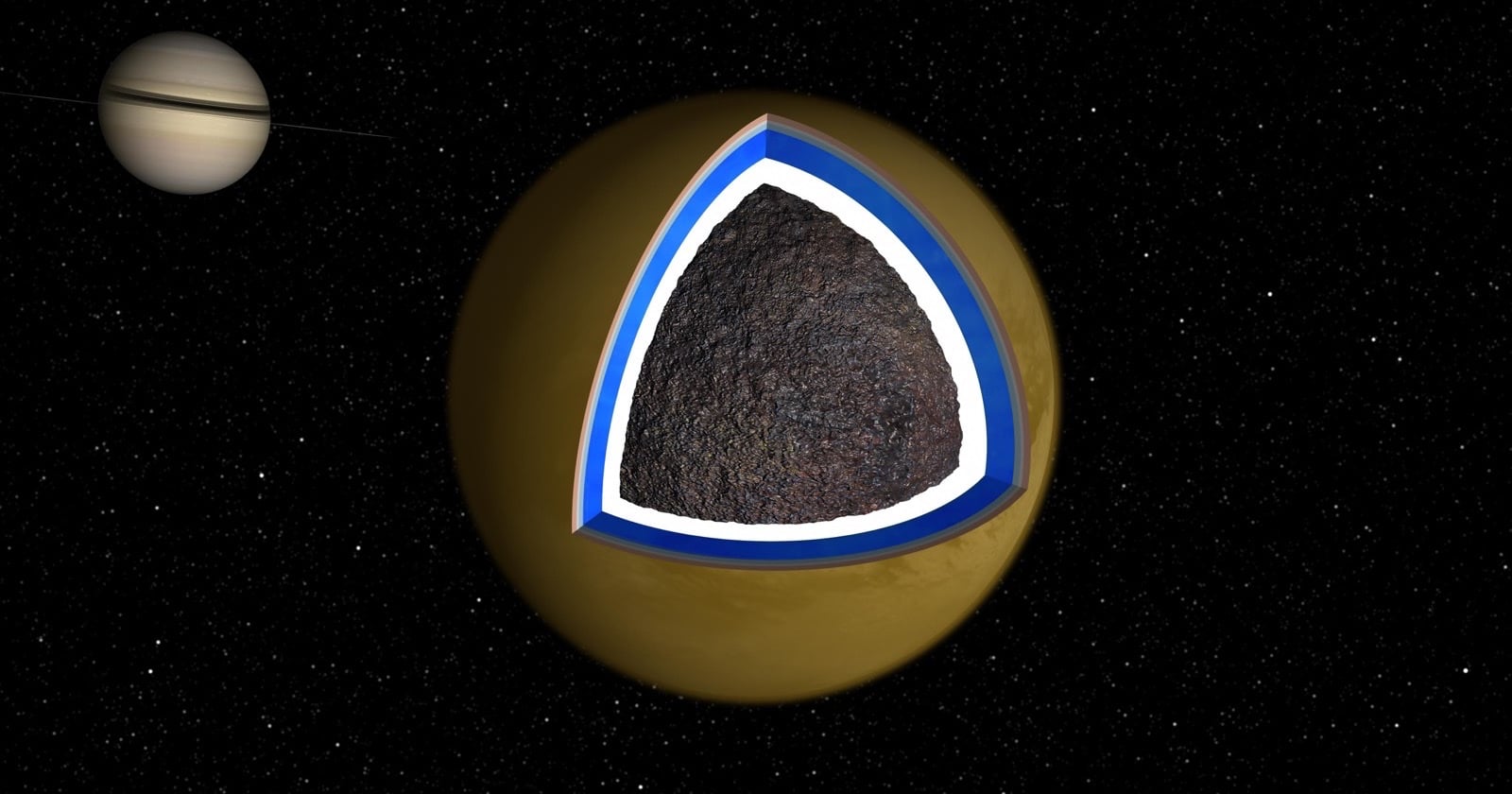
Titan presents an easy temptation to astrobiology. Its atmosphere manufactures carbon-rich molecules continuously, its surface is covered in organic material, and for years Cassini data were interpreted as evidence of a vast water ocean hidden beneath the ice.
A 2025 paper asked what would happen if one small part of that organic inventory reached the water. Could microbes survive by fermenting glycine, the simplest amino acid, and if they could, how much life would the available food maintain?
The model’s upper answer was about 7.5 kilograms of microbial carbon across Titan’s entire ocean. Converted using an assumed carbon mass for a microbial cell, the estimated population was roughly 10^14 to 10^17 cells. Diluted through about 10^22 kilograms of water, even the upper value is only around one cell per 100,000 kilograms.
This is one modelling study, not evidence that Titan is inhabited. It does not set a ceiling on all possible life there. It estimates the population that one metabolism might sustain under one proposed nutrient-delivery route, using an interior structure that later research has challenged.
The paper modelled a food supply, not the origin of life
Antonin Affholder of the University of Arizona and 11 colleagues published The Viability of Glycine Fermentation in Titan’s Subsurface Ocean in The Planetary Science Journal in April 2025. The paper is a bioenergetic calculation informed by laboratory measurements of terrestrial microbes.
It does not model life emerging from non-living chemistry. The researchers begin with a hypothetical population already capable of using glycine and ask whether the reaction releases enough energy for growth, how quickly cells could process the substrate and what population the supply could support at steady state.
Glycine is useful for this exercise because it can be produced abiotically and fermented without oxygen or another powerful external oxidant. Some anaerobic organisms on Earth break it down while conserving energy and incorporating part of its carbon into new cellular material.
The model drew on growth data for strains of Clostridia, a terrestrial bacterial class containing known fermenters. Titan life, if it exists, need not resemble Clostridia. Earth organisms provide measurable rates and temperature responses that can anchor a calculation otherwise built almost entirely from unknowns.
The difficult journey is from the surface to the water
Titan’s upper atmosphere turns methane and nitrogen into a broad range of organic compounds. Haze particles settle to the surface, building an inventory that looks abundant when considered over the whole moon. Abundance at the surface, however, does not make a molecule food for an organism buried far below.
The proposed bridge is an impact crater. A large impact can melt water ice, creating a temporary liquid pool in which surface organics may dissolve or react. If some of that melt migrates downward before it freezes, it could carry glycine towards deeper habitable water.
Earlier work estimated a maximum delivery of about 7.5 to 7,500 kilograms of glycine per year. A 2024 study of how Titan’s impact melt pools evolve found that downward transport may be even less efficient because fewer craters can move material through the ice than previously assumed.
The range used by Affholder’s team is therefore deliberately optimistic at its upper end. The ocean in their calculation has a mass near 10^22 kilograms. Even tonnes of glycine arriving each year become an exceptionally thin food stream once measured against that reservoir.
A reaction can work while a biosphere remains tiny
Under some combinations of temperature, composition and glycine concentration, fermentation released enough Gibbs free energy to permit growth in the model. This is a thermodynamic opening, not a prediction that cells are present.
Habitability and productivity are separate questions. An environment can allow a metabolism while supplying its fuel so slowly that only a small standing population survives. A room may contain breathable air but no food; the first condition does not solve the second.
The team also included cellular maintenance, growth rates and feedback from fermentation products. As microbes consume glycine and release substances such as acetate, carbon dioxide and ammonia species, the remaining reaction becomes less favourable. A simple calculation that converts substrate to biomass at maximum efficiency misses those costs.
The resulting steady-state productivity was typically about 0.01 kilograms of cellular carbon per kilogram of delivered glycine. Under the maximum delivery scenario, standing biomass reached roughly 7.5 kilograms of carbon. At the low end, it was measured in grams.
“A few kilograms” is carbon, not wet microbial mass
The kilograms in the paper are kilograms of carbon locked in cells. They are not the total wet mass of a Titan organism or a compact object weighing as much as a small animal. The comparison is useful for scale but can make the hypothetical biosphere sound more physically gathered than it is.
Using an assumed value near 10^-13 grams of carbon per cell, the researchers converted their standing biomass to approximately 10^14 to 10^17 cells. Earth contains an estimated 10^30 prokaryotic cells, so even the upper Titan figure is tiny on a planetary scale.
The title’s “less than one cell per kilogram” is correct but generous. Divide 10^17 cells by 10^22 kilograms of water and the result is around 10^-5 cells per kilogram. At that upper average, one cell corresponds to roughly 100,000 kilograms of water. The lower estimate is sparser still.
SpaceDaily’s first report on the paper captured its headline constraint. The harder issue is what the global average can and cannot tell a mission designer about one real sample.
The 480-kilometre figure needs careful handling
No spacecraft has measured a 480-kilometre-thick liquid ocean on Titan. The number commonly attached to this story comes from interior models in which Titan’s outer water-and-ice layers extend for roughly that scale. One seismic study described water and ice layers with a combined thickness near 480 kilometres, not 480 kilometres of confirmed open water.
Cassini detected Titan’s tides, gravity and rotational behaviour. Those measurements were consistent with a liquid layer decoupling the outer shell from the deeper interior, but they did not reveal a directly imaged boundary or supply one uncontested depth.
The 2025 glycine paper used an ocean mass of about 10^22 kilograms as the denominator for its global dilution estimate. That assumption matters more to the cell-per-kilogram figure than a single quoted thickness. The interior’s salinity, temperature, ice phases and contact with rock remain uncertain.
Calling the ocean hypothetical is therefore essential. It was a well-motivated interpretation of Cassini data when the bioenergetic work was conducted, not a sampled body of water with a known depth and composition.
A later Cassini reanalysis changed the interior
In December 2025, after the glycine paper appeared, Flavio Petricca and colleagues published a new analysis of Cassini radio tracking in Nature. They measured not only the amplitude of Titan’s tidal response but its dissipative phase lag.
Their models found that a global liquid ocean could not reproduce the strong dissipation. The preferred structure was a roughly 600-kilometre hydrosphere dominated by high-pressure ice near its melting point, with a small fraction of liquid held in local pockets. The paper describes a slushy layer rather than a global sea.
SpaceDaily examined that reversal in its report on Titan’s delayed tidal response. The result does not settle every interior question, but it means the global ocean in the 2025 biomass model can no longer be treated as Titan’s default architecture.
A slushy interior would not make astrobiology irrelevant. Melt pockets could concentrate salts, organic compounds and cells instead of diluting them through a continuous ocean. Yet the pathways delivering glycine, the available temperature range and contact between liquid and rock would all have to be calculated again.
A global average is not a map of where cells would live
Affholder’s team explicitly warned that uniform dilution is mainly a scale comparison. Glycine descending from an impact melt pool would enter the top of the habitable layer locally. Circulation might disperse it, but the efficiency depends on salinity and interior dynamics that Cassini could not resolve.
Cells also tend to occupy interfaces where energy and nutrients meet. Possible niches include the base of the outer ice shell, brine pockets, fresh impact melts or regions receiving chemical flux from the rocky interior. A population concentrated in one such setting could be detectable locally even while its global average remains negligible.
The paper calculated that reaching one cell per millilitre would require concentrating the population within 10^14 kilograms of water or less. Densities nearer terrestrial anaerobic ecosystems would demand confinement to a much smaller volume, on the order of 10^9 litres for the most favourable population estimate.
Those numbers do not show that concentration occurs. They define the degree of concentration a search would need. A mission cannot choose a promising niche until observations show where exchange, liquid and usable chemistry overlap.
Glycine is one menu item, not Titan’s whole biosphere
The calculation does not rule out life using other reactions. Titan’s surface contains acetylene, aromatic hydrocarbons, nitriles and many less well characterised compounds. Some could yield more biomass per delivered molecule than glycine, but their delivery rates and low-temperature biological kinetics are poorly constrained.
The authors also considered organisms consuming the products of glycine fermentation. Adding hypothetical methanogens could raise the total standing biomass to around 13.2 kilograms of carbon in their maximum scenario. That is nearly twice the fermenter-only estimate and still extraordinarily sparse when spread across the assumed ocean.
Chemistry from Titan’s core is another unknown. Water-rock reactions could provide compounds and energy independently of surface impacts, particularly if liquid contacts silicate material. High-pressure ice separating water from rock would suppress that exchange; local melts or convection might reopen parts of it.
The honest conclusion is conditional. A biosphere supported only by glycine delivered through impact melt pools would be small. Titan might offer other metabolisms, other delivery routes or no biology at all.
Detection is harder than habitability
At 10^-5 cells per kilogram, a randomly chosen kilogram from a perfectly mixed ocean would almost certainly be empty. Increasing the sample to a tonne would still leave the expected cell count well below one. Random sampling is not a credible strategy at the upper global average, let alone the lower estimate.
A detector must also distinguish biology from Titan’s enormous non-biological organic background. A single carbon-bearing molecule is not enough. The mission would need patterns difficult to produce abiotically, evidence of metabolism or cell-like structures, and controls strong enough to exclude contamination carried from Earth.
Titan offers no confirmed plume equivalent to Enceladus, where an ocean throws samples into space. A direct attempt to reach a deep water layer would have to cross tens of kilometres of cold ice, communicate from below the surface and preserve faint chemical or cellular signals during collection.
If the slushy model is correct, the engineering target changes again. Local melt pockets might lie at different depths and be difficult to locate. Their smaller volumes could concentrate life, but a probe missing the pocket would sample only ice.
Dragonfly can narrow the problem without reaching the ocean
NASA’s Dragonfly rotorcraft is scheduled to launch no earlier than July 2028 and arrive in late 2034. It will fly between sites on Titan’s surface, drilling small samples and analysing their chemistry. It is not equipped to penetrate to the deep hydrosphere.
NASA states plainly that Dragonfly is not a mission designed to detect life. Its goals include studying prebiotic chemistry, surface habitability and chemical indicators that could inform later searches.
That work still bears directly on the model. Dragonfly can measure which organics exist at the surface, compare dune and impact materials, and investigate Selk crater where liquid water may once have mixed with carbon-rich compounds. Its geophysical instruments may also provide an independent test of Titan’s interior.
SpaceDaily’s earlier account of why Dragonfly will fly rather than rove described the value of reaching many terrains. For this question, variety matters because it may reveal where surface organics and transient water have actually met.
The model’s value is the search strategy it forces
The paper does not say Titan contains 7.5 kilograms of life. It says a specified glycine supply could sustain no more than that amount of microbial carbon under the model’s most favourable delivery scenario. Every term in that sentence is a condition.
Its strength is turning a broad claim about an organic-rich ocean world into quantities that can be revised: substrate delivery, reaction energy, maintenance demand, biomass yield, ocean mass and concentration scale. Better measurements can now change each input rather than merely making Titan sound more or less promising.
The later slushy-interior result makes that discipline more important. Titan may offer isolated aqueous niches rather than one global ocean. Such niches could be richer than the ocean-wide average or completely inaccessible to a mission.
Life can be present and still evade a poorly placed instrument. A sterile sample can show that one location is empty, not that an entire moon is dead. On Titan, the question may no longer be only whether biology ever began, but whether geology has put enough of it anywhere a spacecraft can reach.