

Every early January, in the middle of Northern Hemisphere winter, Earth reaches the closest part of its orbit to the Sun. Near this point, called perihelion, the separation is about 147.1 million kilometres.
Six months later, near aphelion in early July, Earth is about 152.1 million kilometres away. The gap between the two extremes is roughly 5 million kilometres, yet July is usually warm across northern continents and January is cold. The calendar appears to have put summer and winter backward.
It has not. The apparent contradiction separates two effects that are often folded together. Earth’s slightly changing distance alters how much solar energy reaches the planet as a whole. Earth’s 23.4-degree axial tilt determines which hemisphere receives the higher Sun and longer days that define summer.
Earth’s orbit is less stretched than diagrams suggest
Earth follows an ellipse, not a perfect circle, but the ellipse is only mildly eccentric. Its current orbital eccentricity is about 0.0167. A scale drawing of the orbit would look very nearly circular, unlike the strongly flattened oval often used in classroom diagrams.
NASA gives a current perihelion-aphelion difference of about 5.1 million kilometres, or 3.4 percent of the distance. Perihelion usually occurs around 3 January and aphelion around 4 July, although the exact date and time shift from year to year.
Five million kilometres remains an enormous distance. It is nearly 13 times the average distance between Earth and the Moon. Relative to the roughly 150 million kilometres separating Earth from the Sun, however, it is a modest change.
The distinction matters because illustrations often exaggerate orbital eccentricity to make it visible. That teaching device can accidentally imply that Earth spends the year making a large inward and outward journey. In reality, the annual change is small against the scale of the orbit.
Distance does change the strength of sunlight
It would also be wrong to say distance has no effect. Light spreads as it travels, and its intensity follows the inverse-square law. Moving a little closer increases the solar energy falling on each square metre by more than the percentage change in distance alone.
Using NASA’s approximate distances, the top of Earth’s atmosphere receives about 6.9 percent more solar energy at perihelion than at aphelion. The Sun’s apparent diameter is also about 3.4 percent larger in January than in July, although that difference is not obvious to an unaided observer.
The whole planet experiences this distance effect at once. Northern winter, southern summer, the tropics and both oceans all travel through perihelion together. It adds a real but comparatively quiet annual pulse to Earth’s energy budget.
As SpaceDaily’s earlier look at July aphelion explained, distance works around the edges of the seasonal pattern. It does not decide whether January means winter or summer at a particular latitude.
Opposite hemispheres provide the cleanest test
If Earth-Sun distance caused the seasons, the entire planet would warm and cool together. January would have to be summer everywhere because the planet is closest to the Sun, while July would have to be winter everywhere because it is farthest away.
Instead, January brings winter to Canada, Europe and northern Asia while Australia, southern Africa and much of South America experience summer. Six months later, those seasons reverse. Every location shares almost exactly the same Earth-Sun distance on a given day.
A global change in distance cannot make one hemisphere receive summer while the other receives winter. A tilted globe can. That simple hemispheric test is stronger than any impression created by an elliptical orbit drawing.
The tropics add another clue. Many equatorial regions do not experience four temperature seasons resembling those at middle latitudes. Their important annual cycles may be wet and dry seasons shaped by shifting atmospheric circulation. Distance alone would not produce that strong dependence on latitude.
The 23.4-degree lean redirects sunlight
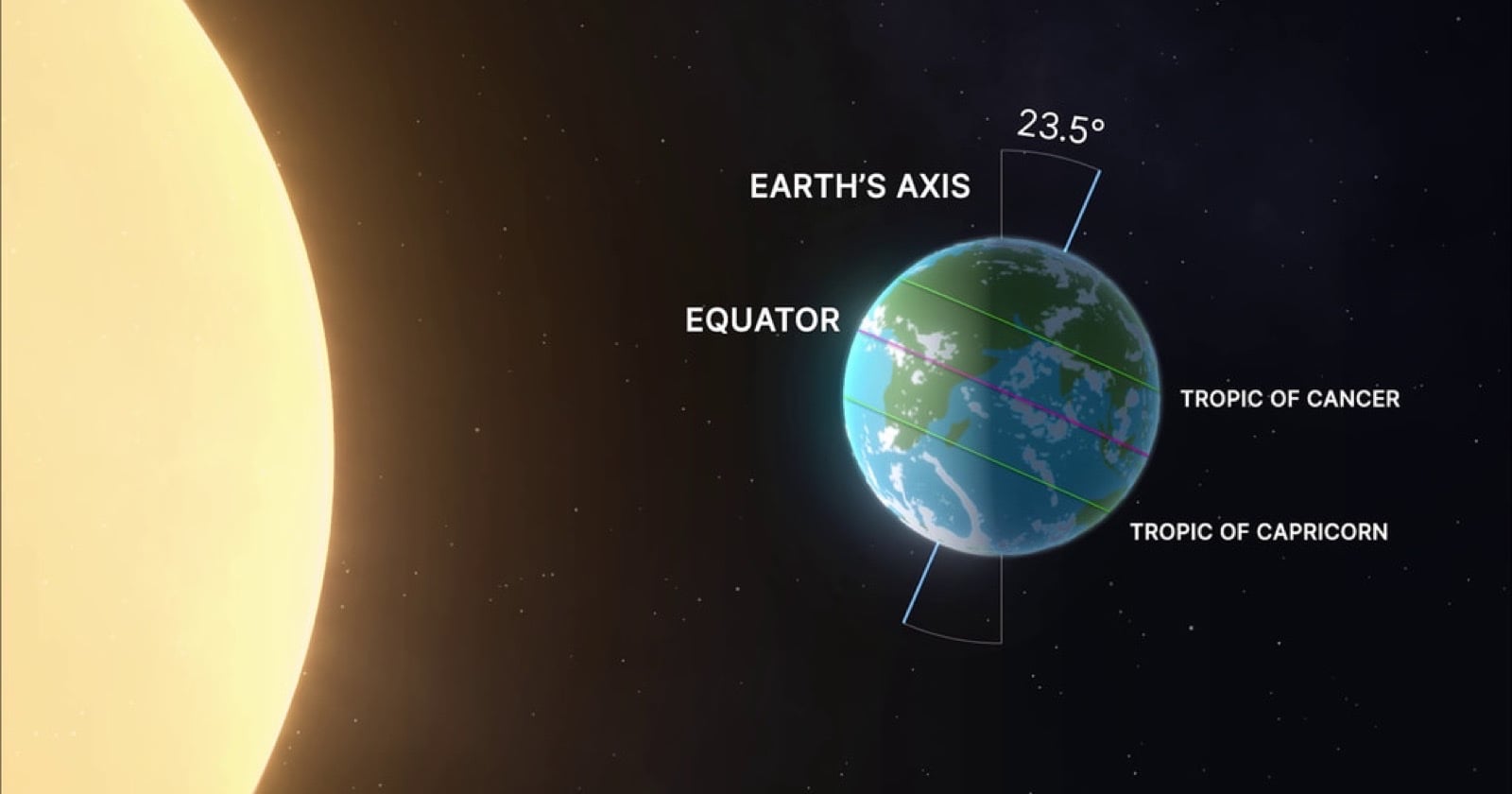
Earth’s spin axis is tilted about 23.4 degrees from a line perpendicular to the plane of its orbit. NASA’s current Earth facts identify that tilt as the cause of the yearly seasonal cycle. The value slowly changes over many thousands of years and is often rounded to 23.5 degrees.
As Earth travels around the Sun, the axis continues pointing in almost the same direction in space. Around the June solstice, the Northern Hemisphere leans towards the Sun. Around the December solstice, it leans away. The Southern Hemisphere experiences the opposite orientation at each point.
Tilt changes the height the Sun reaches in the sky. When the Sun is high, a bundle of incoming light strikes the ground more directly and is concentrated over a smaller area. When the Sun is low, the same bundle is spread across a larger surface.
This is why weak winter sunlight can feel so different even at midday. The change is not meaningfully caused by the Sun becoming five million kilometres more distant or closer. It is caused by the local surface meeting sunlight at a different angle.
A long day receives energy for longer
Solar angle is only half the mechanism. Axial tilt also changes how long a location remains in daylight during each rotation. A hemisphere tilted towards the Sun takes a longer path through the illuminated half of Earth and a shorter path through night.
Longer daylight gives the surface more hours to absorb energy. Shorter nights give it less time to lose that energy before sunrise. In winter, the arrangement reverses: the Sun stays low, daylight is brief and the cooling interval is longer.
The effect strengthens with latitude. Close to the equator, day length remains near 12 hours throughout the year. At middle latitudes, summer and winter days differ by hours. Beyond the polar circles, tilt produces periods when the Sun does not set or does not rise.
NASA’s seasons explanation combines these two consequences: different parts of Earth receive the Sun’s most direct rays at different times, and the two poles take turns leaning sunward. The mechanism explains angle, day length and opposite hemispheric seasons together.
Why the warmest weather comes after the solstice
The solstices mark the greatest tilt towards or away from the Sun, but they usually are not the hottest and coldest days. Land, oceans and atmosphere take time to warm or cool. This lag is similar to the way afternoon is usually warmer than noon even though the Sun is highest around noon.
After the June solstice, many northern locations continue receiving more energy during the day than they lose at night. Temperatures can keep rising into July or August. After the December solstice, accumulated cooling can continue into January even as daylight slowly returns.
Local climate further reshapes the astronomical pattern. Ocean currents, elevation, winds, cloud, snow cover and proximity to large bodies of water all influence how a season feels. Axial tilt supplies the changing solar geometry; the climate system decides how quickly and unevenly the surface responds.
This is also why seasonal temperature cannot be read directly from a distance table. Orbital position determines a small change in incoming energy. Weather and climate respond through systems with memory, circulation and large regional differences.
Perihelion gives southern summer a small extra push
Because perihelion currently falls during Southern Hemisphere summer, the distance effect slightly strengthens the sunlight available during that hemisphere’s warm season. Aphelion slightly weakens the sunlight during northern summer.
That does not make southern summers uniformly hotter. The Southern Hemisphere is dominated by ocean, while the Northern Hemisphere contains more large land masses. Water stores and releases heat more slowly than land, moderating temperature swings and obscuring some of the orbital contrast.
Earth also moves fastest near perihelion and slowest near aphelion, as required by Kepler’s second law. The December-solstice-to-March-equinox season is therefore shorter than the June-to-September season. Northern summer lasts several days longer than northern winter.
Distance thus leaves fingerprints in the strength and duration of the seasons. Those fingerprints are worth keeping because “distance does nothing” is also too simple. The precise statement is that distance modulates the annual cycle, while tilt creates its dominant hemispheric structure.
The alignment changes over deep time
Perihelion currently arrives roughly two weeks after the December solstice. Aphelion follows the June solstice by a similar interval. The pairing can look fundamental, but the orbital ellipse slowly turns relative to the seasons.
Axial precession and changes in the orbit shift the calendar relationship over thousands of years. NASA groups those long cycles under the name Milankovitch cycles. The tilt itself varies between about 22.1 and 24.5 degrees over a cycle of roughly 41,000 years.
Other worlds make the distinction even clearer. Uranus, tilted almost completely onto its side, undergoes extreme changes in which hemisphere faces the Sun during its long orbit. Mars has an axial tilt not far from Earth’s but a more eccentric orbit, so tilt and distance both leave stronger signatures.
Earth happens to occupy a relatively gentle combination: a moderate axial tilt and a nearly circular orbit. Enough tilt produces distinct seasons, while the low eccentricity prevents the whole planet’s solar input from changing drastically between January and July.
The January paradox is a useful correction
January perihelion is memorable because it overturns an intuitive explanation. Closer to a fire usually means warmer, so it is natural to imagine Earth moving nearer the Sun for summer. That picture fails because a planet is not one person standing on one side of a heater.
Earth is a rotating sphere. Its two hemispheres face the same Sun from the same orbital distance, yet tilt gives them opposite combinations of solar height and daylight duration. The pattern only makes sense when local geometry replaces raw distance as the main explanation.
In early January, Earth really is about 5 million kilometres closer to the Sun than it will be in early July. The resulting increase in sunlight is measurable. Northern winter persists because the north is leaning away, its days are short and its sunlight arrives at a shallow angle.
The apparent contradiction therefore does not show that distance is irrelevant. It shows how a smaller, global effect can be outweighed by a stronger, latitude-dependent one. Five million kilometres changes the brightness of the Sun slightly. A 23.4-degree lean changes the seasons.