

Konstantin Batygin’s June 2026 forecast was unusually exposed to failure for a hypothesis that has survived a decade without its planet.
New discoveries from the Vera C. Rubin Observatory, he said, would provide “a direct test of all lines of evidence” for Planet Nine. Rubin might see the proposed world itself. If it did not, its uniform survey could still reveal whether the distant orbital patterns that inspired the hypothesis survive in a much larger, independently selected sample.
The timing matters. Batygin spoke before Rubin’s main survey had formally begun. The Legacy Survey of Space and Time started on 30 June 2026. The summer test he anticipated is no longer a future capability. The telescope is observing, its alerts are flowing and new solar-system objects are being reported.
That does not mean the verdict is already in. A direct image, a statistical test of orbital clustering and a secure rejection of every allowed Planet Nine orbit are different achievements on different timescales.
The claim came with a way to prove it wrong
In the 5 June interview, Batygin emphasised that the Planet Nine hypothesis is refutable. Starting that summer, he expected batches of Rubin discoveries to test the full collection of evidence rather than merely add one more suggestive object.
That is a stronger claim than saying a better telescope may eventually help. It identifies two routes to an answer.
The direct route is conceptually simple. Rubin finds a faint moving source hundreds of astronomical units from the Sun whose orbit falls within the region predicted for Planet Nine. Follow-up observations establish a planetary mass and a coherent orbit.
The indirect route is statistical. Rubin discovers enough extreme trans-Neptunian objects to test whether their orbital alignment, inclinations and other unusual populations persist after astronomers account for exactly where and how the survey looked. If those structures dissolve, the original evidence loses its foundation.
Planet Nine is an inference, not a missed photograph
Planet Nine was not proposed because an image showed an unexplained dot. Batygin and Michael Brown argued in 2016 that several distant objects followed long, eccentric orbits whose orientations appeared unexpectedly clustered. Their original Caltech account described a distant massive planet whose gravity could maintain that arrangement.
The proposed planet was also asked to explain related features of the outer solar system. Models generated detached Sedna-like orbits, objects on steeply inclined or retrograde paths, and a population of long-period bodies whose orbits cross Neptune’s.
A 2024 study led by Batygin treated those low-inclination Neptune-crossers as another line of evidence and published predictions that new surveys could test. Batygin’s own Planet Nine overview presents the hypothesis as a framework connecting several populations, not one anomaly.
None of those results is direct detection. They are comparisons between observed orbital architecture and simulations with or without a distant perturber. The conclusion depends on whether the observed sample faithfully represents what exists.
Small samples inherit the habits of their surveys
The distant solar system is difficult to census evenly. Objects are brightest near perihelion, where they receive and reflect more sunlight. Telescopes have different limiting magnitudes. Some surveys avoid the crowded plane of the Milky Way; others target locations where previous objects or a hypothesised planet are expected.
Those choices create a selection function, the probability that a real object with a particular brightness, position and orbit would enter the catalogue. If discoveries assembled from several surveys point in the same direction, that can indicate a physical alignment. It can also reflect where the surveys were most capable of finding them.
The argument has therefore never been only about adding objects. It is about adding objects through a search whose biases can be measured.
Rubin repeatedly observes a broad southern footprint with the same 3.2-billion-pixel camera and a documented cadence. Astronomers can insert simulated objects into the observing history and ask which would have been recovered. That makes the new sample far better suited to distinguishing a dynamical pattern from a search pattern.
Rubin has already become the discovery machine Batygin anticipated
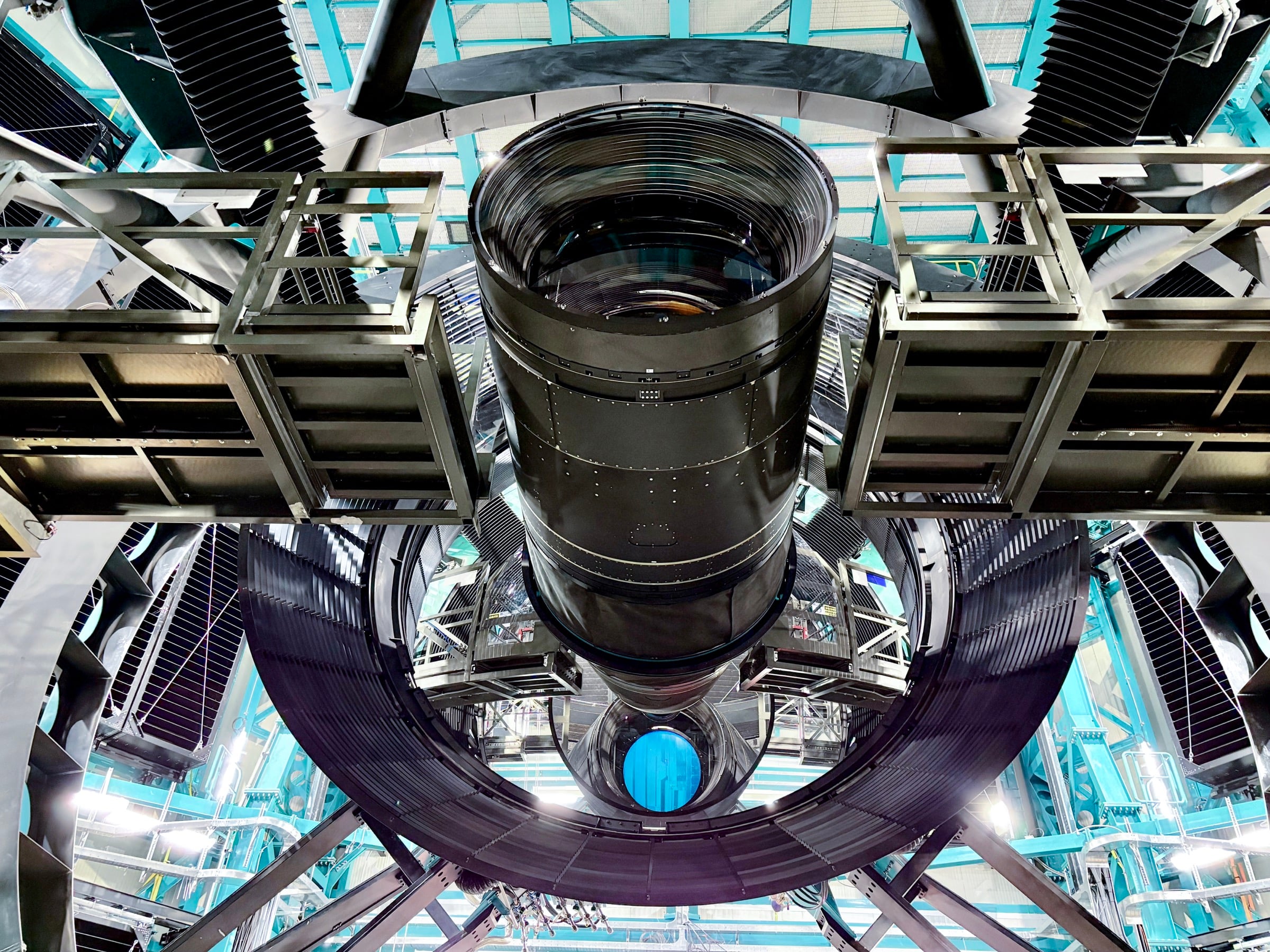
Rubin’s formal survey began after commissioning, an operational-readiness review and the launch of its alert stream. The observatory now takes a detailed exposure roughly every 40 seconds during observing and returns to the southern sky repeatedly.
In only a month and a half of early optimisation surveys, Rubin reported more than 11,000 previously unknown asteroids, including 380 trans-Neptunian objects. That last figure is particularly relevant. The Planet Nine debate has been shaped by samples small enough that each unusual orbit can noticeably alter the statistics.
Space Daily’s earlier look at Rubin’s camera and alert system explained why the observatory is more than a large mirror. The telescope, processing pipelines, Minor Planet Center reports and community software together turn repeated images into linked moving objects.
A distant body may appear in one exposure as an unremarkable point. Its displacement across later images and its annual parallax reveal that it belongs to the solar system. The challenge for Planet Nine is that the motion could be extremely slow, requiring observations to be linked over a longer baseline than a nearby asteroid needs.
A direct detection would be decisive, but not instantaneous
If Rubin finds a visible source hundreds of astronomical units away, the distance alone implies an intrinsically large body. Batygin argued that an orbit consistent with the predicted Planet Nine parameter space would provide the straightforward confirmation everyone has been seeking.
In practice, astronomers would still proceed carefully. A few detections establish motion, not a complete orbit or mass. Researchers would search older archives for earlier appearances, obtain follow-up images and refine the trajectory. Brightness alone mixes size with reflectivity, so classifying the body would require more than one photometric measurement.
The current Batygin and Brown orbital estimate favours a planet of about six Earth masses on an orbit with a semimajor axis around 380 astronomical units, but the allowed region is broad. The planet could be nearer or farther along its orbit, brighter or fainter than a central estimate, and projected onto a difficult part of the sky.
Rubin’s main survey also does not cover the entire celestial sphere. A non-detection in its first months cannot eliminate a planet outside the footprint or below the relevant sensitivity. “Potentially revealing the planet” is accurate. “Guaranteed to photograph it immediately” is not.
The orbital patterns can fail even if no planet is photographed
Rubin’s more fundamental test may be the population it builds. The original clustering claim can be recalculated using objects found by one survey with a well-characterised search history.
If the longitudes of perihelion and orbital poles remain clustered, the result becomes harder to attribute to a patchwork of earlier searches. If the alignment fades towards a random distribution, the apparent pattern may have been a combination of small numbers and observational selection.
“Never real” in this context would not mean previous astronomers invented measurements. The individual orbits remain real. The higher-level pattern could turn out not to be a property of the underlying population, much as a few coin tosses can look meaningfully lopsided before a longer sequence approaches an even split.
Other predictions face the same treatment. Rubin can measure whether highly inclined and retrograde bodies occur at the rates expected under Planet Nine simulations, and whether the low-inclination Neptune-crossing population matches the proposed mechanism. A theory that connects several observations must survive them together.
2017 OF201 shows why every new orbit matters
The dwarf-planet candidate 2017 OF201 occupies an exceptionally wide orbit but does not share the alignment that helped motivate Planet Nine. In the published simulations, one particular proposed Planet Nine configuration destabilises it far sooner than the known giant planets and the Galactic tide do alone.
A previous Space Daily analysis of 2017 OF201 also showed how severe detection bias can be: the object would have been within reach of the archival survey for only about 0.5 percent of its orbit. One discovery implied a potentially much larger unseen population.
That object does not by itself disprove Planet Nine. It constrains particular versions and demonstrates how a single outlier can reshape an argument built from a small catalogue. Rubin’s contribution is to replace isolated surprises with a systematic population.
The summer test has begun, but its clocks run at different speeds
Batygin was right about the operational turning point. Rubin began the LSST at the end of June 2026 and is already reporting solar-system discoveries. The fresh, comparatively uniform sample is beginning to exist.
A moving point in an advantageous location could announce itself quickly. A robust orbit takes repeated observations. A population-level conclusion requires enough distant objects, enough survey coverage and a published treatment of detection efficiency. Ruling out every viable Planet Nine configuration would take longer still.
The outcome is not limited to “planet found” or “search failed.” Rubin could directly detect Planet Nine. It could fail to see the planet while strengthening all of the gravitational signatures. It could preserve some predicted patterns while erasing others. Or it could show that the original architecture was never statistically secure.
Each outcome is useful. Direct detection would open the study of a new planet. A stronger indirect case would narrow where follow-up searches should look. A null result would close a productive hypothesis and improve the census of the distant solar system that made the test possible.
That is why the June statement was more substantive than optimism about a new telescope. Batygin attached a long-running idea to an independent flow of evidence arriving on a public schedule. Rubin is now taking those images. Planet Nine still has not been seen, but the hypothesis has entered the part of science where the next large dataset gets to answer back.