
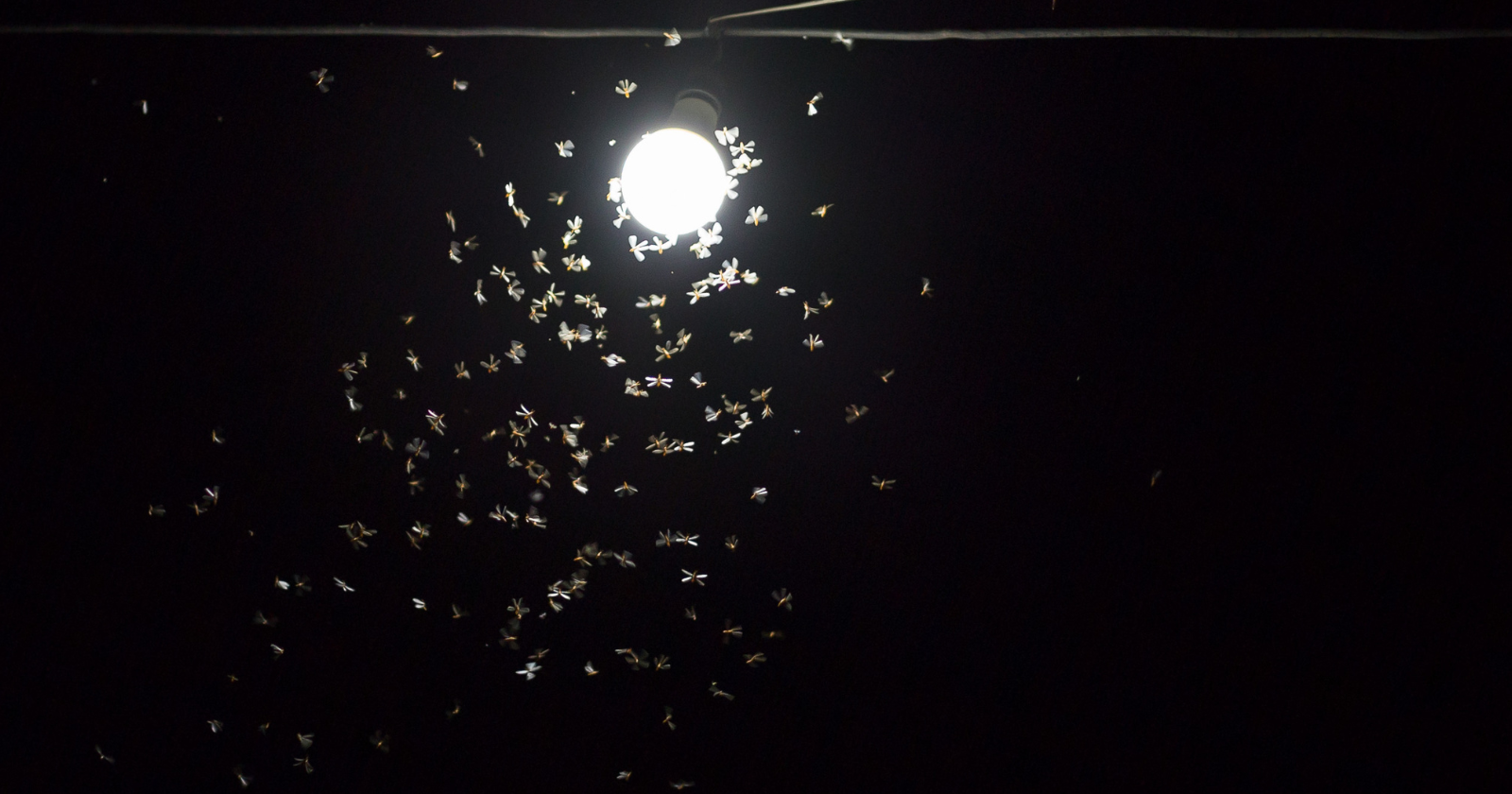
Watch a moth loop a porch light for long enough and it stops looking like desire and starts looking like a pilot with a broken instrument panel.
That reading turns out to be close to the truth. For almost the entire history of insect flight, the brightest thing in view has been the sky, straight up. Tilt your back towards it and you stay right-side up in the air. It is a cheap trick, and until recently, a reliable one.
Then somebody invented the bulb.
What the high-speed cameras saw
A team led by Samuel Fabian at Imperial College London put numbers on the old mystery in a 2024 study in Nature Communications. They combined motion-capture markers glued to the thorax of moths and dragonflies in a London lab with stereo video of wild insects filmed in the cloud forest of Monteverde, Costa Rica. Across 477 field recordings covering ten insect orders, insects almost never flew straight at the light. They flew sideways to it, at right angles, banked hard over, backs turned towards the bulb.
Three patterns kept repeating. Orbiting, a steady banked circle around the lamp, common on still nights and broken up by any decent gust of wind. Stalling, a steep climb away from the source, slowing until forward progress stopped. Inverting, where an insect passing over a light flipped upside down and dived into the ground.
In control videos shot in darkness, under 2 per cent of flights showed anything similar.
The sky as a spirit level
Gravity is easy to sense if you are built like a mammal, with fluid-filled canals in the inner ear reporting up from down. Insects mostly get by without that kit. Their sensory organs are tiny, and the g-forces of flight are violent enough to swamp any signal from gravity alone, so, per Scientific American‘s coverage of the study, they lean on brightness overhead as a stand-in. The behaviour has a name: the dorsal light response, first documented in tethered locusts and dragonflies decades before anyone could film it in free flight.
The Imperial team tested that head-on. Shine ultraviolet light down onto a white sheet spread across the forest floor and insects tumbled and crashed. Point the same shrouded bulb upward at a sheet stretched overhead, making a diffuse false ceiling, and they flew through the corridor underneath as though nothing were wrong.
Honeybees and small flies behaved the same way in a 20 cm perspex box. UV from above, stable climbing flight. UV from below, and almost none of them could stay airborne.
Why the moon theory fails
The finding retires a few old explanations. A moth mistaking a bulb for the moon would hold that light at a fixed angle to one side, but when the researchers toggled between two lamps, orbiting insects cheerfully swapped which flank faced the light in 25 of 37 trials. Heat can be ruled out too, since LEDs throw almost no infrared and still pull crowds.
One boundary worth marking: the effect documented here is local, playing out within a metre or two of the lamp. It stops well short of showing lights hoovering insects in from across a paddock. Fabian and his co-authors point to the only long-distance tracking experiment they know of, in which just 2 of 50 moths released 85 metres from a lamp finished their flight there. Their reading is that lights trap passing traffic rather than summon it.
That distinction matters for anyone deciding where to put a lamp.
The cost to the caterpillars
Does any of this actually dent populations? Adults circling a bulb are the visible part of the problem, and the answer came from ground level.
Douglas Boyes, then a doctoral student, set up matched pairs of lit and unlit verges and hedgerows across Oxfordshire, Buckinghamshire and Berkshire. He counted caterpillars, not adults, since caterpillars stay put and reveal what is actually happening to the local population. Writing in Science Advances in 2021, his team reported 47 per cent fewer caterpillars in lit hedgerows and 33 per cent fewer in lit grass margins. White LEDs did more damage than the yellow sodium lamps they had replaced, a result the UK Centre for Ecology and Hydrology flagged as an awkward side effect of the efficiency rollout.
Boyes died within weeks of the paper’s publication.
Why the numbers drop is still an open question. His team’s best guess is that female moths lay fewer eggs in illuminated habitat, something they were careful to flag as untested.
Brighter every year
51,351 star counts, gathered by volunteers with nothing but their eyes. Christopher Kyba and colleagues used them to report in Science that visible stars fell away between 2011 and 2022 at a rate matching sky brightness climbing about 9.6 per cent a year, roughly a doubling every eight years. Satellite estimates had come in nearer 2 per cent, largely because orbital sensors miss the short blue wavelengths modern white LEDs pour out.
Short, blue-leaning wavelengths are exactly the range insects respond to most strongly, which is what turns rising skyglow from a stargazing problem into an ecological one. Avalon Owens and Sara Lewis, surveying the field in Ecology and Evolution, sorted the damage into five categories, from disrupted foraging and mating to fireflies whose flash signals get drowned out by ambient glow.
Aim it down
Point the light down. That is roughly where Fabian’s paper lands, unusually practical advice for a piece of basic behavioural research: cut unnecessary upward-facing light and tone down ground reflections, because on a lit street the sky never stood a chance of competing anyway. A 2024 Communications Biology study on tailored and shielded road lights went after the same problem from the engineering side.
None of which requires switching off the streets. Pointing lamps at the ground would do most of the work, and the ground is where the pedestrians are anyway.
