

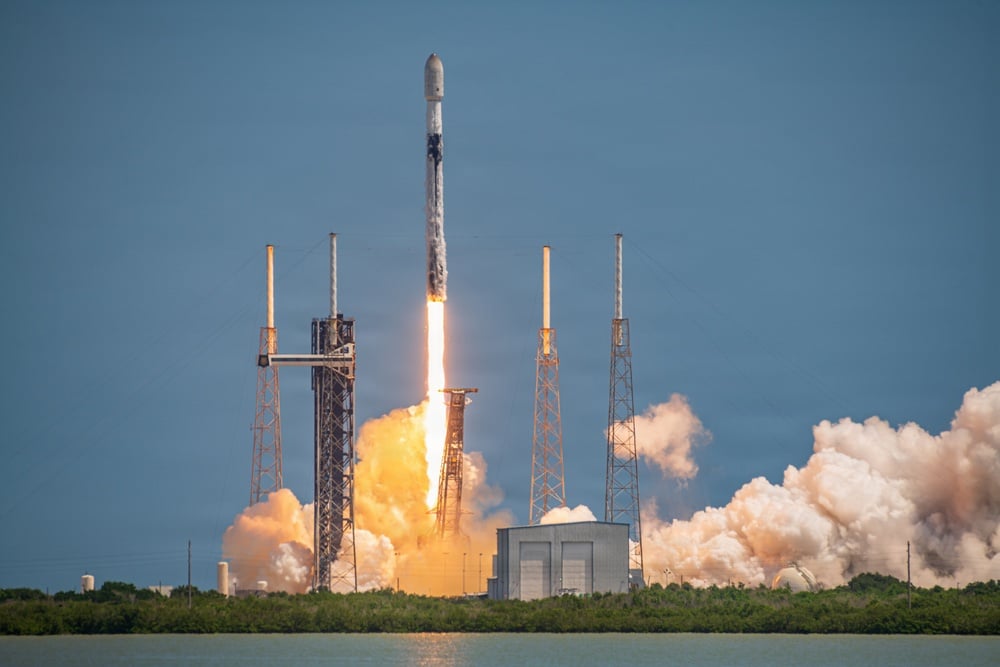
On 19 August 2026, the deployment of 24 more Starlink satellites appears to have carried SpaceX’s broadband constellation through 11,000 spacecraft in orbit. The threshold came seven years and three months after the first full batch of 60 left a Falcon 9 upper stage.
The early baseline is more revealing than the round number. At the start of 2019, fewer than 2,000 active satellites belonging to every company, government, university and other operator combined circled Earth. Starlink now contains more than five times that entire earlier working population.
Those figures are not automatically interchangeable. The 11,000 total is an in-orbit count that can include newly deployed vehicles climbing toward working altitude and retired spacecraft descending towards reentry. The 2019 figure describes satellites judged active. But a later catalog counted more than 11,000 Starlinks working as well as in orbit, so the scale comparison holds even when the definitions are brought closer together.
SpaceDaily has examined each side of this comparison separately. One article reconstructed the launch sequence that crossed 11,000; another traced the global active fleet from early 2019 to 2026. Read together, they describe more than the growth of one service. They show low Earth orbit changing from a domain populated by thousands of individually distinctive missions into one that can be altered by dozens of standardized spacecraft in an hour.
The 19 August threshold is a timestamp, not a permanent inventory
The count can be reconstructed from recent launches. Before the Starlink 10-19 mission on 11 August, reporting based on Jonathan McDowell’s tracking put 10,939 Starlinks in orbit. That mission added 29. Group 17-49 added 24 on 12 August, and Group 17-50 released another 24 after launching from California on 19 August.
Straight addition produces 11,016. The live figure can differ because Starlinks reenter frequently, newly cataloged objects take time to classify and trackers revise their records. The defensible claim is that the August 19 deployment moved the fleet through the line, not that 11,016 remained its exact size.
A later independent snapshot supports the crossing. KeepTrack’s 24 August review listed 11,028 Starlinks in orbit and 11,012 working as of 21 August. It also put the cumulative launch total at 12,798. Another 29-satellite mission had flown on 21 August, so that snapshot cannot isolate the minute of the earlier crossing, but it confirms that the constellation remained above 11,000 under both location and working-status definitions.
This is why a satellite count always needs a date and a rule. “Launched,” “in orbit,” “active” and “in operational orbit” answer different questions. The threshold is robust; the last two digits are provisional.
In early 2019, a megaconstellation was still a forecast
The fewer-than-2,000 baseline comes from Look Up’s second-quarter 2026 space index. The French space-situational-awareness company used its current catalog and historical series to report that the active population had risen from below 2,000 at the start of 2019 to 15,711 at the beginning of June 2026.
A contemporary source gives the historical figure a useful cross-check. In September 2019, the European Space Agency said that more than 9,000 satellites had been launched since Sputnik but only about 2,000 remained functional. ESA published the estimate after its Aeolus wind satellite manoeuvred around Starlink 44, one of SpaceX’s first 60.
Those 60 spacecraft had launched on 24 May. A contemporary launch account described them separating together at about 440 kilometres, then using krypton ion thrusters to move towards 550-kilometre operational orbits. Each weighed roughly 227 kilograms. SpaceX said meaningful service would require hundreds, while its regulatory approvals contemplated thousands.
The important point is not that orbit was empty before Starlink. Weather, navigation, communications, military, scientific and Earth-observation satellites already formed essential infrastructure. It is that the working population changed slowly enough to be counted in the low thousands. One private network now changes by amounts that would once have represented a visible share of the global total.
Falcon 9 and Starlink form an industrial loop
No single technology explains the growth. The constellation is the product of a vertically integrated system: SpaceX designs and builds the satellites, operates the launch vehicle, manages the network and supplies its own demand for repeated launches.
Falcon 9 reuse reduced the penalty attached to every additional batch. Standardized flat-panel satellites could be manufactured in series and packed by the dozens beneath a fairing. A recovered first stage could return to another Starlink mission without the company waiting for a separate customer to buy that flight.
The operating history of booster B1067 makes the feedback visible. SpaceDaily’s account of the stage’s 36 missions in five years found that 25 carried Starlink satellites. Its other assignments included NASA crews and cargo, European navigation hardware and commercial communications payloads. Starlink supplied the repetitions that made an unusually deep reuse record possible.
The relationship works in both directions. Reusable rockets let the network expand and refresh at high cadence. The network provides a continuing internal manifest that keeps rockets, pads, recovery ships, satellite factories and tracking teams in operation. By the 19 August flight, 74 of SpaceX’s first 100 missions of 2026 had been dedicated to Starlink.
A constellation of 11,000 is a flow, not a collection
KeepTrack’s late-August figures imply that roughly 1,770 of the 12,798 Starlinks launched by then were no longer in orbit. Some completed their planned lives, some failed, and others were deliberately removed as the network changed. The difference between launched and orbiting totals will continue to widen even while the live fleet grows.
New satellites begin in relatively low deployment orbits. They undergo checks and use onboard propulsion to raise themselves into assigned planes. Vehicles that do not pass those checks can be held low for faster natural decay. At the other end of the cycle, working satellites lower their orbits before atmospheric reentry when retirement goes as planned.
This moving lifecycle is why McDowell’s catalog separates raising, operational, lowering, failed and reentered spacecraft. SpaceDaily’s profile of the independent tracking project he began in 1989 described how such distinctions became essential as launches accelerated.
Maintaining 11,000 satellites is therefore not a completed construction project. It is a continuing manufacturing, launch, orbit-raising, monitoring, manoeuvre and disposal operation. A fleet this large can lose hundreds of vehicles and still grow because replacements arrive faster.
What scale supplies to the network
The service case for thousands of low-orbit satellites is straightforward. A spacecraft several hundred kilometres above Earth can provide lower latency than a relay in geostationary orbit almost 36,000 kilometres over the equator. As one satellite moves beyond a user’s horizon, another can take over the link.
More orbital planes and more spacecraft create wider coverage, additional capacity and redundancy. Inter-satellite laser links can carry traffic across the constellation before it reaches a ground station. The network can serve ships, aircraft, remote communities and places where terrestrial infrastructure has been disrupted or is costly to extend.
Object count does not measure all of that capability. It gives one compact communications satellite the same numerical weight as a large weather platform, navigation spacecraft or scientific observatory. Eleven thousand does not mean Starlink owns eleven thousand times the mass, power, economic value or strategic capability of a single large satellite.
Count still matters operationally. Each spacecraft follows a trajectory that must be predicted. Each manoeuvrable vehicle needs collision screening and coordination. Each failed satellite becomes an uncontrollable object until drag removes it.
One operator now shapes the shared environment
Look Up counted 10,365 active Starlinks out of 15,711 active satellites at the start of June, or 65.97 percent. KeepTrack’s different late-August catalog put 11,012 working Starlinks among 15,771 active satellites, close to 70 percent. The difference reflects dates and classification rules as well as rapid growth.
Neither percentage means Starlink supplies the same share of every satellite service. It does show concentration by object count. Decisions by one operator about altitude, reliability, collision avoidance, brightness, radio emissions and disposal now affect low Earth orbit at a scale no individual program previously approached.
The 2019 Aeolus encounter provided an early example. ESA moved its spacecraft upward by 350 metres after the estimated collision probability with Starlink 44 reached about one in 1,000. No collision occurred and ESA said no one was at fault. Its broader conclusion was that manual coordination would become impractical as constellations grew, making automated, conflict-free manoeuvre planning necessary.
SpaceDaily’s earlier examination of orbital debris that can manufacture more debris explains the shared risk. A functioning satellite can move; a dead one cannot. A collision between large objects can produce thousands of fragments whose orbits must then be tracked for years.
Disposal solves one problem while opening another
Operating at low altitude gives Starlink an important safety mechanism. Atmospheric drag will eventually pull down a failed spacecraft instead of leaving it in a long-lived high orbit. Controlled lowering can shorten the process for a functioning satellite at the end of service.
That does not make disposal environmentally invisible. Satellites ablate as they reenter, depositing metals and oxides into the upper atmosphere. SpaceDaily’s report on aluminium-bearing reentry particles and ozone chemistry described an area of active research rather than a settled global harm estimate. A fleet replaced continually makes that research more urgent because reentry becomes routine infrastructure, not an occasional event.
A sustainable constellation must therefore meet several tests at once. It needs reliable manoeuvring while operational, prompt removal after failure, low casualty risk on reentry, manageable effects on astronomy and radio science, and a clearer account of what repeated material deposition does to the atmosphere.
The exact number will move; the historical break will remain
Starlink launches continued after 19 August, and older spacecraft continued to descend. China and other commercial constellations were also growing. No honest orbital census will preserve 11,000 as a fixed current total.
The comparison with 2019 survives that motion. In early 2019, every active satellite together numbered fewer than 2,000. By August 2026, one network alone held more than 11,000 spacecraft in orbit and, within days of the crossing, more than 11,000 classified as working.
That change was made by a production system rather than a single mission: reusable rockets, serialized satellites, an internal launch customer and continuous replacement. The result is useful global infrastructure and an unprecedented concentration of orbital responsibility. The milestone is not merely that SpaceX built the largest constellation. It is that one operator built more than five equivalents of the entire working satellite population with which the Starlink era began.