

The young Sun presents an awkward double image. It was substantially dimmer than the star overhead today, yet far more violent. Four billion years ago, Earth received less sunlight while probably enduring repeated showers of energetic particles from eruptions on a rapidly rotating star.
A study published in The Astrophysical Journal Letters has now tested one part of that picture in the laboratory. Kensei Kobayashi, Vladimir Airapetian and their colleagues irradiated mixtures intended to represent mildly reduced primitive atmospheres with protons. The experiments produced substantial amounts of nitrous oxide, alongside material relevant to prebiotic chemistry.
The result connects two questions that are usually discussed separately: how early Earth stayed warm under a faint Sun, and where the reactive nitrogen needed for chemistry before life came from. It is one laboratory-and-modelling study, not a settled reconstruction of the Hadean atmosphere. Its importance is that a pathway first developed in simulations can now be compared with measurements.
A faint star over liquid water
Standard stellar evolution says the Sun brightens as it ages. Around four billion years ago it supplied only about 70 to 75 percent as much energy as it does now. A simple climate calculation therefore leaves early Earth frozen, but ancient rocks and zircons indicate that liquid water existed. This mismatch is the faint young Sun paradox.
The word paradox does not mean the evidence violates physics. It means some warming processes are missing from the simplest calculation. Carbon dioxide, methane, hydrogen, clouds, surface reflectivity and pressure have all been investigated. The atmosphere also changed repeatedly as impacts, volcanism, escape to space and reactions with the crust altered its composition. There was no single unchanging “early Earth” atmosphere.
The water itself had an even longer history. As SpaceDaily reported in our examination of interstellar water, part of Earth’s inventory probably inherited deuterium-rich ice from material older than the Solar System. Having water and keeping it liquid, however, are different problems. The new work concerns the second one.
The young Sun was dimmer but not quiet
Brightness is only one property of a star. A young solar-type star rotates faster and sustains stronger magnetic activity. NASA’s retired Kepler telescope recorded enormous flares on other stars, giving researchers a statistical proxy for the Sun at an age no instrument could observe directly.
Young, rapidly rotating solar analogues can produce superflares every few days. Among mature stars selected to resemble the present Sun, a 2024 analysis of 56,450 Kepler targets found nearly 2,900 superflares. The team reported in Science that such stars produce an event above 1034 ergs about once per century on average. That is a population rate, not a prediction that the Sun itself is due to erupt on a timetable.
A flare is a burst of electromagnetic radiation. A coronal mass ejection is an expulsion of magnetised plasma, and shock fronts associated with an ejection can accelerate protons and other particles. These phenomena are related but not interchangeable. For early atmospheric chemistry, the important agents are the energetic particles able to enter the atmosphere and generate cascades of secondary electrons.
How a proton storm changes nitrogen
Molecular nitrogen is abundant and chemically stubborn. Its two atoms are bound by a strong triple bond, so an atmosphere can contain a great deal of nitrogen without making that element readily available for further chemistry. Lightning, impact shocks and ultraviolet radiation are among the proposed ways to break the bond before biological nitrogen fixation existed.
An energetic proton arriving from space can initiate a shower of collisions. Secondary electrons split nitrogen and other atmospheric molecules, creating reactive atoms and radicals. Those fragments can then enter reaction networks that ordinary sunlight or mild temperatures would struggle to begin.
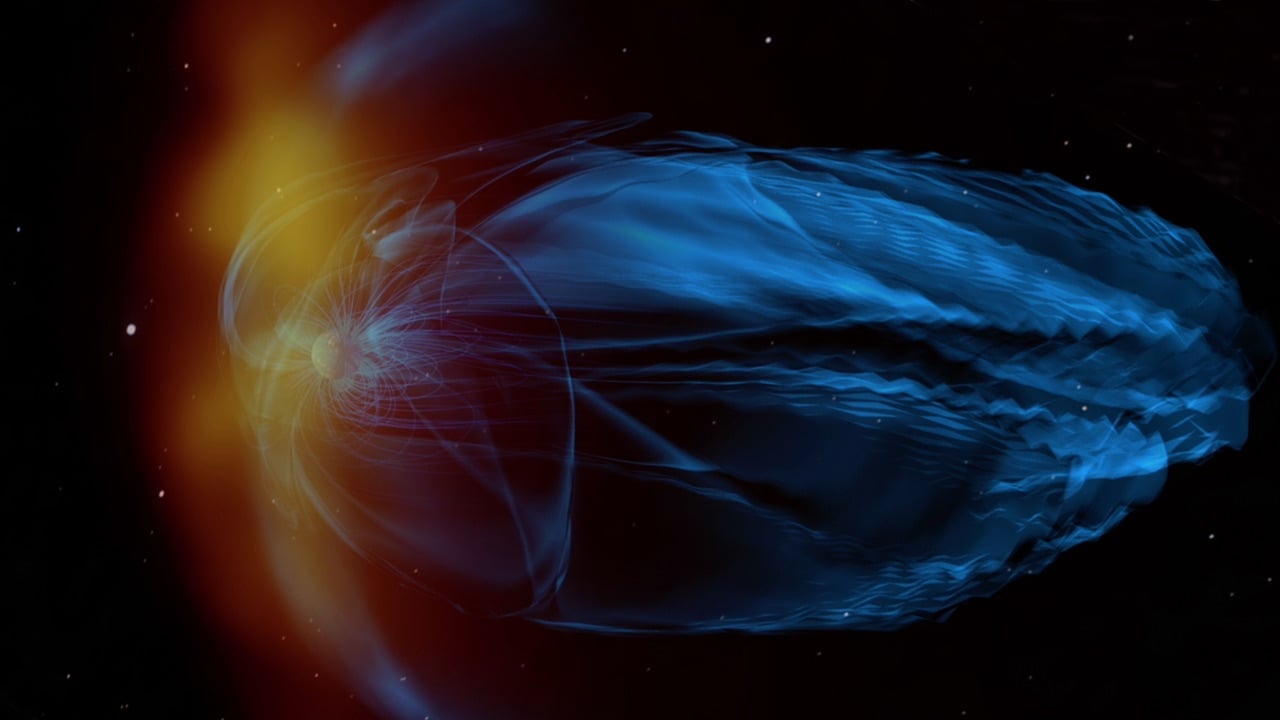
In 2016, Airapetian and colleagues used stellar observations, magnetospheric simulations and atmospheric chemistry to develop this idea in Nature Geoscience. Their model found that repeated superflare-associated particle events could compress the young magnetosphere, widen the polar regions open to incoming particles and drive reactions involving nitrogen, carbon dioxide and methane.
That calculation produced two especially interesting molecules. Nitrous oxide, N2O, is a strong greenhouse gas. Hydrogen cyanide, HCN, is poisonous to modern organisms but a versatile starting material in laboratory routes toward amino acids and components of nucleic acids. Calling it a feedstock does not mean that HCN automatically becomes life. It means the molecule opens useful chemical pathways if the surrounding environment supplies the right water, minerals, energy and sequence of reactions.
The 2026 experiment adds physical evidence
The new paper moves beyond an atmosphere that exists only inside a computer. The team exposed nitrogen- and carbon-dioxide-rich gas mixtures to proton irradiation, then measured the resulting products. Nitrous oxide reached mixing ratios as high as roughly 1,000 parts per million in some experimental conditions. The irradiated material also contained precursors that yielded amino acids, including glycine.
The authors scaled their results to an early-Earth scenario and estimated a possible global production rate on the order of 2 × 10¹⁰ kilograms per year for the relevant prebiotic material. That large number is model-dependent. It combines a controlled experiment with assumptions about particle flux, flare frequency, atmospheric composition and how laboratory yields translate to an entire planet.
Earlier experiments had already shown that solar energetic particles could outperform spark discharges in some weakly reducing mixtures. A 2023 study in Life compared proton irradiation, lightning-like sparks and ultraviolet light, finding amino acids and carboxylic acids across several starting compositions. The 2026 work extends that experimental programme by tying nitrous oxide production to photochemistry and a three-dimensional climate calculation.
Enough warming even after ultraviolet destruction
Producing a greenhouse gas in a sealed chamber is not the same as retaining it in a young planet’s atmosphere. The active Sun also emitted strong ultraviolet radiation, which would split nitrous oxide back into nitrogen and oxygen. The researchers therefore modelled both production and destruction rather than treating the maximum laboratory concentration as a permanent atmospheric value.
According to NASA’s 24 August account of the study, the climate calculation found that if only ten percent of the experimentally indicated nitrous oxide survived, equatorial temperatures could still reach about 5 degrees Celsius. That is above freezing, although it does not describe every latitude, season or stage of early Earth’s evolution.
Nitrous oxide is often described as about 300 times more potent than carbon dioxide, but that modern comparison can mislead when carried into a radically different atmosphere. A gas’s climatic effect depends on concentration, altitude, spectral overlap, pressure and the other gases present. The useful claim here is narrower: within the atmospheres used in the paper’s model, flare-driven N2O made a meaningful contribution to warming.
Warmth and chemical feedstock from the same source
The attractive part of the hypothesis is its economy. A persistent source of energetic particles could both strengthen greenhouse warming and turn inert atmospheric nitrogen into reactive compounds. The same violent stellar environment that threatened atmospheric loss may also have helped create conditions in which surface chemistry could proceed.
Temperature matters to that chemistry in a less obvious way. Warmer is not always faster in the useful sense. NASA’s summary notes that temperatures just above freezing can favour the assembly of complex amino-acid chains compared with warmer conditions, partly because fragile intermediates persist longer. A temperate surface with liquid water may therefore offer a better chemical workshop than either a frozen world or a hot one.
Hydrogen cyanide belongs to the older modelling branch of this story, while the strongest new laboratory result concerns nitrous oxide and amino-acid precursors. Keeping that distinction matters. The 2026 experiment supports the broader particle-driven mechanism; it does not directly recreate every reaction or demonstrate a complete route from an atmosphere to the first cells.
What the result does not establish
No direct sample of Earth’s atmosphere from four billion years ago survives. Researchers infer its composition from rocks, isotopes, models of mantle outgassing and comparisons with planetary formation. Changing the assumed proportions of nitrogen, carbon dioxide, carbon monoxide, hydrogen or methane changes what proton irradiation can make.
The flare history is reconstructed indirectly too. Kepler observed other stars for a few years, while the claim concerns the Sun across hundreds of millions of years. Stellar age, rotation, starspot coverage and the relation between flares, coronal mass ejections and high-energy proton spectra all introduce uncertainty. Frequent eruptions could also erode an atmosphere, especially around a planet with weak magnetic protection or poor volcanic replenishment.
Nor is nitrous oxide the only answer to the faint young Sun problem. Carbon dioxide weathering feedbacks, methane hazes, collision-induced absorption involving hydrogen, clouds and episodes following large impacts may all have contributed at different times. The new mechanism is best read as another physically tested component, not a replacement for the rest of early-Earth climate research.
A clue for planets around other stars
The experiment was designed with exoplanets as well as Earth in mind. Young G-type stars like the Sun and cooler K- and M-type stars can remain magnetically active, bathing close planets in energetic particles. Under some atmospheric conditions, that activity might extend the range over which a rocky surface remains temperate while supplying reactive nitrogen chemistry.
There is no simple rule that an active star is good or bad for habitability. The outcome depends on the planet’s gravity, magnetic environment, starting inventory, distance from the star and ability to replace escaping gas. Particle storms can drive useful chemistry, strip atmospheres or do both during different eras.
NASA’s 2016 visualisation of the faint young Sun problem pictured early Earth beneath a compressed magnetosphere and a stormy star. A decade later, the laboratory evidence makes that picture less purely conceptual. It still does not reveal exactly how life began, but it strengthens a specific link between stellar violence, planetary warmth and the nitrogen chemistry available before biology existed.